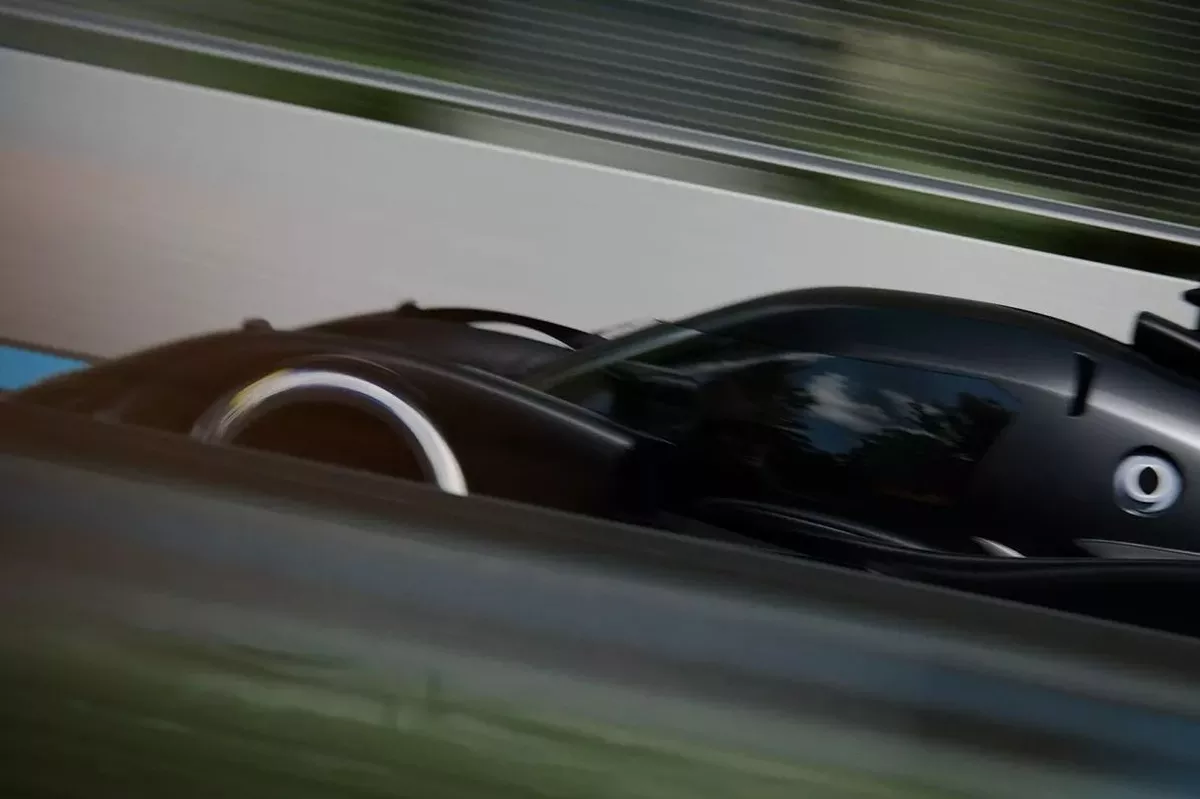
Peugeot says it is “reasonably confident” that a heavily revised version of its 9X8 can finally turn the French manufacturer into a consistent FIA World Endurance Championship (WEC) contender when the updated Hypercar debuts in 2027.
Team Peugeot TotalEnergies has embarked on its largest development programme since the current 9X8 underwent a fundamental redesign in 2024, with the latest evolution extending significantly beyond conventional aerodynamic refinement. Peugeot has already begun an extensive testing campaign and accumulated close to 3,600 kilometres with the development car as it attempts to address weaknesses that have followed the programme since its WEC debut in 2022.
The manufacturer formally confirmed in July that the 9X8 had entered its next phase of development ahead of the 2027 WEC season, targeting improvements to performance, efficiency and overall competitiveness. The project also follows Peugeot’s earlier decision to continue developing its existing concept rather than abandon the 9X8 for an entirely new Hypercar, with the team seeking to exploit regulations that allow additional Evo Jokers where a significant performance deficit is demonstrated.
Peugeot looks to correct compromises in original 9X8 concept
Much of Peugeot’s optimism centres on finally being able to address compromises created by changes to the Hypercar regulations after development of the original 9X8 had already begun.
The first version of the car was designed around the original Le Mans Hypercar rules, including equal-sized 31-inch tyres at the front and rear. Peugeot developed a radical wingless concept that relied heavily on ground effect to generate its aerodynamic performance, setting it apart from the more conventional designs adopted by its rivals.
However, the regulations subsequently evolved as the FIA and ACO worked towards convergence between LMH and IMSA’s LMDh platform. Those changes altered the competitive environment around which Peugeot had originally designed the car, leaving the 9X8 operating with compromises that have proved difficult to overcome.
Team principal Emmanuel Esnault believes those regulatory developments are central to understanding why Peugeot has struggled to consistently extract the performance it expected from the programme.
“Between the moment the concept was launched and today, there were quite some important changes in the technical regulations, which made our package not fit perfectly with how the regulations progressed,” Esnault said, as reported by motorsport.com.
The issue has remained particularly important because Hypercar homologation severely restricts conventional in-season development. Manufacturers cannot simply redesign major elements of their cars whenever weaknesses emerge, with controlled Evo Joker allocations instead governing significant performance changes.
2024 overhaul failed to deliver expected breakthrough
Peugeot has already attempted one major intervention. For 2024, the manufacturer substantially revised the 9X8, abandoning several of the defining elements of the original wingless concept.
The updated car introduced a conventional rear wing, changed to the staggered tyre dimensions used by its rivals and featured extensive aerodynamic and bodywork revisions. Peugeot later stated that around 90 per cent of the car’s aerodynamics and bodywork had been renewed as part of the transformation.
The modifications improved some areas but did not deliver the sustained competitive breakthrough Peugeot required. The 9X8 remains without a WEC victory despite several podium finishes since the programme began, leaving the manufacturer searching for another solution.
Peugeot consequently considered going significantly further. An entirely new Hypercar was evaluated before the manufacturer ultimately committed to another evolution of the 9X8, a decision that was helped by a regulatory change allowing governing bodies to approve additional Evo Jokers for manufacturers demonstrating a significant performance deficit.
The development programme comes after Peugeot had already exhausted the five Evo Jokers available under the original allocation. Earlier this year, the manufacturer therefore outlined plans to use the additional regulatory flexibility to substantially revise the current 9X8 rather than replace it completely.
Early testing gives Peugeot reason for optimism
Peugeot remains cautious about making predictions before the revised car has completed its homologation process, but early running has provided encouragement.
Esnault stressed that the development programme remains unfinished and that results from private testing cannot guarantee how competitive the car will be once it returns to a full WEC field.
“At the moment, from what we have seen on track, on data, from the drivers’ feedback, it’s looking positive. We don’t want to be over-optimistic. We do not take anything for granted, but it’s a good base to work and to develop.
“It’s a work in progress. They are very complex cars. It does require a big investment, lots of time in terms of aerodynamic study, simulation and testing campaigns on the track.
“So, we are reasonably confident. But based on the four past years we had, we know that we have to not underestimate the level of competition and how strong the championship is.”
That caution reflects the depth of the current Hypercar field. Peugeot sits seventh in the 2026 Manufacturers’ Championship on 16 points after the first five rounds, only four ahead of newcomer Genesis. Toyota, BMW and Ferrari currently occupy the leading three positions in a category that also includes Cadillac, Alpine and Aston Martin.
The 9X8 has nevertheless produced occasional signs of front-running potential. Peugeot secured its first WEC pole position at Spa-Francorchamps earlier this season, while the #93 car finished seventh and set the fastest race lap. That performance has not translated into sustained competitiveness across different circuit types, which remains one of the central issues the 2027 programme is intended to solve.
Le Mans remains Peugeot’s biggest target
Any evaluation of the revised 9X8 will inevitably centre on the 24 Hours of Le Mans.
Peugeot returned to the Hypercar category with ambitions of adding to its three previous overall victories at La Sarthe, but the current programme has struggled to challenge for victory at the manufacturer’s most important race.
Its 2026 campaign provided another difficult example. The #93 and #94 cars qualified 16th and 18th respectively before finishing 12th and 11th after 24 hours. Peugeot at least demonstrated strong reliability, with the #93 completing more than 5,100 kilometres without a technical failure, but outright pace left both cars well away from the front.
The result came during the centenary year of Peugeot’s first Le Mans appearance and reinforced the need for substantial improvement. The marque’s broader Hypercar struggles were also evident in the 2026 Le Mans field assessment, where Peugeot entered the event still searching for the final step required to fight consistently against the established frontrunners.
Asked whether the 2027 development was specifically intended to solve the car’s long-standing problems at Le Mans, Esnault made Peugeot’s objective clear.
“If I answer no, we are not doing our job. It’s what we consider as a technical answer to what we have experienced this year.”
Le Mans exposes many of the weaknesses Peugeot is attempting to address. The circuit combines extremely high-speed sections with heavy braking zones, kerb usage and changing ride-height demands, while the car must remain aerodynamically predictable across traffic, fuel loads and long stints.
Revised car already completes extensive running
Peugeot has moved quickly since committing to the 2027 evolution.
The revised 9X8 completed its first track running at Paul Ricard in July, around the same period in which Ferrari began testing changes to its own 499P. The two programmes come from very different competitive positions, but the simultaneous development work highlights how manufacturers are already looking beyond the current season. Ferrari’s own work has included testing a revised 499P ahead of its planned 2027 Evo package.
Peugeot subsequently completed a more extensive 24-hour simulation earlier in September. The extended running allowed the team to examine reliability, tyre behaviour and component durability while continuing to collect aerodynamic and mechanical data.
Nearly 3,600 kilometres have now been completed with the revised car, providing Peugeot with a sizeable early database before the specification is finalised.
Another major Paul Ricard test is planned, with the manufacturer expected to run the 2027 development alongside the current 9X8. Direct comparison should give engineers a clearer picture of where the revised package has progressed and where additional development remains necessary.
Testing is then expected to continue at Silverstone later in the year, exposing the car to another circuit with significantly different corner characteristics and surface conditions.
Bumps and kerbs among areas of improvement
One of the most encouraging aspects of the development programme has been the revised car’s behaviour over uneven surfaces.
The existing 9X8 has often been sensitive to the operating window required to maintain aerodynamic performance. Any improvement that allows Peugeot to maintain a more consistent platform while riding kerbs or dealing with bumps could therefore increase both driver confidence and the range of circuits at which the car can perform.
Esnault identified those areas when asked where the drivers had noticed the clearest improvement.
“It’s ability to absorb bumps and curbs, and aerodynamic consistency and stability.
“If you look at the championship and the homologation process, it’s an aero car championship. Aero is one of the main focuses, considering the speed you are reaching. It’s a key element.”
Aerodynamic consistency may prove just as important as headline downforce. Modern Hypercars are developed to operate within carefully defined aerodynamic performance windows, and a car that becomes unpredictable as ride height, yaw or track conditions change can leave drivers unable to exploit its theoretical peak performance.
Peugeot’s focus therefore appears to extend beyond simply creating more load. Making that load easier to access consistently could prove central to broadening the 9X8’s operating window.
Shwartzman involved before 2027 race debut
Robert Shwartzman has also sampled the revised 9X8 during Peugeot’s development programme.
The former Ferrari reserve driver was confirmed earlier this month as a full-time Peugeot driver for the 2027 WEC season and will therefore arrive with direct experience of the car’s development before his competitive debut.
Shwartzman returns to the WEC after racing in IndyCar, having previously won the Lone Star Le Mans at Circuit of The Americas on his Hypercar debut in 2024. Peugeot has already scheduled him for several tests during 2026, allowing him to contribute to the programme before taking up his race seat.
His involvement also provides engineers with another reference point alongside Peugeot’s established drivers, who have spent several seasons understanding the current car’s strengths and weaknesses.
Final specification still requires approval
Despite the mileage already accumulated, the precise specification that will race in 2027 has not yet been fixed.
Peugeot’s planned changes remain subject to approval from the FIA and ACO under the Hypercar homologation process. The additional Evo Joker regulations are particularly significant because Peugeot had already exhausted its standard allocation before embarking on the latest programme.
The 2026 rules allow additional modifications where the governing bodies determine that a manufacturer has demonstrated a significant lack of performance. That provision gave Peugeot a route to pursue another substantial development package without waiting until the next standard Joker allocation becomes available.
The manufacturer has therefore described the current programme as an evaluation and development process rather than presenting the testing car as the final 2027 specification.
Peugeot officially described its objective as placing the 9X8 consistently among the championship’s leading contenders when it announced the latest development phase in July. Whether the homologated package can achieve that will only become clear once the car is competing under WEC Balance of Performance against its rivals.
Peugeot aware latest evolution must deliver
The stakes surrounding the 2027 car are considerably higher than they were before the 2024 update.
Peugeot has now spent four seasons developing the 9X8 without securing a WEC victory, and its current seventh place in the Manufacturers’ Championship illustrates how difficult it has been to convert occasional flashes of speed into consistent results.
The wider Hypercar category is becoming no easier. Established programmes such as Ferrari, Toyota and Cadillac continue to develop, BMW has become an increasingly significant force, while newer projects from Aston Martin and Genesis add further depth to a field already separated by extremely small margins.
Peugeot’s decision to retain the 9X8 therefore represents confidence that the underlying platform still has potential worth developing. The 2027 project is intended to remove more of the compromises inherited from a concept created for a different regulatory environment while preserving the areas of the car the manufacturer believes remain fundamentally sound.
2027 shapes up as pivotal season for 9X8
Early driver feedback on kerb behaviour, bump absorption and aerodynamic stability has given Peugeot reason to believe the direction is correct. The 24-hour simulation and nearly 3,600 kilometres of running provide further foundations, while additional Paul Ricard and Silverstone tests will continue the development process.
But Esnault’s caution remains important. The 2024 transformation was itself supposed to move Peugeot towards the front and ultimately failed to produce the expected breakthrough.
The difference this time is the scope of the programme and the lessons accumulated since. Peugeot believes it now better understands where the original concept became compromised, how those limitations affect performance and what must change to create a wider and more predictable operating window.
That leaves 2027 as potentially the most important season yet for the 9X8. Peugeot is not promising that its latest evolution will immediately transform the car into a winner, but after four difficult seasons, the manufacturer believes it finally has a technical direction capable of giving its Hypercar programme the competitiveness it has been searching for since 2022.