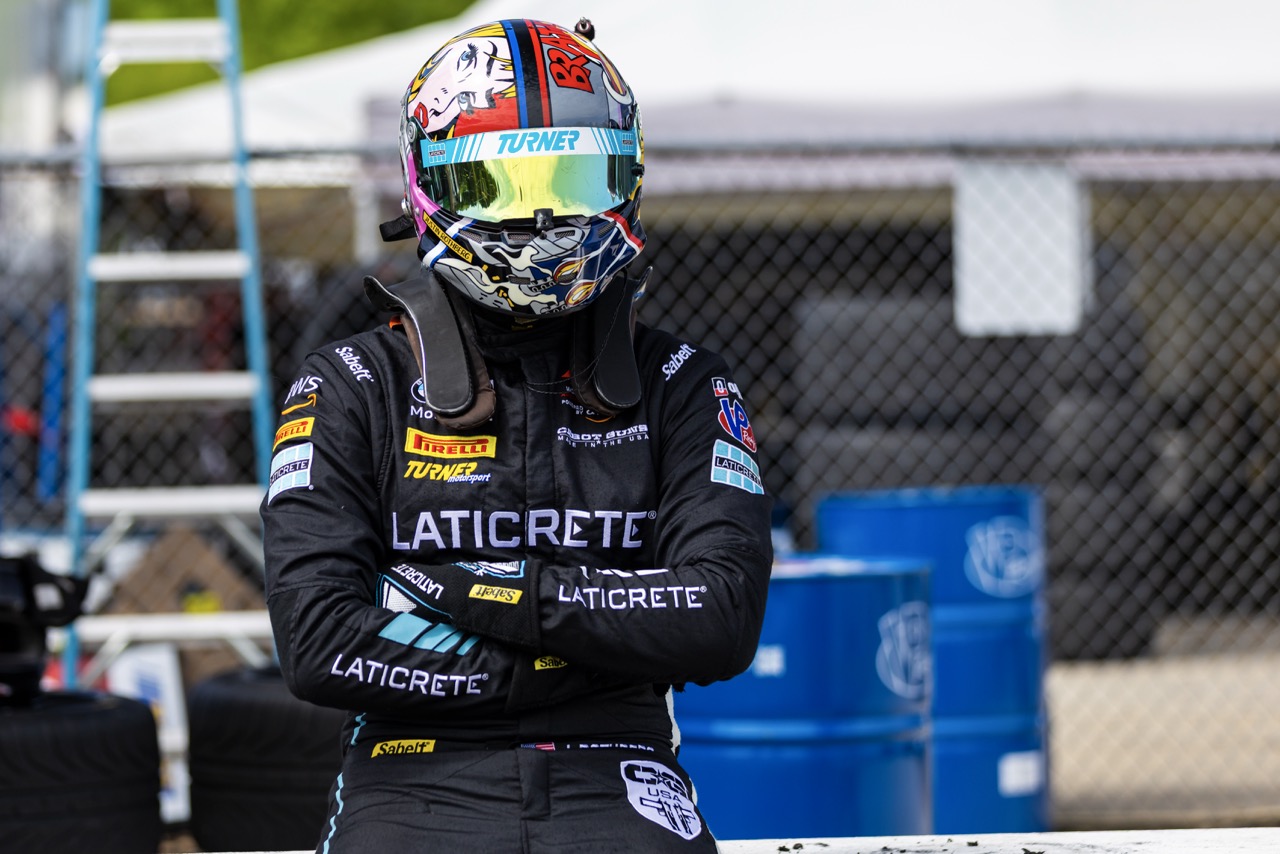
Justin Rothberg spent the previous two GTWC America seasons establishing himself as one of the leading Pro-Am competitors, but the Turner Motorsport driver entered 2026 looking for a new challenge rather than another opportunity to repeat past success.
Alongside Robby Foley in the No. 29 BMW M4 GT3 EVO, Rothberg claimed consecutive Pro-Am championships and also added a GT America title. However, instead of remaining in familiar territory, he stepped into the Pro class this season and placed himself against a much faster benchmark.
The move has already delivered a first Pro-class victory at Sebring International Raceway. More significantly for Rothberg, though, the season has allowed him to measure his development against Silver-rated drivers and identify what he must improve to compete consistently at their level.
Rothberg welcomes the challenge of quicker competition
Rather than viewing the increased level of competition as an obstacle, Rothberg has embraced the opportunity to race against faster drivers.
His previous success gave him valuable experience with the Turner Motorsport BMW, the circuits and the demands of a championship campaign. However, the switch to Pro changed the level of performance he needed to produce.
“I like competing against quick drivers because it pushes me to go faster,” Rothberg said to GTWC America. “I think I’ve learned a lot this year.”
That learning process has shaped Rothberg’s season.
Although Pro-Am provided intense competition, Rothberg recognised that the move into Pro required him to increase his pace considerably. Instead of competing predominantly around Bronze-driver benchmarks, he now needs to match the Silver-rated opposition around him.
“It definitely was a proper echelon,” Rothberg explained. “Pro-Am was competitive, but it’s still Bronze pace at the end of the day, and then stepping up to Pro I had to do Silver pace. It was the next big step to take.”
Consequently, Rothberg entered 2026 with experience on his side but a completely different performance target ahead of him.
A new benchmark changes Rothberg’s approach
Rothberg did not need to relearn every element of GT racing when he moved into Pro.
He already understood the BMW M4 GT3 EVO, knew many of the circuits and had experienced the fluctuations that come throughout a championship season. Instead, the biggest difference came from the drivers against whom he now judged his pace.
That shift has encouraged Rothberg to study his lap times against the Silver-rated competitors he directly races.
Foley naturally offers another reference inside Turner Motorsport. However, Rothberg recognises the difficulty of judging every aspect of his own performance against his highly experienced teammate.
“I try to compare myself to Robby, but that’s just humbling every single time,” Rothberg laughed. “I’ve tried to stop comparing against him and instead compare myself against the Silvers I’m directly racing against.”
That approach gives Rothberg a more relevant measure of his development.
Instead of trying to reproduce Foley’s pace immediately, he can assess whether he continues to close the gap to the drivers who represent his direct competition. In turn, those comparisons allow him to identify smaller areas where he can continue improving throughout his first Pro campaign.
Sebring victory provides first Pro breakthrough
Rothberg and Foley received their first major reward of the season at Sebring International Raceway.
The Turner Motorsport pairing secured their first Pro-class victory after the leading car suffered a mechanical problem. Rothberg would have preferred to win through an on-track pass, but he also recognised that reliability, opportunity and execution all form part of racing.
“It felt great,” Rothberg said. “Obviously we were really excited. It would’ve been better to get it done by actually passing them on track, but we’ll take what we can get. It happens, that’s racing.”
The result nevertheless represented an important milestone.
Rothberg had already proven his ability to win championships in Pro-Am. Sebring, however, gave him his first victory since taking the next step and offered evidence that the No. 29 pairing could capitalise when opportunities emerged in Pro.
Still, one victory has not changed how Rothberg views the wider challenge.
Rothberg refuses to remain comfortable in Pro-Am
Two consecutive Pro-Am championships could easily have encouraged Rothberg to remain in a class where he had already established a winning formula.
Instead, those titles increased his appetite for progression.
Rothberg wanted to test himself against stronger competition and discover whether he could continue developing when the required level increased. Therefore, he approached the Pro move as a new stage of his career rather than an extension of his previous championship success.
“The Pro-Am championship is great, but I didn’t want to be stuck there,” he stated. “I wanted to be able to compete in the Pro class against Silvers.”
That motivation also explains why Rothberg focuses so closely on his pace relative to the Silver-rated drivers.
Another Pro-Am campaign could have offered an opportunity to chase further silverware. Instead, the move to Pro gave him a more demanding target and forced him to develop aspects of his driving that previous success could no longer test.
As a result, Rothberg now measures progress through improvement rather than trophies alone.
Summer break interrupts Rothberg’s developing rhythm
The opening part of the 2026 campaign took Rothberg through Sonoma, Austin, Sebring and Atlanta before the calendar entered its summer break.
That time away gave him an opportunity to travel and recharge. However, it also created another challenge for a driver who continues to build experience at Pro pace.
Track time remains particularly valuable as Rothberg works to sharpen the final details of his performance. Therefore, a lengthy spell outside the car can interrupt the rhythm he wants to establish.
Road America will now bring that break to an end from 28 to 30 August.
Rothberg already knows the 4.048-mile circuit, but previous experience alone will not guarantee the pace he needs against his Pro-class rivals. Instead, he will need to quickly rediscover his rhythm at one of the calendar’s fastest and most demanding venues.
Competitiveness remains the priority for second half
Despite entering the second half of the campaign as a reigning two-time Pro-Am champion and a Pro-class race winner, Rothberg has avoided setting an arbitrary target for victories or podiums.
Instead, he wants to remain competitive against the drivers around him and continue raising his own performance level.
“I just want to stay competitive, stay sharp, and be driving as good or better than the guys I’m competing against,” he detailed. “They’re all really quick, so if I can do that, then we’re in a good position.”
That objective reflects the wider philosophy behind his move into Pro.
Rothberg already knows how to win races and championships. However, this season asks him to prove that he can increase his pace when the standard around him rises.
Therefore, remaining competitive against the Silver-rated field represents a meaningful benchmark in its own right.
Longer races add another element to Rothberg’s development
The three-hour race format has also given Rothberg more opportunities to develop inside the car.
Additional driving time helps him build experience, while longer stints expose him to changing conditions that shorter races cannot replicate to the same extent.
Tyre condition, fuel loads and strategy can all alter how he needs to approach different phases of a race.
“Sometimes I’m on scuffs, sometimes I have heavy fuel,” he shared. “It adds more strategy into it, and I enjoy that.”
Those variables require Rothberg to adapt continuously rather than simply chase outright pace.
For a driver already using 2026 as an opportunity to expand his skill set, the format adds another layer to the learning process. It also gives him valuable preparation for an even greater endurance challenge at the end of the season.
Indianapolis 8 Hour presents a different challenge
While Rothberg enjoys the regular three-hour format, the Indianapolis 8 Hour will significantly increase the demands on Turner Motorsport when the championship reaches its finale.
The longer race brings another driver into the equation, expands the strategic possibilities and places greater emphasis on maintaining performance throughout eight hours of competition.
Furthermore, the double-points structure increases the event’s influence on the final championship outcome.
Rothberg therefore views Indianapolis separately from the races that precede it.
“I really like the three-hour format,” Rothberg said. “But I think the 8 Hour is still its own beast.”
Before Rothberg turns his attention to Indianapolis, however, Road America and the remainder of the regular campaign will provide further opportunities to assess the progress he has made since stepping into Pro.
His objectives remain deliberately straightforward. He wants to stay sharp, compete with the Silver-rated drivers around him and continue reducing the gap to the level he now targets.
After two seasons defined by championship success, 2026 has introduced Rothberg to a different measure of achievement. Instead of protecting his position at the top of Pro-Am, he chose to raise the benchmark.
Now, as the second half of the season approaches, the challenge lies in proving how quickly he can reach it.