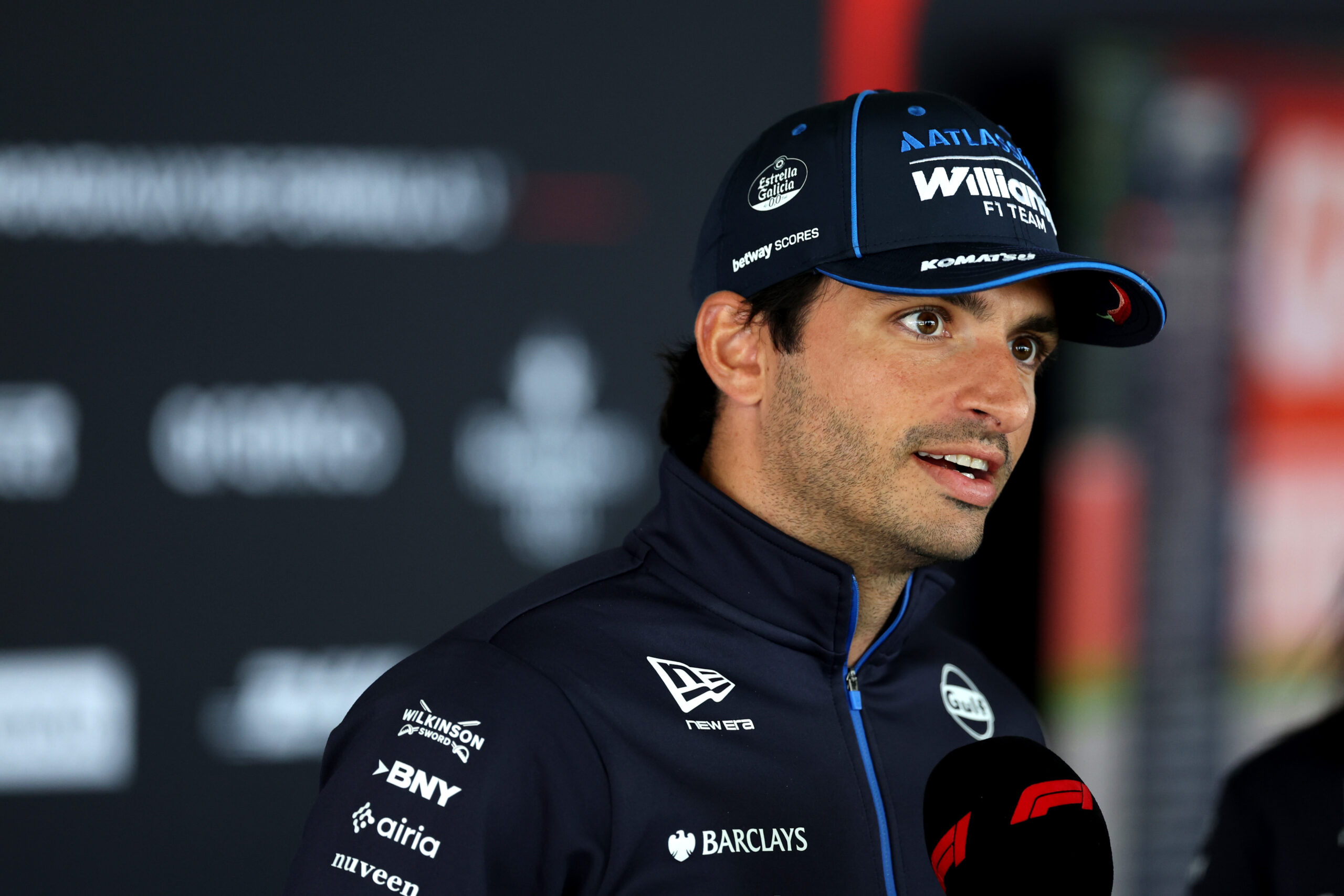
Ahead of the 2026 Canadian GP, Williams F1’s Carlos Sainz has urged the FIA and F1 to “stand firm” with their decision to push ahead with the proposed changes to the 2027 power unit regulations.
As it stands, a shift towards a 60-40 split between combustion and electrical energy could be on the cards. This would see an increase in fuel flow for the V6 engine and reduced energy deployment limits, alongside larger battery capacity to ensure the current generation of cars do not run out of electrical energy so quickly over a lap.
While teams have started to push ahead with the development of their 2027 challengers, the proposed changes could require significant chassis redesigns, as several outfits had already decided to carry their chassis over into next year and had allocated their cost-cap resources elsewhere.
As such, teams may need to agree on a potential one-off cost cap allowance to help offset any unexpected development work, although the FIA could push through with the decision in the interests of safety.
Speaking in a print media session on Thursday in Montreal, Sainz believes the change and decision could be one that benefits the sport.
“There’s a very interesting proposal for 2027, a proposal that I think goes exactly in line to where the sport I think should go. Unfortunately, like always in this sport, there will be politics involved and different interests involved across the main manufacturers that will push back and push forward depending on what they’re looking for.”
“That’s why I can just ask the FIA and FOM to be tough with what they believe is the right thing for the sport and even if you need to vote, that they can still stand firm and believe in what’s right for the sport.”
Sainz: F1 “still not exactly” where it should be despite minor regulation changes
Despite a minor regulation change introduced ahead of the Miami GP, the Spaniard explained that while it was a small step forward, the sport is still not where it should be. Strongly in favour of the potential decision, he believes there is a common consensus across the grid, and one that he believes is the right direction for the future of F1.
“I think what we saw in Miami, even though it was a very small step forward, is still not exactly where F1 should be and there’s a very positive, interesting set of changes for 2027. If you would ask just the drivers, we would all be in their favour or pushing for that direction.”
“For us drivers that will never be enough, I think we all love what we love. If there is electrical [energy], it should be an add-on rather than a dependency on electrical power like we have now.”
“In the past we’ve had KERS, we’ve had the previous PU regulations in which the electrical [part] felt more like an add-on on top of what was already a solid PU.”
Although the 60-40 split in the power unit may still not be enough to satisfy drivers, he believes it is a compromise that will make do for now. Nonetheless, Sainz has expressed hopes of seeing “real racing” return alongside more engine-focused competition in 2030.
“And I think for drivers, purists, we will always believe 60-40 probably is still not enough. But at least it’s something you can race with until real racing and real engines come back in 2030.”
“The question is, do all the teams and all the engine suppliers agree to do it? I think everyone has an agenda, obviously. Are we prepared to do that step? Let’s see.”