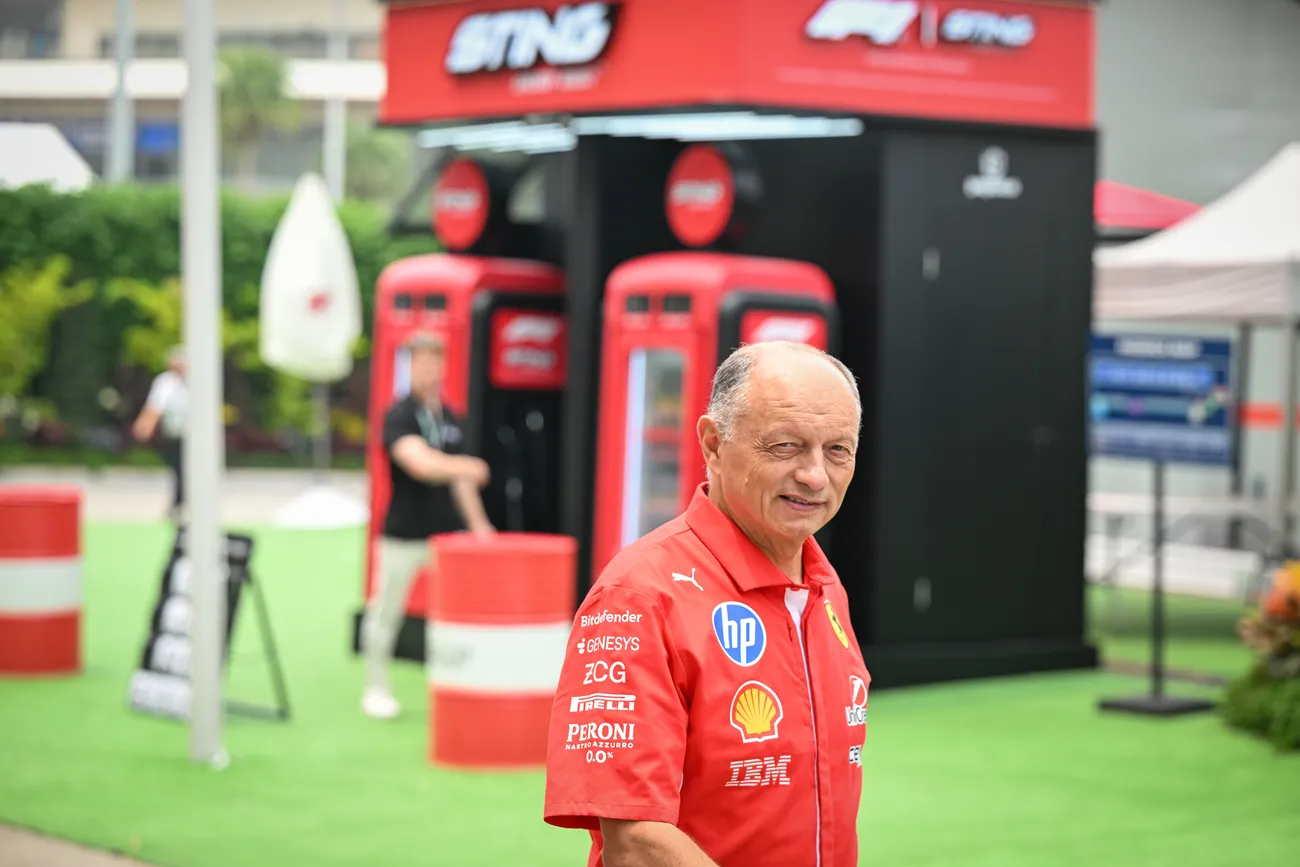
Fred Vasseur analysed a good 2026 F1 United States GP for Scuderia Ferrari as Charles Leclerc finished 2nd, backed up by Lewis Hamilton in P4.
Not for the first time this year or previous ones, Scuderia Ferrari were very fast in practice. In fact, they led all three in Austin as the Monegasque in particular looked like a pole candidate.
In Q2, the nine-time race winner was P1. However, he went slower in Q3 by seven hundredths, falling to 4th behind Kimi Antonelli and the Red Bulls. Lewis Hamilton found half a second from the middle segment but was only P5 himself.
On Sunday, the race pace was very strong. While Charles Leclerc was behind Max Verstappen fighting for 2nd through the first two stints, an eight-lap tyre offset allowed the 29-year-old to pass his old karting rival on Lap 49. Without the VSC to clear Valtteri Bottas’ Cadillac, Lewis Hamilton would have also caught and overtaken the four-time World Champion; he finished up just a second behind.
Vasseur not concerned about how qualifying ended up at 2026 F1 United States GP
Although Q3 was hugely disappointing for Scuderia Ferrari, the Team Principal outlined in his print media session the incredibly close gaps in F1 2026. Less than a tenth covered Max Verstappen in 2nd to Lewis Hamilton in P5 in Q3.
“It’s not really like this.
“If you have a look at the last 4 or 5 races, we are always in the same situation. But we don’t have to draw a conclusion because we are P5 and you are three hundreths of a second to P2. It’s not a disaster.
“Overall, I think the weekend went well and everything is working as expected on the package.
“It shows that we did all the laps, from the first lap of FP1 to the last lap of the race in good shape, except the last two laps of Q3 on both cars. It’s probably where we missed something.
“Today, I think it was between 1 and 2 stops. We had to be aggressive starting from P4 and P5. It was a good call from us.
“Now, when you start behind, you start to have dirty air, you have to be a bit more aggressive.
“Without the Virtual Safety Car at the end, Lewis was perhaps able to come back on Max.
“Overall, I think it’s a good weekend in terms of pace, execution, everything went well except for the last lap in Q3.”
Lots of cars failing to take a (big) step forward in Q3
In Q3, Leclerc, Russell and Norris all went slower than Q2. On the final runs, the wind and cloud cover was a factor as nobody could improve significantly on run 2 in the final segment apart from Lewis Hamilton.
Vasseur believes getting the tyres in the working window was key in qualifying for the 2026 F1 United States GP.
“It’s true for us, but if you have a look at yesterday, I think it was quite particular. McLaren [Norris] didn’t improve, Russell didn’t improve, Verstappen didn’t improve [by much]. I think what is true is that in the car for the tyres, the window is very narrow. As soon as you are a bit out, quickly you lose 2 or 3 tenths.
“Today in F1 on the top 8, 2 or 3 tenths can be six positions. It means that you can move from the super result to nowhere.
“For a gust of wind, you slide a little bit too much in the outlap, you have to slow down. As in the case in Madrid, you have to slow down a little bit and not stick to your pace in the outlap. The impact is huge.”
Is the SF-26 a more sensitive car in F1 qualifying, particularly Q3?
In Q1 and Q2 in Singapore, Lewis Hamilton was fastest. However, he only ended up P3 to polesitter Max Verstappen. Leclerc was quickest in Q2 at COTA but only ended up 4th in Q3.
As other teams — particularly Mercedes and Red Bull — have made big steps in Q3 through the season or recently, the Ferraris have stalled out somewhat.
Vasseur believes the 2026 F1 United States GP qualifying was a similar story for all teams as the tyres were very tricky to get in the window late into the afternoon at COTA.
He also outlined the toughness of qualifying in general with tyre overheating and sliding the very sensitive Pirelli tyres a key factor in the final outcome.
“I think, at least this weekend, it was true for everybody, probably Kimi did a step also, because you can also imagine that he was not in the right spot before, and he put everything together for Q3.
“But I think the other seven cars, except Hadjar, the other six cars, did a step back. Charles did the fastest lap in Q2, but for sure we didn’t do a perfect job in Q3. This is true for us, true for everybody.”
Fine margins and details
“But yeah, we have to put together all the parameters to try to have a better understanding of the situation, and I think all the teams are improving step by step like this, but it’s so marginal that sometimes, against the wind, you are sliding a little bit, you overheat the tyres.
“For details, sometimes you can be out of the spot. It’s not that it costs you five tenths. Sometimes you have the top five cars, yesterday it was P2 and P6, I think we had one tenth.
“If you don’t put everything together, you can move from P2 to P6.”
The use of the hard tyre and the complex nature of choosing what tyres to use in F1 2026, according to Fred Vasseur
The race saw quite a variance in strategy. The Mercedes and McLaren drivers went for M-H, and it was S-H for Hadjar; Max Verstappen tried the S-S-M route, while the Ferraris of Leclerc and Hamilton did the S-M-H one.
As they had a tyre offset at the end, both Ferraris passed Lando Norris, with Leclerc also getting Verstappen for 2nd.
Fred Vasseur explained how difficult it was to read the tyres at the 2026 F1 United States GP as the softer ones in the range have been lasting for many, many laps in the previous few rounds.
“I’m not on the pit wall to forecast what we will do at the end, but we are just trying to be the best for sure.
“We are in the situation today that Norris is a good example. The pace of Norris during the race was a bit up and down. It’s true for Norris, it’s true for everybody.
“But it means that in this kind of situation, we are more focused on ourselves to try to do the best. It’s very difficult to read the tyres, because quite often this year, you can have the projection that you have three compounds on the same line, but to do the choice between soft, medium and hard, it’s never an easy one.
“It means it’s difficult to predict, especially when the conditions are changing, when it was a bit hotter on Friday.
“But overall, I think all the teams reacted pretty well to this.”