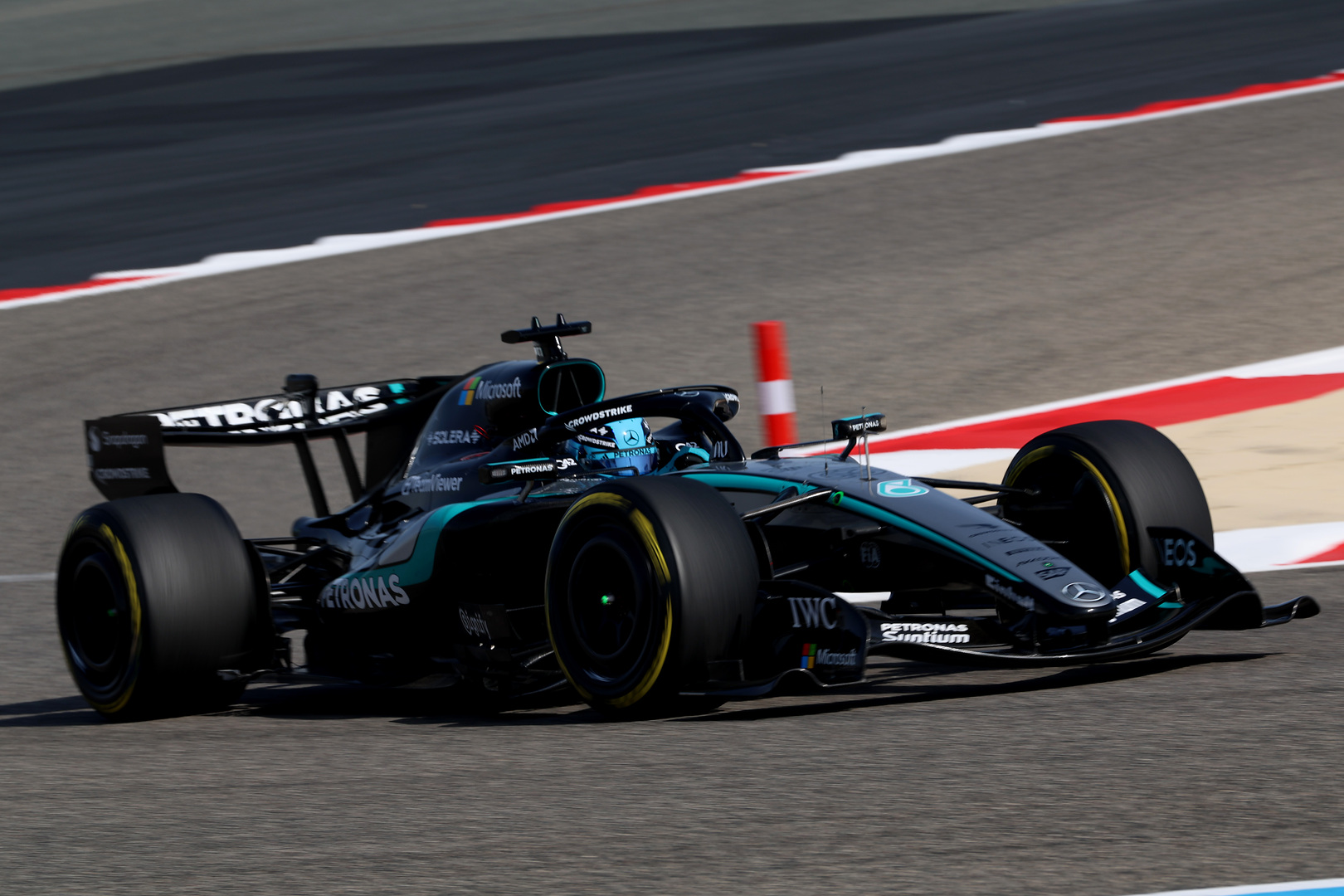
During F1 Testing in Bahrain, Mercedes team principal Toto Wolff commented on the FIA potentially implementing changes to the compression ratio tests ahead of the start of the 2026 F1 season, following competitors’ complaints.
Recently, the Mercedes engine’s compression ratio has been a hot topic in pre-season discussions. The new 2026 F1 Regulations reduced the maximum compression ratio from 18:1 to 16:1. Compliance with the limit is to be tested at ambient temperature. Nonetheless, reports suggest that Mercedes has discovered a method to boost its engine’s compression ratio during operation, while staying within the legal limits during FIA testing.
Reports indicate that the FIA might revise testing procedures before the 2026 F1 season. This potential change surprised Mercedes team principal Toto Wolff, who, until last week, believed no modifications were planned.
“I’m a little bit more confused in the recent weeks about how it came to the point now that it suddenly became a topic, because until last Friday, I was given the impression that things wouldn’t change.
“Well, I read an article from an Italian website that said things are going to change, so I thought that we should know!”
Wolff believes Mercedes could be “screwed” if changes are implemented ahead of the 2026 F1 season
Implementing an intervention requires a supermajority in the Power Unit Advisory Committee, meaning four out of five engine manufacturers, the FIA (governing body), and the commercial rights holder (FOM) must agree. Three engine manufacturers—Ferrari, Honda, and Audi—are reported to have filed complaints with the FIA. Red Bull, initially believed to be employing the same trick as Mercedes, is now reportedly aligned with these three manufacturers. If the FIA and FOM support the other engine makers, Wolff warns that Mercedes would be “screwed.”
“It’s not only the teams, you need the votes from the governing body, and you need the votes from the commercial rights holder, and if they decided to share an opinion and an agenda, then you’re screwed.
“I think that the kind of lobbying from the other engine manufacturers has massively ramped up over the last few months. I mean, secret meetings, secret letters to the FIA, which obviously, there’s no such thing as a secret at this point. And that has brought it to this situation.”
Potential changes influenced by complaints from rival teams
During development, Mercedes collaborated closely with the FIA to ensure adherence to the 2026 F1 Regulations. After receiving FIA confirmation, Mercedes proceeded, with Wolff noting that lobbying by competitors had influenced the current debate and potential changes ahead of the 2026 F1 season.
“You know, in this sport, it’s full of surprises, so there is never a situation where you can say you’re sure about anything. All along the process, when you design an engine, you’re keeping the FIA very close to the decisions you make, and that’s what we did.
“And we have had all the assurances that what we did was according to the rules. It’s not even like we’re talking about some massive performance gain, and that’s what it was, but I think all of our competitors got a little bit aggrieved and lobbied the FIA for a long time.”
Wolff: Changes to test ahead of the 2026 F1 season could hamper performance
In a recent interview about the 2026 Regulations, Nikolas Tzombasis indicated that the FIA is eager to resolve the debate before the 2026 F1 season begins. If new regulations or testing procedures are introduced, Mercedes and its customer teams will be required to comply, notes Wolff. The Mercedes team principal also mentioned that operating the engine outside its intended design could be very harmful to the performance.
“Well, if it becomes a regulation, you need to adhere to the regulation. And if you can’t adhere to the regulation, then the FIA needs to come out with some kind of invention, how to adjust for that, and that’s unclear to us.
“Of course, you develop an engine over a long time, and you have lead times, and if you were told you can’t operate the engine in the way you have developed it, that could be quite damaging for the performance.”
Mercedes will not take legal action if the FIA decides to implement changes
Initially, there were rumors that Mercedes might take legal action if changes were made before the start of the 2026 F1 season. However, Wolff dismisses these rumors, stating that Mercedes would “respect” the FIA’s decision.
“There is no such scenario as we would sue anyone. In Formula 1, in my opinion, it is more essential than ever that you know what the rules are, but engineering ingenuity is always respected, and that’s why we always respect the governance of the sport.
“If the governance of the sport decides to change the rules, be it against our position or for our position, we just have to get along with it.”
Wolff is concerned about “precedent” change could set
Wolff makes it clear that, in his view, the compression ratio is not a major performance differentiator and points to the “complications” of implementing a new rule ahead of the start of the 2026 F1 season.
“It’s just a few horsepower. In England, you would say ‘a couple,’ which is more like ‘two or three.’ So, almost negligible risk to make any major difference over the course of a Grand Prix.
“It’s more about what is the precedent we are setting, what are the complications of introducing a new rule, how do you monitor it, in which way do you adjust if you felt the need to adjust, how will it influence ADUO, the engine balancing system.”