Ford has confirmed that it will manage its upcoming FIA World Endurance Championship (WEC) Hypercar programme entirely in-house, marking a strategic shift in how the American manufacturer approaches top-level prototype racing.
The decision forms a key part of Ford’s preparations for its return to the pinnacle of endurance racing in 2027. By running the programme internally, the company intends to strengthen its engineering capabilities while accelerating the transfer of race-bred technology to its road car range.
Ford prepares for top-class return in WEC Hypercar category
Ford revealed in January that it will rejoin the FIA WEC Hypercar category in 2027. The move will mark the brand’s first factory effort at the top level of the championship in decades and will revive memories of its legendary successes at the 24 Hours of Le Mans during the 1960s.
Today, the manufacturer already competes in the FIA WEC’s LMGT3 class through customer team Proton Competition. However, the upcoming Hypercar project will represent a full-scale factory campaign.
Earlier this year, Ford also confirmed that French constructor ORECA will design and develop the chassis for the new prototype. The collaboration draws on ORECA’s extensive experience in endurance racing and prototype engineering. Meanwhile, Dan Sayers, formerly Programme Director at Red Bull Ford Powertrains, will lead the Hypercar project.
As development continues, Ford Racing has begun assembling the operational structure required for a successful entry. Engineering and motorsport consultancy group Venture Engineering will provide technical and operational support as the programme moves towards its on-track debut. At the same time, Ford Racing has started recruiting key personnel and building the team infrastructure necessary to support the ambitious timeline leading to 2027.
Ford outlines in-house Hypercar strategy for WEC return
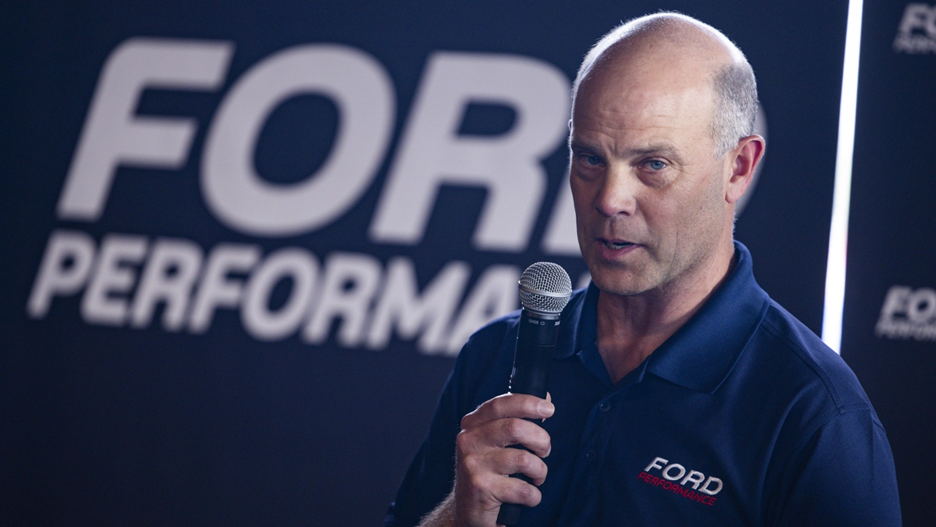
Explaining the strategy behind the decision, Ford Racing Global Director Mark Rushbrook highlighted why the manufacturer wants to maintain direct control over the programme. According to Rushbrook, operating the effort internally will allow Ford to strengthen its technical expertise, build a unified team culture and accelerate development across both its racing and road-car divisions.
He also stressed that Ford Racing wants to take full responsibility for the project rather than relying on the traditional structure in which an external organisation manages the day-to-day operations of a factory racing effort. By doing so, the company believes it can react more quickly to competitive challenges while embedding long-term knowledge within the organisation.
A new approach for Ford Racing
Rushbrook explained that the Hypercar programme represents a significant moment for the manufacturer as it prepares to return to the top level of endurance racing. Rather than following a conventional model, Ford has chosen to oversee every aspect of the programme itself.
“It’s an exciting time as we continue to build and develop our Ford Racing Hypercar programme,” commented Ford Racing Global Director, Mark Rushbrook. “Competition runs through our veins and, as ‘America’s Race Team’, it seems only right that we carry the banner ourselves. Breaking from the traditional model of many manufacturers – and often our own model in the past – Ford Racing will oversee and manage every aspect of our prototype racing project.
Furthermore, Rushbrook emphasised that the decision aligns closely with Ford’s wider philosophy of developing expertise internally. The company intends to create a foundation that will not only support the Hypercar programme but also benefit future customer racing initiatives.
“In-keeping with our core values, we will build our own internal expertise to create a framework for long-term success and learnings that will find their way into customer programmes of the future.
“We are not looking outside of our walls to find who can run a programme for us; we are looking within Ford Racing to build programmes infused with our passion. This gives us the ability to react more quickly on-track, enhancing our competitiveness. It also allows us to bring technology back to our road cars more effectively and efficiently than ever before.
Managing the challenge ahead
At the same time, Rushbrook acknowledged that the approach presents a significant challenge. With the Hypercar debut scheduled for 2027, Ford must simultaneously develop the car and assemble a complete racing operation within a relatively short timeframe.
“It doesn’t come without challenges, of course. In less than two years, we need to not only build the car itself but every part of the team, too – but we are building quickly and systematically.
Nevertheless, Ford plans to rely on its extensive global infrastructure to support the project. The company already possesses several advanced motorsport and engineering facilities, which will play a crucial role in developing the Hypercar and supporting race operations.
“We have at our global disposal advanced racing facilities in Dearborn, Michigan and Charlotte, North Carolina in the United States, as well as Red Bull Ford Powertrains and our Hypercar facilities in the UK. We also have our chassis partner, ORECA, who have decades of winning experience and will additionally provide trackside support.
Partnerships supporting the programme
Although Ford will run the programme internally, Rushbrook pointed out that key technical partners will still play an important role. In particular, the collaboration with chassis constructor ORECA brings valuable experience to the project, especially given the French organisation’s extensive success in endurance racing.
“These are assets that no-one can match – with over 100 Le Mans starts between them, they make the perfect partners to assist Ford Racing in this exciting new endeavour. While we bring these partners in, we are proud that this is very much a Ford Racing effort, and we are building a team culture which mirrors that of Ford Racing – passionate and driven by a need to be the best.
Ford looking to carry the Blue Oval into Endurance Racing with WEC Hypercar return
Ultimately, Rushbrook framed the programme as a natural extension of Ford’s long-standing competitive spirit. As the company prepares for its return to top-tier sportscar racing, he believes Ford Racing itself is best positioned to lead the effort.
“Ford Racing rings true to the competitive blood that runs through the entirety of Ford Motor Company. It is a privilege to be racing as ‘America’s Race Team’. After all, there is no-one better to carry the Blue Oval into the highest level of international sportscar racing than Ford Racing itself.”
Ford believes that the in-house approach will strengthen its ability to compete at the highest level while creating lasting benefits across the company. By integrating its racing and engineering operations more closely, the manufacturer aims to develop technologies that will eventually influence future road cars.
With the Hypercar debut scheduled for 2027, the coming months will see Ford continue expanding its team, refining the prototype design and preparing for testing as it builds towards a highly anticipated return to endurance racing’s top class.