Every driver entering the FIA Junior Ladder is chasing Formula 1 and other top-level series, yet the pathway meant to lead them there is becoming increasingly limited.
The ladder begins with Formula 4, before moving up to Formula 3, Formula 2, and ultimately Formula 1. Each of these categories filters and develops talent, but tight grid spaces in F3 and F2 have created growing concerns about fairness and opportunity.
Neither championship has imposed a limit on the number of seasons a driver can compete in, despite having only 30 seats in F3 and 22 in F2. A contrasting approach can be seen in F1 Academy, which has 18 seats and currently limits drivers to a maximum of two seasons, encouraging advancement and ensuring regular seat changes. In 2027, this two-year limit will increase to three years as the series continues to grow, allowing drivers slightly more opportunity and progression.
Seeing this approach in the all-female championship leaves many wondering whether F2 and F3 should also introduce similar limits on how long drivers are allowed to remain in the series.
The decrease in driver rotation
One of the main arguments in favor of introducing season limits in F2 and F3 is that they would reduce the risk of stagnation within the junior ladder. In recent years, it has become common for drivers to remain in the same category for multiple years. This lack of seat changes has reduced opportunities for emerging talent competing in feeder series such as F4 and Formula Regional European Championship by Alpine (FRECA).
Richard Verschoor is a clear example of this issue, as his extended stay in F2 has played a major role in the debate around introducing season limits. Verschoor began his F2 career in 2021, where he finished P11 in the Drivers’ Standings before continuing in the series for four more seasons until 2025. While he improved over time, finishing P3 in the 2025 championship, he has held one of the 22 F2 seats for 5 seasons, only breaking through in his final year. Now, in 2026, he has joined McLaren’s Driver Development Program at 25 and made his endurance racing debut.
Beyond Verschoor, Kush Maini has now entered his fourth F2 season with a fourth different team. Similar patterns also appear in F3, as Brad Benavides is now competing in his third F3 campaign.
Preserving F3’s developmental role
Formula 3 plays a key role within the FIA junior ladder as the first major step into higher-level single-seater racing. When created in 2019 through the merger of GP3 and the FIA F3 European Championship, F3 served as a training ground for F2 and F1, allowing young drivers to showcase and develop their skills in an extremely competitive environment.
Given its emphasis on development, long-term participation is arguably less aligned with its original purpose. Therefore, introducing season limits would reinforce this without major disruption, as most drivers progress from F3 within one to three seasons.
No driver has ever competed in four full F3 seasons, though several have reached three full seasons before moving up to F2, such as Logan Sargeant, Nikola Tsolov, and Mari Boya. This is also visible on the current grid, with 14 of the 30 drivers competing in their second or third year in F3.
Season limits are not a new concept, as previous series have successfully implemented them. The FIA F3 European Championship (2012-2018) limited drivers to a maximum of four seasons and set an age limit of 25, reinforcing its role as a youth-focused feeder series.
Without formal limits, more experienced drivers can remain on the grid for longer, reducing turnover and undermining F3’s role as a short-term developmental step.
The crowded final step
On the other hand, the FIA Formula 2 Championship presents a more complex issue as it is widely considered the final step before F1. Drivers often want to stay in the series as long as possible to prove they are ready for the pinnacle of motorsport, such as Verschoor and Maini.
However, the reality of the pathway to F1 suggests that progression from F2 is far from guaranteed. Since the championship’s debut in 2017, only 22 drivers have moved directly from F2 to the F1 grid.
More recently, a clear pattern has emerged among drivers promoted to F1, as many have stood out with strong performances and championship results in their debut F2 season. This includes Gabriel Bortoleto, Kimi Antonelli, Isack Hadjar, Ollie Bearman, and Arvid Lindblad. Hence, staying longer does not necessarily improve a driver’s chances of reaching the top level, though it does block opportunities for young talent.
It is also important to note that while staying for too long can be a problem, some drivers begin in weaker teams and may need time to demonstrate their full potential. Others improved over multiple seasons, such as Felipe Drugovich, who won the 2022 championship in his third F2 campaign. Additionally, while it’s rare, not all drivers aim for F1, with some targeting other high-level series such as Formula E, IndyCar, and the World Endurance Championship (WEC).
Bruno Michel on capping the number of seasons allowed
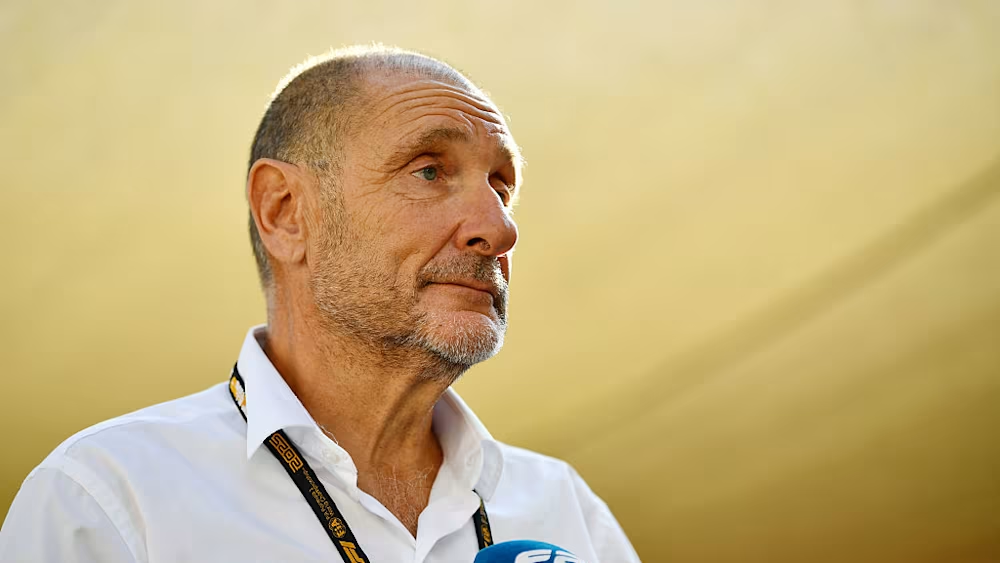
As previously reported, during a media session attended by Pit Debrief, F2 and F3 CEO Bruno Michel shared his reluctance to introduce such caps. For him, experienced drivers add value by becoming benchmarks for rookies, while many stay simply because they enjoy racing in F2 rather than seeing it only as a step toward F1.
“Now, number one, those drivers absolutely love F2 and they’re happy to continue. And even if maybe for them it’s not a way for F2 to F1, but it’s a championship they absolutely love and they want to do it,” he said, addressing the debate around long-term drivers such as Verschoor.
“And number two, what we always consider is that when we have new drivers who are arriving into Formula 2, it’s really interesting that they can compete with these kind of drivers who have a massive experience of Formula 2 because it’s the way to see where they are in terms of performance compared to drivers like Victor Martins this year [2025] who’s going to be in his third year.”
While these arguments carry weight, they ultimately miss the series’ core purpose. Like F3, F2 serves as a stepping stone rather than a long-term career destination. With only 22 seats available, allowing drivers to remain for multiple seasons significantly restricts opportunities for those progressing from F3, weakening the effectiveness of the ladder.
Restoring progression
As F2 and F3 operate at different stages of the junior ladder, they cannot be fully compared to the smaller, newer F1 Academy model. However, they still share the same fundamental goal, as they are development series and not long-term stops.
Without clear limits, the system risks stagnation. Emerging drivers receive fewer opportunities to progress and prove themselves, while others become stuck at a single stage in their still-developing careers, undermining the pathway’s purpose.
A three-season limit in both championships would therefore help restore progression, ensuring regular changes while allowing F2 and F3 drivers enough time to adapt and demonstrate their potential.