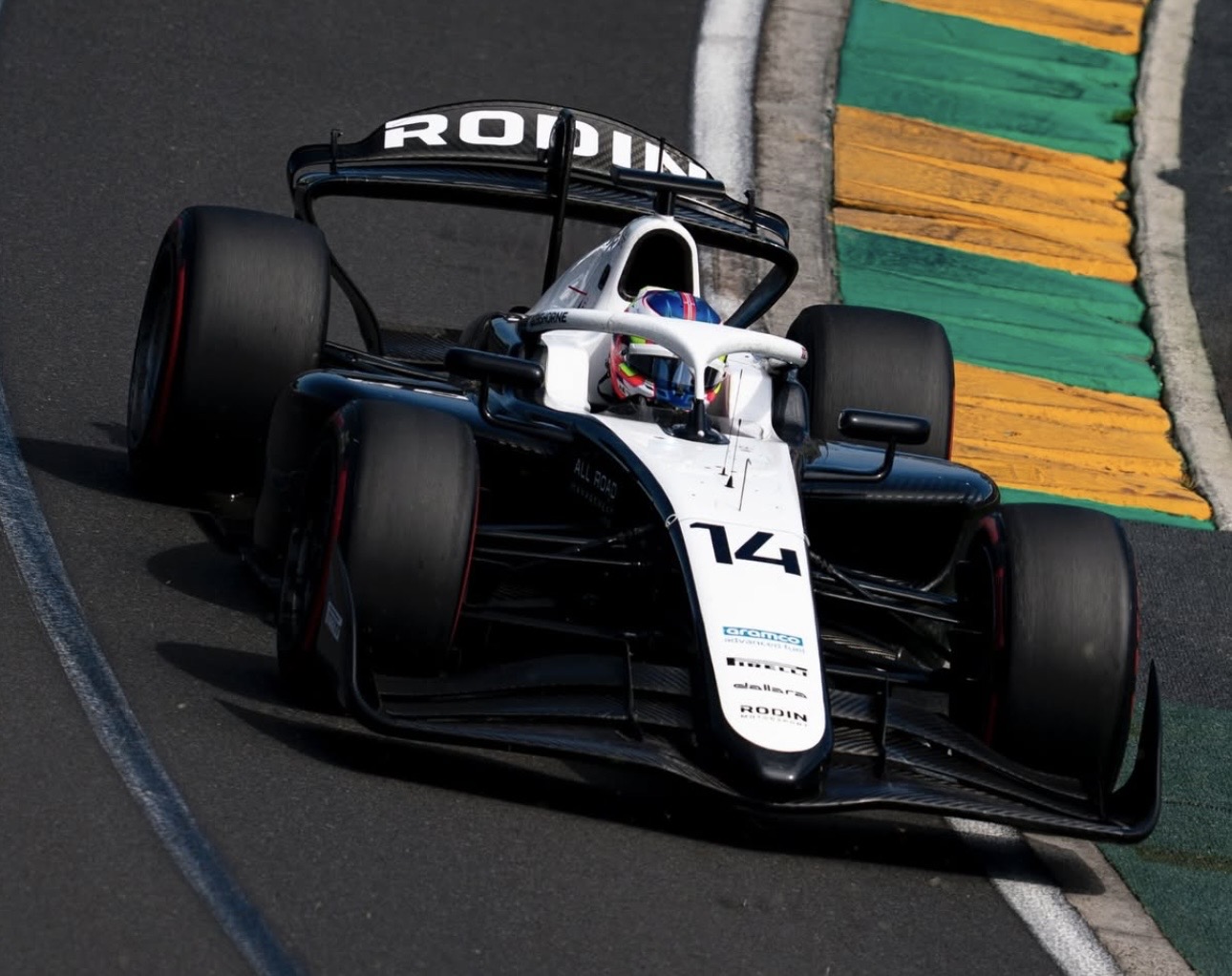
Rodin Motorsport have invested in opening a new Driver Performance Centre near their UK headquarters to further help drivers achieve victory in F2 in 2026. As Formula 2 teams all run the same-specification car, they must think outside the box to make a difference.
Explaining the idea behind the Driver Performance Center, Sporting Direcetor Benn Huntingford said:
“We’ve invested in a full motion simulator from Dynisma. With the physical size of the simulator alone, we’ve built a new facility, primarily around the sim but also incorporating extra facilities to fully support a driver’s development path required to succeed in single-seaters.”
“We also have five static simulators set up with live data telemetry in a purpose-built room, a gym with a sauna and everything else the drivers need to work on their performance outside the car.”
The idea is to find new ways to help their drivers get closer to their goals.
Driver Performance Center has been in development for a long time at Rodin Motorsport
Over a year ago, the Rodin team began investing in the new project. While the F2 season has just begun, the team is coming up with new ways to optimise their equipment and drivers’ performance.
“It’s quite a substantial investment. We ordered the simulator a year ago, as the production lead time for a motion sim can take up to 12 months before it arrives and is set up.” Huntingford said.
“Then in terms of the facility, that had to come together quite quickly once we had the delivery date for the simulator.
“We had to prepare the building and build all the infrastructure that needs to be in place ready for the sim. So, we’ve been working on it properly for the last year.”
The simulator is a tool many drivers rely on to improve their performance. Drivers across Formula 1, 2, and 3 spend hours in the sim to maximise their potential. Rodin has specifically relied on data from the post-season test in Abu Dhabi, as well as the first rounds of 2026, to improve the accuracy of the sim.
“We came online initially with the full motion sim in October, before an extensive period of development where we worked on the vehicle models, the dynamics and correlating everything with the real car.”
“There’s a lot of work we can do in terms of bringing the car model on and getting up to speed and then utilising our F3 and F2 drivers’ feedback and the experience of being in our car at the track has also been crucial in making sure we extract the potential out of their pre-event preparation.”
Rodin preparing for the remainder of the F2 2026 season
While the simulator helps drivers familiarise themselves with each track, it also assists the team in analysing performance. Having data on drivers’ performance on track, as well as in the simulator, can be hugely beneficial for the team. Furthermore, the motion physics and new elements of the sim combined with the upgrades the team has made are expected to improve performance.
Huntingford conitnued to explain the benefits of the facility, stating:
“Having the motion makes it a lot more realistic, with more feedback for the driver with the movement and the bigger screens and the whole environment, so it just becomes a step closer to reality,” Huntingford continued.
“But also outside of the driving, Formula 2 and Formula 3 aren’t just about being quick now, because everybody’s quick. There are all the systems you need to learn, all the processes, the tyre warm-up, what you do with the brakes and the clutch.
“So it’s the ability to be more accurate with all of that, as well as working alongside their engineers on those processes. That’s a bigger part now of what the drivers need to take on and learn compared to in the past.
“It’s quite new for us, but we believe a junior team needs to be looking after all these things in-house. Everything from the driver’s fitness – we’ve got a full-time human performance coach that looks after the drivers, benchmarks where they’re at with their physical performance along with VO2 max testing, nutrition, understanding jetlag, the whole package.
“Having all that information available and focusing on what we can do with the drivers feels like a real step forward.”
The level in F2 is constantly improving
With the gaps in F2 being immensely narrow, the level of competition is intense. The weekend can start off great for a driver, then completely shift by the time the Feature Race arrives. With so many drivers improving their level, just having high speed is no longer enough. To succeed in F2, every minor element must come together. From speed, to accuracy, and consistency, every corner is important.
The Sporting Director believes that with the new facility, the increased data will help Rodin make a difference in F2 2026.
“There’s always been quick drivers, and it’s always been about small margins, but I think more and more now we’re seeing we can go to a circuit and we see the grid separated by less and less. The margins just get smaller and smaller.
“All the teams are good, all the drivers are good and finding that little advantage seems to get a little bit harder each year.
“So with the new sim, something that we can do is train the drivers to be more adaptable. For example, when there’s changes when we get to a circuit and the grip feels a bit different to what we’re expecting, we can pre-empt all of that with the driver.
“We can work through those different scenarios so that we’re a little bit more prepared when we arrive at the circuit to cope with different situations.
“The level in F2 and F3 is constantly rising, other teams have got strong facilities as well so it’s just a case of making sure that what we can offer is as competitive as everyone else and executed to the highest standard.”
As the level rises, Rodin will hope to be on top in 2026.