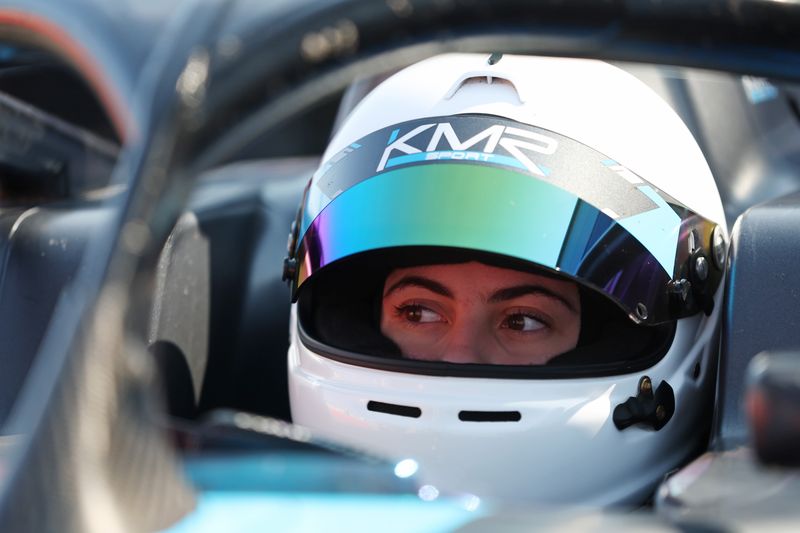
Lily-May Watkins continues to build her motorsport career with clarity and intent as she prepares for the GB4 Championship. In an exclusive interview with Pit Debrief, she reflected on her transition from karting to cars, the role of simulation in driver development, and the importance of mindset in a highly competitive environment. As her journey progresses, Watkins demonstrates not only technical growth but also an increasing awareness of the psychological demands of racing.
From karting to GB4: Watkins on adjusting to a steep learning curve in motorsport
The transition from karting to cars represents a defining step in any driver’s career. For Watkins, this move required both physical and mental adaptation, particularly given her direct progression from rental karting. This shift demanded not only technical adjustment, but also a recalibration of expectations and approach.
“I honestly—obviously, going from rental [karts] straight into cars, it was even more of a step for me than it was otherwise. But honestly, I think the main difference is just—well, obviously the speed is one there—but I feel like that’s not actually as big as you think. It’s more just like the strength and the conditioning, like your mindset, because I feel like a lot of the time your mindset can create and cause you to be slower than actually physically you can be.”
In expanding on this experience, Watkins highlighted how the perceived challenges of speed often overshadow more significant factors. She pointed instead to the importance of physical conditioning and, crucially, mental discipline.
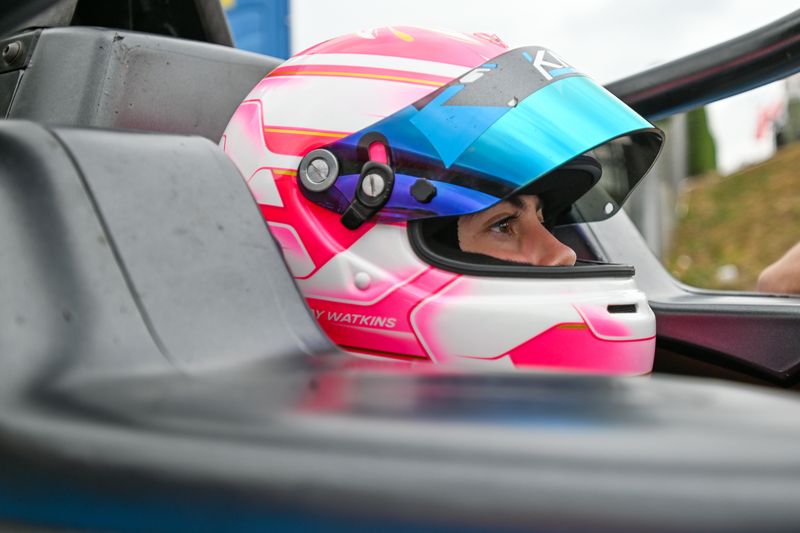
Watkins on building preparation through simulation and development programmes
As Watkins progressed, she placed increasing emphasis on structured preparation. Development programmes and simulator work became essential tools in bridging the gap between karting and car racing. These resources allowed her to approach each new challenge with a degree of familiarity.
“So I joined the Arden Driver Academy when I first started karting. And obviously with that simulator work… I feel like simulator is a very important part of getting into real-life racing, because you get—not like you get the speed—you get how you’re driving the car. Obviously, it’s very different when you jump in the real car, but it almost gives you that basis to feel like you’ve already been there before rather than just jumping in and thinking that it’s all new at the same time.”
Through this process, Watkins reduced the learning curve typically associated with stepping into new machinery. In doing so, she reinforced the value of preparation that extends beyond traditional track time. Consequently, simulation emerged as a key pillar in her development strategy.
Sim racing as a modern pathway into motorsport
Alongside her personal preparation, Watkins also reflected on the broader role of sim racing within modern motorsport. As technology continues to advance, simulation increasingly mirrors real-world conditions, making it a powerful training tool for drivers at all levels.
“I think it’s very much like a tool that everybody should be using. It literally gives you that basis—basis of everything.”
Watkins’ direct assessment underscores the universality of simulation as a resource. She positions it not as optional, but as fundamental to driver development in the current landscape.
“Obviously, with how good simulators have gotten in recent years, it’s very, very similar in terms of your preparation. There’s always going to be some differences, but it translates very well. Obviously, you don’t get the same adrenaline aspect, which is different in real life. But other than that, everybody should really be using it because it just gives you that step compared to all your competitors that don’t use it.”
By acknowledging both its strengths and limitations, Watkins presented a balanced perspective. While simulation cannot fully replicate the intensity of real racing, it offers a clear competitive advantage. As a result, it continues to shape how drivers prepare for higher levels of competition.
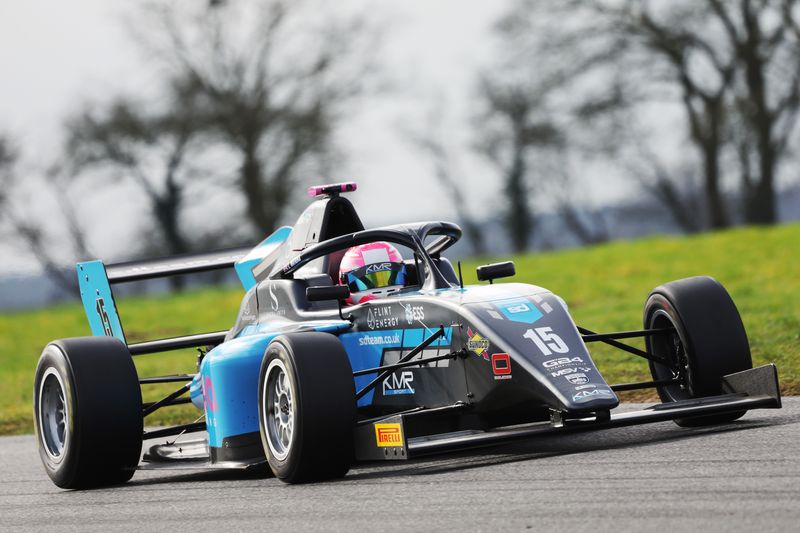
Watkins on preparing for GB4 and the physical, technical, and mental growth required for the transition from karts
With her focus now on GB4, Watkins has adopted a comprehensive and structured approach to preparation. Drawing on past experiences, she has worked to strengthen all aspects of her performance, particularly those she identified as areas for improvement.
“My team has been a great help. Obviously, I’ve started with the same team between this year and last year, and we’ve definitely got a very good relationship. I feel like they were able, during the off-season, to push me.”
This strong relationship with her team has provided continuity and support, enabling consistent progress during the off-season. Their role extends beyond technical guidance, contributing to her overall development as a driver.
“We’ve spent a lot of time on the simulator, and also just that physical preparation I didn’t have last year. Jumping in quite late last season, I didn’t have the same physical preparation. But we’ve been working, obviously, in the gym, on the simulator.”
By addressing the gaps in her previous preparation, Watkins has ensured a more stable foundation heading into the new season. This combination of physical training and simulator work reflects a more refined and disciplined approach.
“But also I’ve been doing a lot of mental preparation, because I feel like that’s a lot of things I was lacking last year—just having that extra confidence to be able to know that I’m good enough in that space.”
Importantly, she identifies confidence as a decisive factor in performance. Her increased focus on mental preparation signals a shift towards a more complete and balanced development model.
Managing setbacks: resilience and perspective
In a sport defined by fine margins, setbacks remain inevitable. Watkins acknowledges this reality and emphasises the importance of maintaining perspective, particularly during challenging race weekends.
“Honestly, it’s more like my support network. This year I’ve got the right people around me just to be able to pull me out of something. If I’m having a bad day, just being able to stop me and just being like, “life is okay, it isn’t all that big, you’re going to be better next time.” Because it’s when you let one race become every other race that it starts to go downhill.”
This reliance on a strong support network enables Watkins to manage the emotional demands of competition. By keeping individual setbacks in context, she avoids allowing them to affect her broader performance, demonstrating a clear approach to resilience.
“So it’s just being able to separate one race and being like, “this happened, but then next time I can be better.””
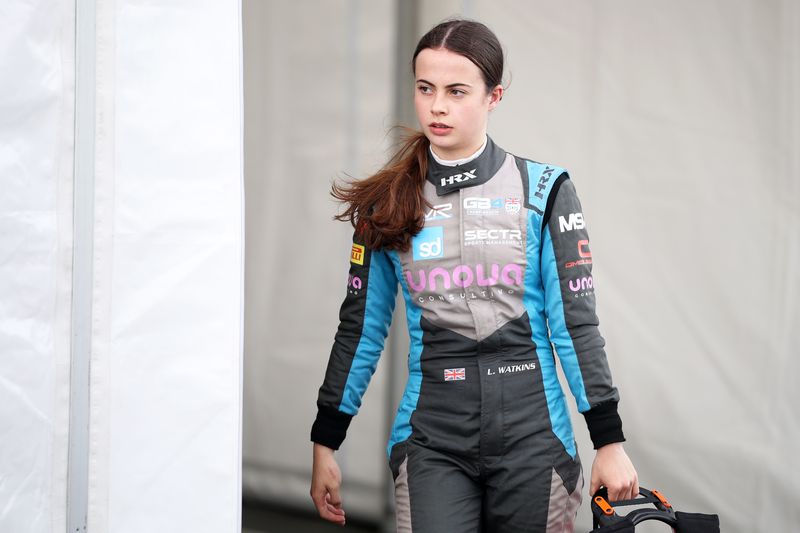
Watkins on the role of support systems in sustained development from karts to GB4
Finally, Watkins highlighted the people who have shaped her journey. Her progression reflects not only personal effort, but also the influence of a dedicated and supportive network.
Her family forms the foundation of this support, providing consistency throughout her career. This stability plays a crucial role in enabling her to pursue motorsport at a competitive level.
“Obviously, my parents have been there since day one. They support me no matter what.”
Beyond family, Watkins acknowledges the impact of professional guidance. Her coach and manager contribute to both her development and her opportunities within the sport.
“And then my performance coach, Sasha, she’s been there since the start of my last season. Just being able to have her be with me since I’ve developed from where I was then to where I am now is kind of insane. And yeah, my manager—he obviously got me into here, and without him I don’t know where I’d be. And then, yeah, obviously the team. The team has pushed me further than I ever thought.”
“So kind of just everybody, really,” she concluded, highlighting that these relationships have created an environment that had fostered her growth and confidence. Thus, as Watkins continues her journey, this collective support remains central to her ongoing progress.
Support, mindset, and preparation key as Watkins prepares for 2026 GB4 season
As Lily-May Watkins prepares for the next phase of her career in GB4, her reflections reveal a driver who understands the complexity of modern motorsport. By combining technical preparation, physical conditioning, and mental resilience, she continues to refine her approach. Moreover, her emphasis on simulation and support systems highlights the evolving nature of driver development. In this context, Watkins moves forward with both purpose and perspective, equipped to meet the demands of an increasingly competitive field.