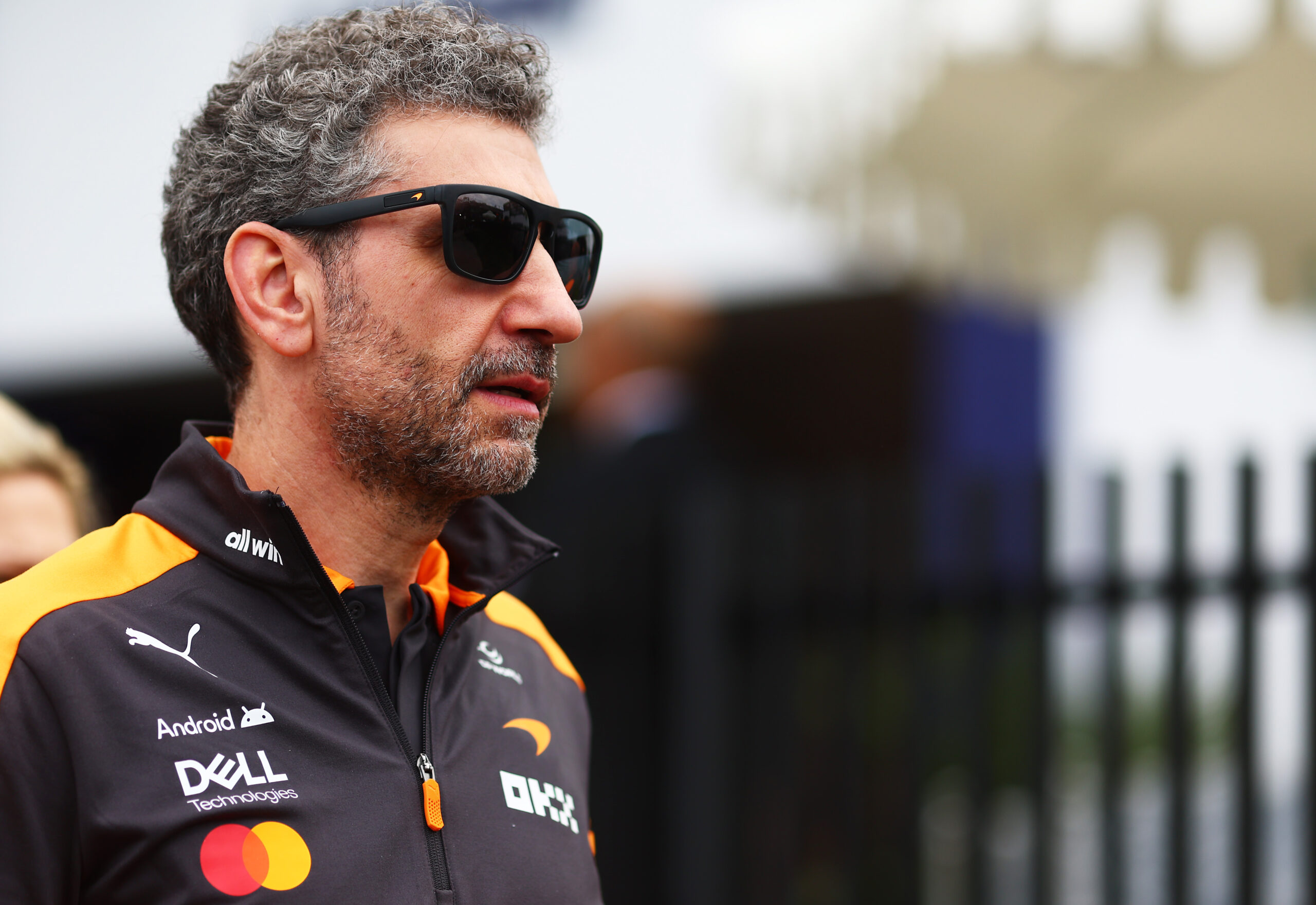
McLaren have endured a mixed bag of performance in their 2026 Formula 1 (F1) campaign, with Andrea Stella offering a candid reflection on the team’s early-season struggles.
At this point last year, McLaren were sitting comfortably on 111 points after Round 3. In contrast, they have managed just 46 points over the same period in 2026—highlighting the scale of the challenge they now face.
After entering the campaign with high expectations following their 2025 title success, McLaren instead found themselves on the back foot in the opening rounds. However, Stella’s reflections underline a team that is not only aware of its shortcomings, but already taking steps to address them.
“I agree that the first part of the season presented some challenges, essentially for two reasons,” Stella said. “The first is that it took longer than expected to learn how to harness the full potential offered by the power unit. Furthermore, we suffered from various reliability issues in this area, which not only had a significant impact on results but also on the pace of our learning process.”
Reliability concerns early on in 2026 for McLaren
Those reliability concerns were evident from the outset. Oscar Piastri was unable to start the opening two races of the season, while a double DNS in China—also affecting Lando Norris—marked a rare and costly blow. It was the first time since the 2005 United States Grand Prix that both McLaren cars failed to start a race.
In a season shaped by evolving technical demands and tight competition, those early setbacks proved costly. Extracting performance from the power unit is critical in modern Formula 1, and the lack of early optimisation left McLaren chasing valuable tenths while rivals built momentum.
The second issue stemmed from the development of the McLaren MCL40, with Stella pointing to both timing and philosophy as key influences.
“The second is that the design phase of the MCL40 was affected both by the fact that we continued to fight for the Championship right up to the final race in 2025 and by a different approach to design,” he explained. “Specifically, we wanted to make sure that the launch spec of the car was a healthy platform for development. As we know, there is a long way to go with the new 2026 regulations.”
Mercedes and Ferrari leading the way
That long-term mindset reflects a strategic shift within McLaren, prioritising development potential over immediate peak performance. While that approach may have compromised early results, it could prove decisive over the course of a regulation cycle where adaptability is key.
“These, in short, are the reasons why we found ourselves trailing behind rivals such as Mercedes and Ferrari, who arrived better prepared than us at the first round of the season.”
At present, Mercedes lead both the Constructors’ and Drivers’ Championships, with Kimi Antonelli setting the early benchmark.
Despite the early setbacks, Stella was keen to emphasise the positives at McLaren, particularly the resilience and unity that carried them to championship success just a season ago.
“If this is the ‘dark’ side, there were many ‘bright’ aspects,” he said. “The first, let me say, is represented by the character shown by the team and the drivers, in line with what we saw in 2025 when we won both titles. Once again, we have faced the difficulties in a united and cohesive manner, both internally and with our partners at Mercedes HPP [High Performance Powertrains].”
That cohesion has been evident not only behind the scenes, but increasingly on track. McLaren’s ability to remain composed under pressure has allowed them to steadily chip away at their deficits, with signs of progress beginning to emerge as the season unfolds.
“In addition, we have seen in Suzuka the first signs of progress, where we secured our first podium of the season thanks to Oscar’s second place,” Stella said. “In the background, we have also noticed that the development rate of the car looks very promising. There is still work to be done on reliability and on optimising performance, but I believe we have taken a step in the right direction.”
MCL40’s development in the 2026 F1 season
That result at the Japanese Grand Prix not only delivered points, but also a boost in confidence—an indication that the MCL40’s underlying potential is beginning to surface as understanding improves.
Looking ahead, Stella believes the break in the 2026 F1 calendar has provided a valuable reset for McLaren, allowing the team to refine its approach and accelerate development in a more controlled environment.
“There has certainly been the chance to work in a more consistent and linear manner,” he said. “Moreover, our winter plans had already established that the May races in North America – first in Miami and then in Montreal – would see the introduction of the first upgrades of the car from its original version, which has essentially been on track since the Bahrain tests.”
Stella believe’s those upgrades represent a key milestone in McLaren’s 2026 F1 season, with a comprehensive aerodynamic package set to be introduced across the Miami Grand Prix and Canadian Grand Prix weekends.
“We plan to introduce a comprehensive package of aerodynamic solutions, which will be phased in between the two Grand Prix events,” Stella explained. “It will certainly not be straightforward to introduce them over two Sprint weekends, given the limited time available for any comparative testing with just one hour of Free Practice each weekend, but we are confident that what we bring to the track should deliver the performance we expect.”
The challenge of implementing upgrades during Sprint weekends adds another layer of complexity, limiting track time and increasing the pressure on simulation accuracy and preparation. Even so, McLaren appear confident that their groundwork will translate into meaningful gains.
McLaren closing the performance gap
Still, Stella remains grounded about the wider competitive picture, acknowledging that every team has had the same opportunity to develop over the break.
“Saying that, the other 10 teams have also had the same opportunity to work on developing their packages,” he said. “I don’t expect there to be any revolutionary shifts in the pecking order, but we aim to reduce the performance gap to the frontrunners in the coming races, whilst also capitalising on the continuous progress made in exploitation of the power unit thanks to the work carried out alongside Mercedes HPP.”
With development accelerating, lessons being absorbed, and confidence gradually returning, McLaren now head into a crucial phase of the season. The upcoming races could prove pivotal in determining whether their early compromise in favour of long-term development will ultimately pay off.
“I’m really keen to get to Miami and start finding out who has done their homework best.”