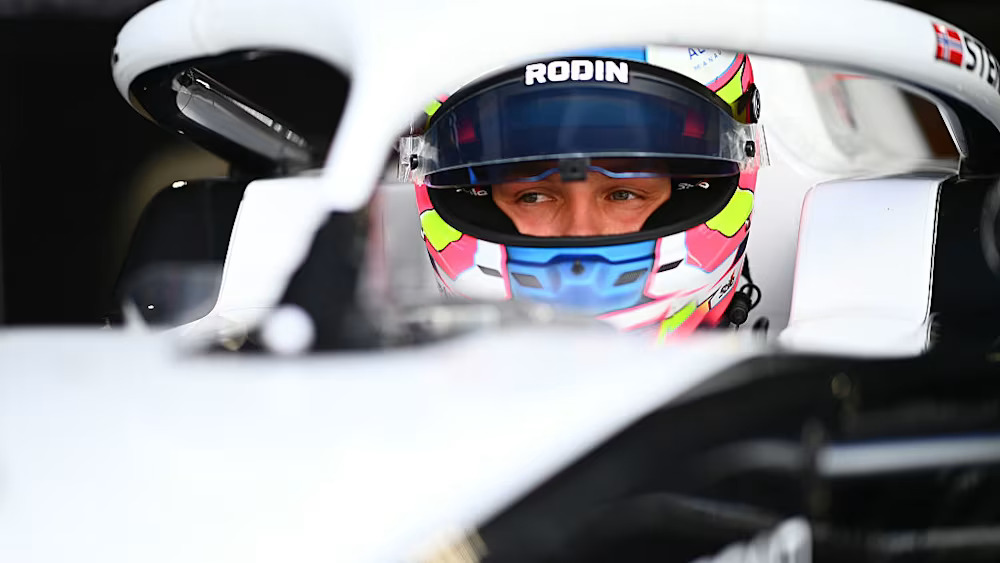
The journey through the junior ranks is rarely straightforward, but for Martinius Stenshorne, it’s one being shaped by a clear understanding of car balance, racecraft, and preparation as he heads into his 2026 F2 season with Rodin Motorsport.
He opened up on the key elements behind his development, from how he likes his car to feel, to the lessons carried over from karting, and the role simulation now plays in his progression.
Finding the Perfect Balance
For Stenshorne, car setup begins with a strong preference, and a clear dislike.
“First of all, I’m not a big fan of understeer,” he said. “I would say I like the car to have quite a good front end, especially in the mid-corner.”
“Apart from that, I think you cannot have a car that is too much in that one direction as well, so it’s about finding the right balance. But for sure, if anything, I like the car to be a bit more loose in the rear than having too much understeer.
“I think the best car I’ve driven wasn’t in a certain direction balance-wise.”
It’s an approach that highlights maturity beyond his years. While he favours a responsive front end and a slightly freer rear, he’s equally aware that outright performance comes from balance rather than extremes.
Stenshorne’s pathway through karting
Like many drivers on the single-seater ladder, Stenshorne’s foundations were built in karting, and it remains a crucial part of his racing DNA.
“Karting is all about racecraft. It’s about the way you drive because it is still not so far away from single seaters. It’s quite similar, but I think mainly it’s about the racecraft.”
“But with all the driving you learn, you still have a lot more help in formulas than you do in karting. You have an engineer that tells you exactly what to do as well, so I think about the racecraft quite a bit, how to do starts and also race with others.”
“It’s always the difficult situation to be in during the races. You can have someone behind pushing to try to overtake you, but you want to save your tyres, so it’s about finding the right balance.”
“You don’t want to use all your tyres too early either so you just have to do as best as you can and try to keep the guy behind whilst not using your tyres too much.”
Those lessons in racecraft, in particular, managing pressure while preserving tyres, remain central to his approach today.
Preparation for a weekend is everything
In modern motorsport, preparation often starts long before a driver arrives at the circuit, something Stenshorne is fully aware of.
Testing remainly highly important, but with race weekends very short in Formula 2, every second counts before hitting the track.
“Testing is quite important. It’s not always so easy, especially when you come to a new track with a new car as well, to learn everything before qualifying.”
“So, it’s a bit easier when you have a few sessions to get used to everything. But also the simulator prep before the weekend is quite important, just to know how you want to do everything.”
“I think most of the preparation though comes from the simulator. Also looking at onboards and data from previous years and seeing how other people are doing it.”
“But usually the track is not always so good in FP, so you kind of have to build into it and the tyres are not the same as they are in qualifying. So, there’s a few things to keep in mind, but the simulator is a good tool.”
From simulator work to studying data and onboard footage, his preparation reflects the demands of modern junior racing, where marginal gains can make all the difference.
Stenshorne settling in with Rodin in 2026
Adapting to new machinery can often be a challenge for young drivers, but Stenshorne’s pathway has offered some stability.
“In each category I’ve been in I have been with the same team, so I haven’t changed teams in the same category. So, I don’t really know about adapting between cars in the same championship and having to drive it differently.”
In 2024 and 2025, Stenshorne spent his FIA Formula 3 years with Hitech, before making the move to F2 with Rodin for his 2026 F2 season.
“But so far with Rodin, I’m feeling quite comfortable with the car.”
With racecraft sharpened through karting and continuously evolving in single-seaters, Stenshorne has the tools to manage the fine margins that define race weekends. Now embedded within Rodin, that consistency and familiarity are already allowing him to focus on extracting performance rather than adapting. If that combination clicks, his 2026 season could be where everything starts to come together.