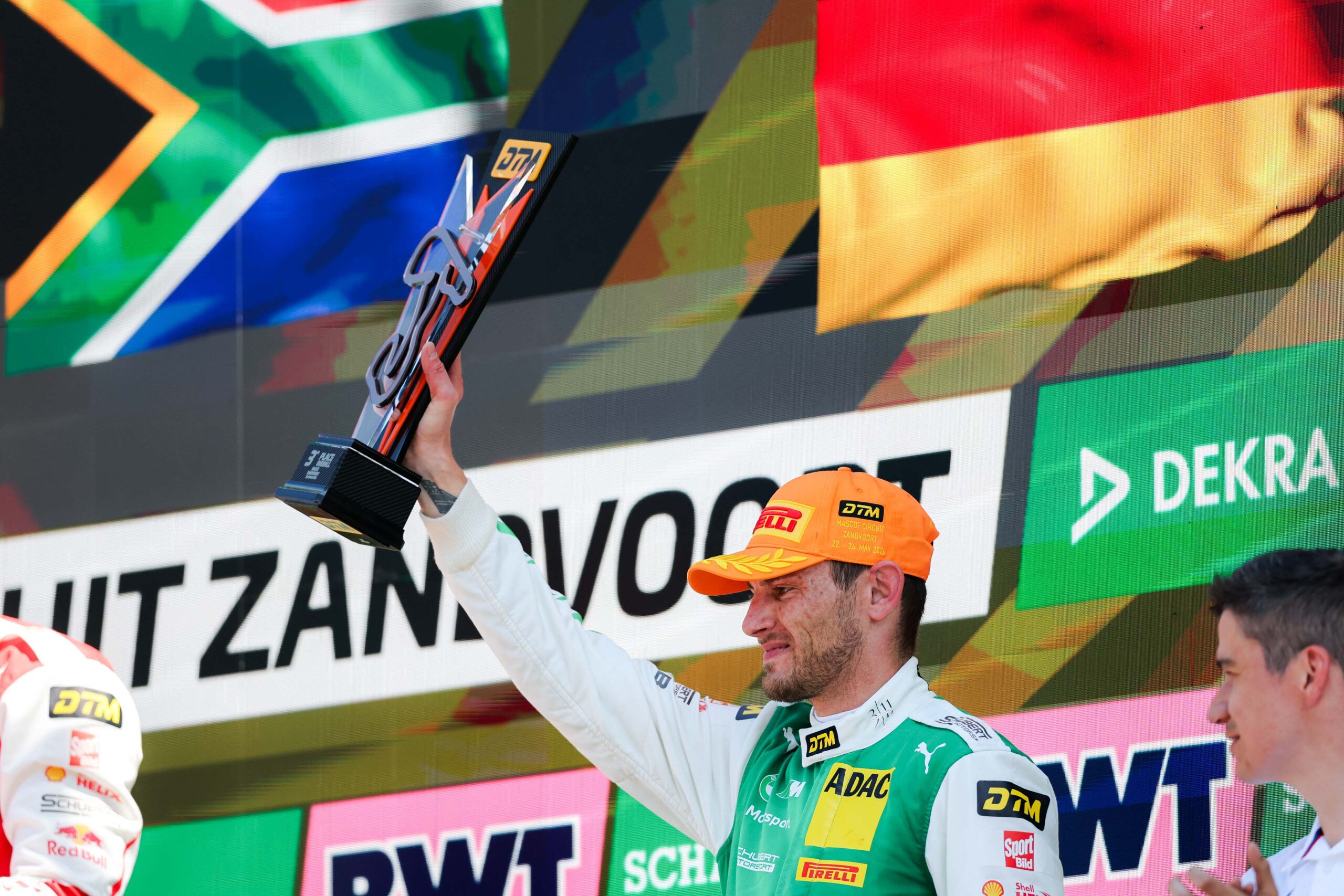
Marco Wittmann credited strong tyre management and the right strategic decisions for his recovery to third place in the second DTM race at Zandvoort.
The Schubert Motorsport driver remained outside the leading battle during much of the opening half of the race but carefully managed his tyres before using the Safety Car restart and an alternative pit-stop strategy to move through the field.
After delaying his second mandatory stop until lap 26, Wittmann emerged among the leading group and passed Thierry Vermeulen to claim third. He then spent the closing laps trying to attack Ben Dörr for second while simultaneously defending from the rapidly approaching Maro Engel.
The result completed a double podium for Schubert Motorsport, with Wittmann finishing behind teammate and race winner Kelvin van der Linde and Dörr’s McLaren.
Tyre management proves key to Wittmann’s recovery at DTM race 2 in Zandvoort
Wittmann explained that preserving his tyres during the first half of the race gave him a performance advantage following the Safety Car period.
“Yeah, I think we made the right strategy calls in the end, and tyre management was also a big factor. During the first half of the race, I tried to save the tyres. Then, after the Safety Car and the restart, I had more performance than the cars around me.”
“I think saving the tyres earlier was key because it allowed me to attack and overtake cars later on. Once again, the team made the right strategy calls, and we managed to move up the order. It was a cool race with a lot of fights.”
The alternative strategy brought Wittmann back into contention during the second pit-stop phase. However, his out-lap was far from straightforward, as he rejoined in the middle of a closely packed group and immediately had to defend his position.
“The out-lap after the second stop was difficult because there was a train of four or five cars, and I had to defend as hard as possible to keep my position. It worked out, and then we were running inside the top four or five. At that point, we knew it could be a good race for us.”
Wittmann and Dörr both charged past Vermeulen during the closing stages after the Ferrari driver began to lose performance. While Dörr moved into second, Wittmann followed him through to take the final podium position.
Caught between attacking Dörr and defending from Engel
Once in third, Wittmann found himself caught between two separate battles. The BMW driver attempted to pressure Dörr ahead while also monitoring Engel, who was quickly reducing the gap from behind.
“In the end, I had a good fight with Ben [Dörr], who defended well. At the same time, Maro [Engel] was closing quickly from behind. I don’t know whether he had a tyre offset or an advantage in tyre age.”
“It was difficult for me because, on one hand, I wanted to attack Ben, but on the other, I also had to defend from Maro. In any case, I’m very happy with P3 today.”
Dörr held on to secure his first official DTM podium, while Wittmann resisted Engel’s late pressure to finish third in Zandvoort. Engel crossed the line fourth and regained the championship lead, while Wittmann moved up to third in the standings with 52 points.
Wittmann explains contact with Feller
Earlier in the race, Wittmann was involved in contact with Ricardo Feller during the Safety Car restart. He described the incident as the result of a chain reaction as the field repeatedly accelerated and slowed before racing resumed.
“Yeah, it was a bit of a chain reaction during the Safety Car period. Just before we restarted the race, there was the typical braking-and-accelerating effect throughout the field.”
“It caught me slightly by surprise in the chicane and on the downhill section. When I had to brake, the car went fully into ABS, and I hit the rear of his car. There was nothing I could do at that point.”
Wittmann apologised to Feller after the contact and was relieved that neither driver suffered any significant consequences.
“I apologised to him, and luckily, nothing happened. Obviously, it wasn’t something I did on purpose. It simply caught me by surprise.”
“When the front tyres are unloaded on the downhill section, it is very easy for the car to go into ABS. At that point, you are almost a passenger while trying to slow the car down. That is basically what happened.”
Feller continued and eventually completed the top ten, while Wittmann remained in contention before making his late charge towards the podium.
New Pirelli tyre creates an additional challenge
Tyre behaviour was one of the defining elements of the race, with several drivers gaining or losing positions depending on how effectively they managed their tyres across each stint.
Wittmann believes demanding circuits such as Zandvoort and the Sachsenring naturally make tyre management difficult but also feels that the challenge can improve the racing in DTM.
“I mean, we know that tracks like Zandvoort and the Sachsenring are very demanding on the tyres. I think any time you race here, it becomes difficult.”
“But in the end, I think it also gives a cool show to the fans, and for us drivers, it’s a challenge. You need to manage the tyres in the race. On the other hand, in qualifying, you have one lap with very high peak performance, and then in the race, you need to manage the tyres. You can see who does a better job and who maybe suffers more.”
He added that the differences between cars can create a greater variation in performance throughout a stint, contributing to the changing order and late-race battles seen at Zandvoort.
“It’s also a little bit car-dependent, and this basically creates a mix in the race. Therefore, I think the tyres work well. Obviously, they have a little bit more degradation than last year’s tyre, but in the end, it’s the same for all of us.”
“If it gives a good show to the fans and also for us, then it’s definitely a good direction.”