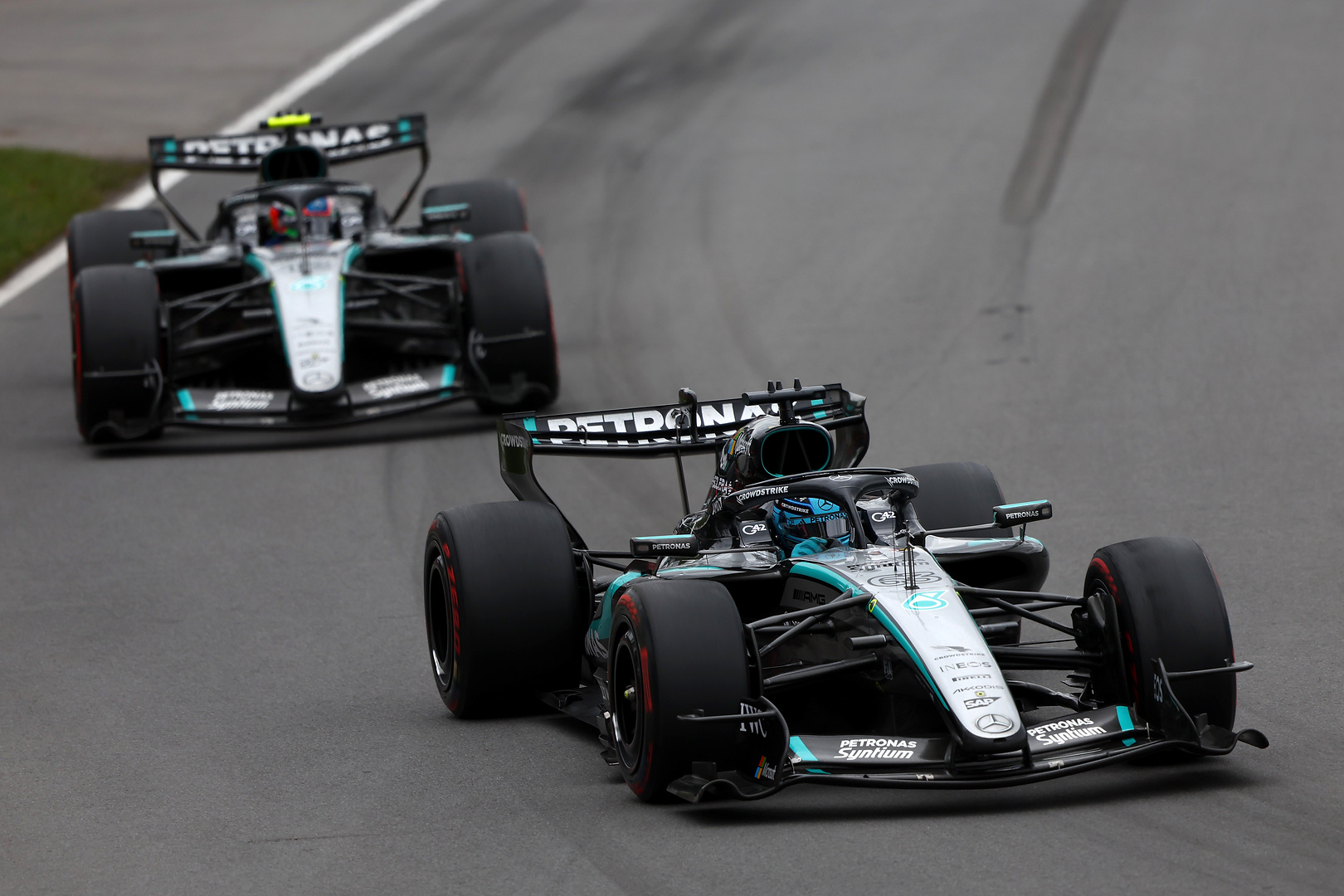
Following the unexpected DNF of George Russell from the 2026 F1 Canadian GP, Mercedes explained the reason for the W17 to suddenly come to a halt.
Mercedes driver George Russell was on for a successful weekend, having taken the win in the Canadian GP Sprint Race and looking a prime candidate for victory in the main event, battling with teammate and F1 Drivers’ Championship leader Kimi Antonelli for the lead.
However, Russell’s race came to a sudden stop on Lap 30 of the 2026 F1 Canadian GP, while he was leading. After his DNF, Russell watched as Antonelli secured his third consecutive win, extending his lead over the Briton in the Drivers’ Championship.
Mercedes Technical Director James Allison reveals the reason for Russell’s retirement from the 2026 Canadian GP
During a video debrief posted on the team’s X account, Mercedes Technical Director James Allison revealed the reason for Russell’s retirement from the Canadian GP. The team had just introduced its first upgrade package of the 2026 F1 season and was hoping for a “strong” showing, says Allison.
The F1 Canadian GP weekend was nearly perfect, but frustrations about the reliability of Russell’s W17 overshadowed the event, Allison notes.
“It was a big weekend for us – key because it was the weekend where we introduced our first major upgrade for the year, and we were looking for it to be strong.
“It was, but a weekend that was otherwise extremely good from a performance point of view was marred by the disappointment we all feel for letting George down with the reliability of the car.”
In the 2026 F1 Canadian GP debrief video, Mercedes’ technical director explained that a “catastrophic” battery failure was the reason for Russell’s early retirement from the race. According to Allison, the battery overheated, causing the failure, though Mercedes has yet to find the cause for the overheating.
“It was an engine kill that was caused by a failure in the battery, which just suffered a catastrophic failure a third of the way into the race and brought George’s race to an end there.
“We can see enough at the end of the race that the battery was fairly unhappy, some heat damage there, and we’ll have to figure out in the coming days and weeks exactly what caused that and put it right.”
Bradley Lord shares further details on Russell’s DNF
During episode 3 of the Nu Silver Arrows Radio Show, Deputy Team Principal Bradley Lord provided further insight into the failure that caused Russell’s DNF at the Canadian GP, mentioning that a “kill of the air system” in Turn 8 initiated the failures that ultimately led to his retirement.
“But, a sudden sort of kill of the air system on the car as he came into turn eight, and then that did a reasonable amount of damage afterwards as well.”
Lord mentioned that Mercedes will thoroughly review the data to determine the cause and prevent similar issues in the future. Mercedes will take some time to conduct this analysis because they need to ship the part back to the factory first.
“So, we got the car back, we were able to get the module out of it. It had to undergo some sort of pretty unusual safety procedures, and then has to be shipped back actually to the UK.
“So, it will be several months before the hardware gets back, and we need to really dig through the data to understand exactly what went wrong, and then how can we try and prevent a repeat on any of the other modules in the future.”
No warning signs for the impending failure
In the same episode of the Silver Arrows Radio Show, Evan Short, Head of Trackside Electronics and Controls, revealed that there were no warning signs from the data ahead of Russell’s 2026 F1 Canadian GP DNF.
Short further explained that Mercedes engineers typically do not follow the race on a TV screen, but became aware of Russell’s predicament when data transmission from the Briton’s car suddenly stopped.
“Like in this particular case, very little. So, we’re looking at the data. The first thing we see is a sudden stop in all the squiggly lines that we’re looking at.
“And of course, the first thing we think is, ‘Oh, something’s gone wrong in my laptop.’ And then you look around and think, ‘Oh, no one’s got any data.’ And actually, because we’re not watching, the engineers don’t tend to be watching the television live.
“That’s the first thing you notice. And it’s only when you then glance up at the TV and see the car grinding to a halt that you realise what’s really happened.
Since Mercedes won’t have the part back for a while, the team’s focus is currently on analysing the data from the Canadian GP to find “clues,” says Short.
“But as Bradley [Lord] says, you know, we’ve got a lot of folks going through that data now with a fine-tooth comb. So, while we won’t have the hardware back, I’m sure there’s going to be some clues in the seconds leading up to the failure.”