
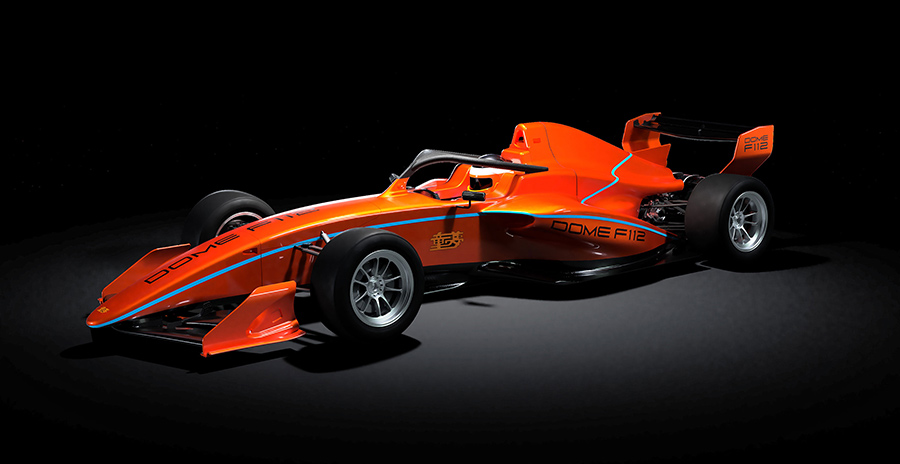
The Formula Regional Japanese Championship (FRJC) will introduce its next-generation car from the 2027 season as the series prepares to move into a new international-standard phase.
Promoter New Pacific Sports Marketing Co., Ltd. confirmed that FRJC will adopt the “2nd Gen” vehicle package after assessing safety, cost, parts supply, fairness and long-term series operation. The decision marks a major technical step for the championship, which has run first-generation Formula Regional machinery since its launch in 2020.
The new package will centre on the DOME F112 chassis, a Toyota GR Yaris-derived turbo engine developed and certified by Auto Tecnica Motori, and 15-inch Pirelli tyres. In addition, FRJC will require entrants and drivers to hold international licences from 2027 as it aligns more closely with global Formula Regional standards.
FRJC enters new international-standard phase
FRJC has framed the move as a major evolution for the championship and its role in Japan’s junior single-seater pathway.
“Entering a new stage as an internationally-standard series.”
That direction reflects the championship’s wider purpose. FRJC launched in 2020 under FIA Formula Regional regulations and has since provided a platform for young drivers aiming to progress through the formula racing ladder.
However, the series now faces a changing operational landscape. Rising logistics costs, increasing component prices and the need for a stable parts supply system have all shaped its decision-making. Therefore, FRJC has chosen to introduce the 2nd Gen car from 2027 rather than continue with the current first-generation package.
DOME F112 chassis brings upgraded safety and engineering tools
The new FRJC car will use the DOME F112 chassis, which complies with the enhanced 2026 FIA Formula Regional 2nd Gen regulations. The chassis includes updated front impact, rear impact and survival cell structures, giving the series a significant safety upgrade.
Moreover, the DOME F112 introduces a new third element in the suspension. This addition allows teams to adjust ride height and pitching control more independently, giving drivers and engineers a more advanced platform for set-up work.
The chassis also follows the FIA’s latest aerodynamic direction. DOME has developed the car around an overtaking-focused aerodynamic concept, with a delta-style front wing and rear winglets that meet current aero standards.
Through wind tunnel testing and CFD analysis, DOME has refined the aerodynamic package to place greater emphasis on downforce and engineering development. As a result, FRJC expects the car to offer a stronger learning environment for drivers and engineers.
The DOME F112 will also retain the Marelli control system already used in the current DOME F111/3, maintaining continuity with Formula Regional’s global technical standards.
Suspension options offer different handling characteristics
FRJC has also highlighted a difference in the new car’s handling philosophy. Compared with the DOME F111/3, which offers mild characteristics suitable for a wide range of drivers, the DOME F112 will feature a standard suspension geometry with a slightly more advanced set-up.
That configuration will increase steering information and give drivers a sharper technical challenge. However, teams will still have the option to select the more conventional mild handling characteristics.
Consequently, the new car should allow FRJC to balance accessibility with a more demanding learning environment. That flexibility matters in a category designed to prepare drivers for higher levels of single-seater racing.
Toyota-based turbo engine joins the package
The DOME F112 will run with the ATM163T engine, based on the 1.6-litre inline three-cylinder turbocharged G16E-GTS unit used in the Toyota GR Yaris.
Auto Tecnica Motori, the Italian constructor that worked on the first-generation FRJC engine package, handled development and certification. Meanwhile, TOM’S Co., Ltd. will manage engine supply, maintenance and technical support in Japan.
By adopting the latest turbo unit, FRJC aims to combine strong reliability with improved performance. Importantly, the championship noted that the 2nd Gen package will not bring major changes to the power-to-weight ratio, even though it will deliver a major improvement in safety performance.
Pirelli 15-inch tyres confirmed
Pirelli will supply the sole tyre for the 2nd Gen FRJC car, with the championship adopting the 15-inch tyre format used in national Formula Regional championships under the FIA framework.
This move further aligns FRJC with international Formula Regional standards. It also gives drivers experience with a tyre package that reflects the direction of the wider category.
The reference sales price under the 2026 FIA cost cap sits at €111,500 for the chassis and €35,175 for the engine. However, the FIA will announce 2027 prices at the beginning of the year based on the OECD Consumer Price Index.
FRJC outlines 2027 introduction timeline
FRJC has also published the first key dates for the transition. Application acceptance will begin in early July 2026, while engine acceptance and maintenance will start from mid-July 2026.
Vehicle deliveries will begin from February 2027. After that, the series plans to hold joint testing in early April 2027 before the 2027 season begins from mid-April onwards.
That schedule gives teams time to prepare for the new technical package, complete maintenance processes and understand the DOME F112 before the first competitive event.
2nd Gen move strengthens FRJC’s development role
The 2027 car introduction represents more than a simple equipment change. FRJC has used first-generation machinery since 2020, but the new package will move the championship closer to the latest FIA Formula Regional framework.
The DOME F112’s upgraded safety structures, refined aerodynamic concept, more advanced suspension options and Toyota-based turbo engine all point to a series that wants to raise its technical level while maintaining stable operations.
Furthermore, the move to an international-format series will place FRJC more firmly within the global junior single-seater landscape. With international licences required from 2027, the championship will offer a more globally aligned environment for drivers, teams and engineers.
As a result, FRJC will enter a new chapter in 2027, combining improved safety, modern performance standards and a clearer international identity.