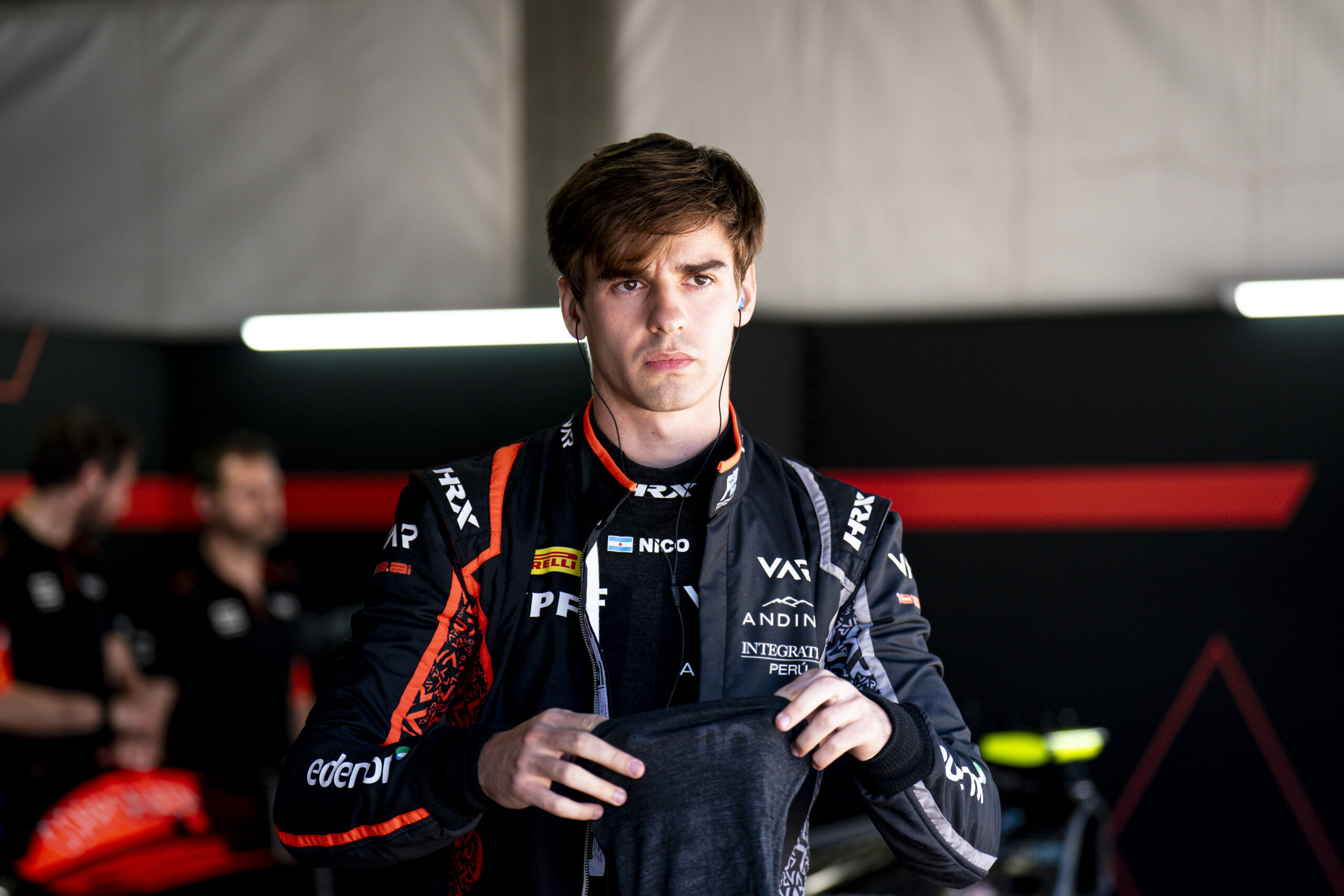
Nicolás Varrone’s route to Formula 2 has not followed the traditional junior single-seater ladder.
The Argentine joined Van Amersfoort Racing for the 2026 Formula 2 season after building much of his reputation in sports cars. Before making the move, he had already won the LMGTE Am class at the 2023 24 Hours of Le Mans, claimed the FIA World Endurance Championship title in the same category and added further endurance experience across GTs, prototypes, LMP3, LMP2 and Hypercars. His record also includes a Daytona 24 Hours class win, underlining why his switch to Formula 2 stood out so sharply.
Varrone’s move stands out because most Formula 2 rookies arrive through Formula 3, Formula Regional or Formula 4. He instead reached the grid after proving himself in endurance racing, making his 2026 season less of a conventional promotion and more of a rare late single-seater opportunity.
Speaking exclusively to Pit Debrief, Varrone traced his love of racing back to a childhood surrounded by motorsport.
“Since even before I have memory, I was always playing with cars. That’s what my family says. I came from a racing family and my dad used to have a race team when I was young. My dad used to race also, my mum also, back in the day.”
“So yeah, we come from a family of drivers. When I was young, from two to five, five to sixteen years old, I was always in my dad’s team workshop with race cars, watching races at home. Then I started at seven years old, the first time I went to a go-kart track near home. I went on a Saturday and that’s how it all started.” He continued, “I never stopped.”
“I always loved to be a racing driver and honestly, to make a career out of it, it was always my goal. When you start and you’re young, you need to find a sponsor and try to make your way, and you know you’re going to make it. So I realised it quite late because it’s not easy. For sure, you are good and you win championships and races, and you think you can do it, but it’s not only about that.”
“You need to like motorsport and it has been a few years since I turned it into my main job, my job, let’s say. That was my goal always, so yeah, I’m really happy about it.”
Endurance success before F2
Varrone did not arrive in Formula 2 as an unknown quantity. He arrived as a proven endurance driver who had already earned major results on some of the biggest stages in sports car racing.
That success makes his Formula 2 move especially interesting. Varrone could have continued building a career in endurance racing, where he had already won major races and secured manufacturer-level opportunities. Instead, he chose to take a chance on a category that demands a very different skill set and offers little time to adapt.
Why Varrone took the Formula 2 opportunity
Varrone’s switch to Formula 2 came after years of success in closed-cockpit machinery. However, he said the move gave him the single-seater chance he had never properly had earlier in his career.
His career developed through opportunity rather than a linear ladder. Instead of progressing from F4 to Formula Regional, F3 and then F2, Varrone built his name by making himself valuable in endurance racing and earning drives through performance, shootouts and professional relationships.
“Yeah, that’s what everyone asked me, just because my career has been quite crazy and I never had the chance to do a proper season in single-seaters, like a career, because I never had the money.”
“Single-seaters to come to F1 and all these kinds of roads, it’s not only about being good, it’s just about having the money to do all those steps, like F4, FREC, F3, then F2. It costs a lot of money and if you’re good, you can get drives for free and people pay for your seat because they want to drive with you, and that’s how I made my career.”
“Basically racing with gentlemen that wanted to race with me, doing shootouts, kind of getting the seat and going to race.”
A reignited chance
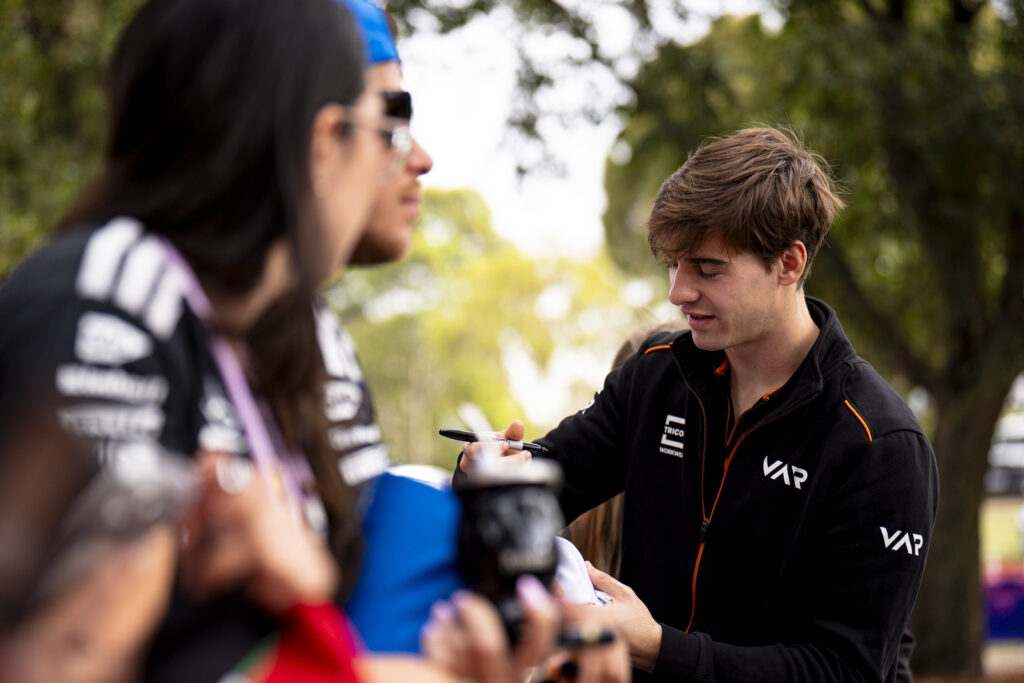
“I never had this chance and now, with the whole Argentinian passion for F1 coming back, there was this chance with some people that came. Actually, a guy from Argentina that is working with us kind of made this happen.”
“He came with this idea of going to F2, and it was a bit weird at the beginning because it was not what I expected or I never had it in mind. And I said, you know what, I never had this chance. I have it now for some reason, so I should take it and let’s see how I do.”
F2 demands a different rhythm
Although Varrone had single-seater experience earlier in his career, Formula 2 represented a major change after his recent years in endurance racing.
The Argentine did not simply move into a different car. He moved from shared machinery, long stints and multi-class racing into one of the most intense single-seater categories in the world. Formula 2 demands immediate pace, precise tyre preparation, standing starts and a very different approach to wheel-to-wheel racing.
“Yeah, it’s honestly not easy. It’s really, really tough and it’s a lot of hard work from my side to get up to speed quickly. There are a lot of good drivers here that are driving in the series for quite long and also coming from all the single-seater ladder, which really helps.”
“For me, I had three test days in Abu Dhabi, three test days in Barcelona at the beginning of the year, and I tried to be up to speed as quick as possible. It’s not been easy. A lot of different technique of driving and things you get used to, but we’re getting there every race and that’s what we want, to be competitive as soon as possible.”
Varrone relearns key habits
Varrone said the braking demands, steering feel and standing starts have all required adjustment.
“There were a lot of things. I mean, and I’m still learning, like braking, how you brake in this car is so different. To get used to the deceleration and how you manage the braking, how you pick the braking and the way you use the brakes is so different.”
“And also the fact to have no power steering, it’s something that is different, the feeling that it gives you. So just get used to that and trust it a bit more.”
“And street circuits, here Monaco, first time for me ever, so it’s not an easy one. So yeah, basically, re-learning a lot of stuff. It’s not easy, a lot of information, but also standing starts. I’ve never done since a long time ago, so yeah, there’s a few things that I’m learning every time.”
The answer underlined how much of Varrone’s rookie season has centred on muscle memory. His experience gives him race craft, discipline and perspective, but the Formula 2 car asks different questions under braking and through corner entry. That has made every session part of a wider adaptation process.
Monaco adds another new challenge
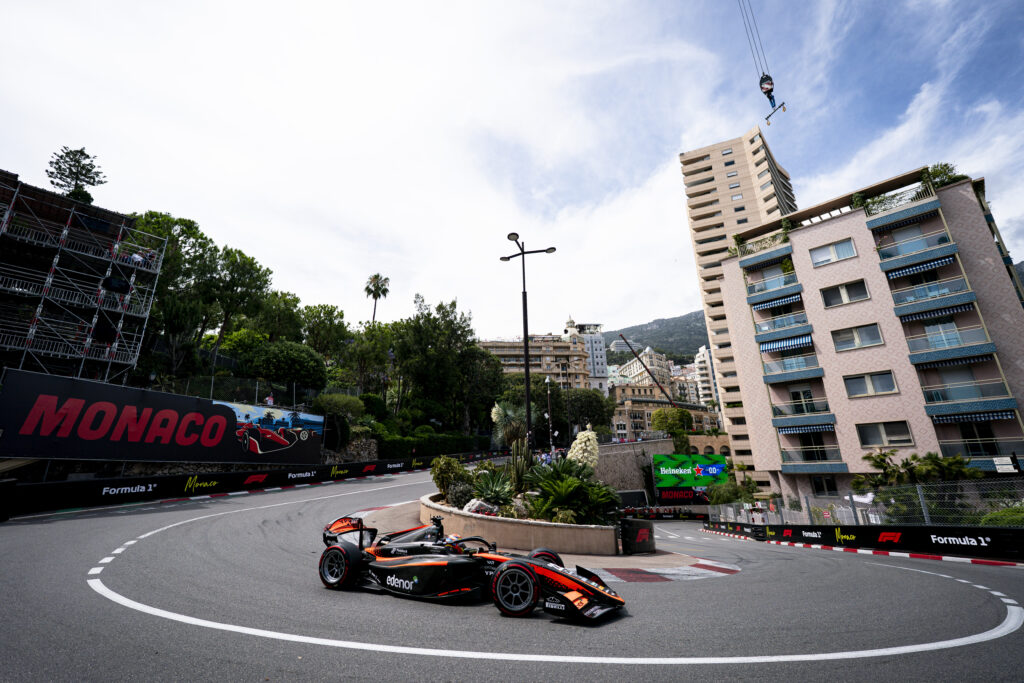
Varrone’s rookie Formula 2 campaign also brought him to Monaco, one of the most demanding street circuits in motorsport. For a driver still adapting to a Formula 2 car, the narrow streets of Monte Carlo added another challenge. Monaco gives drivers almost no margin for hesitation.
“It’s really cool, it’s a new experience for sure. We have done Free Practice now and it’s not been easy. Some bits, getting used to it, the first laps, it was quite tense inside the car because it’s not something that I do often.”
“But yeah, then just getting the rhythm and getting a bit more comfortable and getting up to speed. For sure, there’s a lot of things to improve and to learn, but to maximise. But I think it’s part of the process.”
“A lot of people ask me, ‘why are you doing this?’ ‘Why are you doing this change?’ And I feel like in life, if there’s this opportunity, you have to take it because you don’t know what could be the next step or what can happen because of this.”
Varrone says adaptability defines top drivers
Varrone’s career has already taken him through GTs, LMP3, LMP2, prototypes and Hypercars. That varied background shapes how he views modern racing.
That background also explains why the Argentine driver does not view switching categories as a weakness. For him, moving between cars has become part of his identity as a driver, even if Formula 2 has demanded the steepest adjustment so far.
“It’s always the most important thing. I really feel like the really good drivers are the ones that adapt to different cars in different situations.”
“In my career last year, I’ve driven every type of car. Even in endurance, I’ve driven GTs, Prototype, LMP3, LMP2s, Hypercars, kind of doing one-off races. You have to love it, you have to be a quick driver. You can adapt to different things.”
“And even though I feel like this is really the biggest change I made in my career, I feel like I need to be fast as quickly as possible because that’s what good drivers do in a way.”
“When you see, I don’t know, [Juan Pablo] Montoya. I think he drove everything. F1, IndyCar, NASCAR, whatever, and he won in every single one of them. So I think that’s what makes a really good driver and yeah, that’s what I aim for.”
IndyCar remains an ambition
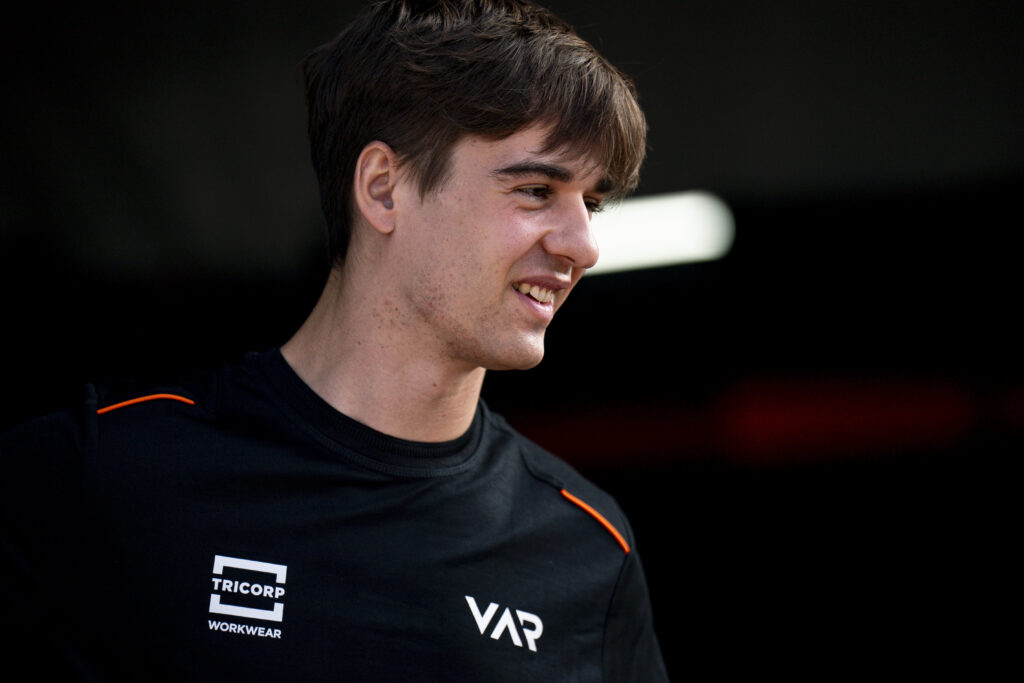
Formula 1 remains the dream, but Varrone also named IndyCar as a series he would like to try.
“I must say, for sure, F1. I think everyone wants to be there one day and I wish one day I can drive a Formula 1. But one series outside of that is IndyCar. I really love IndyCar. I’m a big fan of it and I think it’s a really cool series and hopefully in the future I have the chance to be.”
A reference point for young Argentine drivers
Varrone’s move to Formula 2 has made him a visible reference point for younger drivers from Argentina and Latin America. With more Latin American drivers emerging across karting and junior single-seaters, Pit Debrief asked what it means to him to carry that role.
“I mean, I think it’s quite cool because, like them, you have their careers and respect their careers and having them as a reference. Yeah, it’s pretty cool now to be on the other side.”
“Once you are in the rhythm of racing and trying to beat your spot, when you look back, it’s really satisfying that we get to be in that place and I get to be in that place.”
“I’m always pretty nice if they come up. At least the other day, I was having dinner with one of the younger guys that is racing in the lower single-seater from Argentina and just trying to give them advice for their careers and for the future, what I have experienced and what has worked for me.”
“So yeah, it’s really nice to be on that side and I really appreciate it.”
Varrone’s advice
When asked what his main advice would be, Varrone pointed to the importance of treating every lap as an opportunity.
“For me, take every lap you do in a race car as the last one of your life because, in this sport, at least for me, it’s super expensive and you don’t have the chance to be driving all the time unless you are a millionaire, which a lot of people are, but in my case, that was not my case.”
“I just try to take 100% out of every lap I’ve done in any race car, any day that I’m in a race car, just because you don’t know who is there, you don’t know when the opportunity can come. Whenever you’re on the track, just maximise everything and go 100%, full push. For sure, it’s difficult, but just give it your all and someday someone will come and some opportunity will come.”
His advice mirrors the way he built his own career. Varrone did not always have the security of a long-term junior programme. Instead, he had to turn individual chances into the next opportunity, which made every test, race and one-off appearance matter.
Varrone still feels connected to endurance racing
Although Formula 2 has become his main focus this year, Varrone has not stepped away from endurance racing completely.
“No, no, no, I don’t think it really stalled because I’m still doing endurance racing. I still do some racing. I will do this year, now in the near future and at the end of the year. I’m still involved there.”
“But yeah, I just feel like I’m missing something. Now it feels weird to be here in Monaco when tomorrow is Le Pesage in Le Mans and I feel like I should be there because I’ve been doing it the last four years in a row. And now it’s like something will be missing this year.”
“There are a lot of races that for sure I will miss, like going, I don’t know, IMSA, Watkins Glen is one of my favourites. Watkins Glen is my favourite track and not going there this year will feel weird, but in a way it just gives more value to what you have done. If you’re missing it, it’s because it’s a big thing for you. So for sure I will miss it, but I will be watching it 100%.”
Varrone wants a legacy built on versatility
Varrone does not want people to remember him only for one championship or one type of car. Instead, he hopes his career shows that he could be competitive in anything he drove.
That makes his Formula 2 season about more than results alone. Varrone is trying to prove that a driver can build an unconventional career, move between disciplines and still deserve recognition at the highest level.
“That’s a tricky one and I don’t know. I just want to be like, maybe everyone wants to be remembered as a great driver, but I feel like from how my career has been, I want to be one of those drivers that is remembered that every car that he’s driven or every series he’s driven, he was super fast and super competitive.”
“Because I tell you, at the moment, it’s not like I did a normal career driving all these different types. I’ve been driving in everything, so I really want to be one of those guys that have driven everything, that really won in a lot of different series.”
“And then, kind of like Montoya’s time. He was racing everywhere and he was fast, and then he jumps in anything he needs to do. As far as I can go, that’s what I got.”
For Varrone, Formula 2 represents both a risk and an opportunity. He did not arrive through the usual junior ladder, but that difference gives his story its identity. After proving himself in endurance racing, he has taken on the biggest single-seater challenge outside Formula 1 and now wants to show that versatility can be one of his greatest strengths.