The countdown to the 2026 24 Hours of Le Mans begins well before the race itself. From Friday, 5 June, the event enters its traditional “Great Week”, with scrutineering in the heart of Le Mans city centre opening a packed programme of technical checks, fan activities, practice sessions, qualifying, Hyperpole and, finally, the 24-hour race.
The 94th running of the 24 Hours of Le Mans will take place on 13–14 June 2026 at the Circuit de la Sarthe, with the race scheduled to begin at 16:00 local time on Saturday, 13 June and end at 16:00 on Sunday, 14 June. The official Le Mans programme begins on Friday, 5 June, with scrutineering and the M24 Motorsport Museum both listed from 10:00 to 19:00.
Key 2026 24 Hours of Le Mans schedule
Friday, 5 June
- 10:00–19:00 — Scrutineering Day 1
Saturday, 6 June
- 09:00–14:00 — Scrutineering Day 2
- 15:00–16:00 — City centre procession
Sunday, 7 June
- 10:00–13:00 — Test Day / Free Practice 1
- 15:30–18:30 — Test Day / Free Practice 2
Wednesday, 10 June
- 14:00–17:00 — Free Practice 1
- 18:45–19:15 — Qualifying: LMP2 & LMGT3
- 19:30–20:00 — Qualifying: Hypercar
- 22:00–00:00 — Free Practice 2
Thursday, 11 June
- 14:45–17:45 — Free Practice 3
- 20:00–20:20 — Hyperpole 1: LMP2 & LMGT3
- 20:35–20:50 — Hyperpole 2: LMP2 & LMGT3
- 21:05–21:25 — Hyperpole 1: Hypercar
- 21:40–21:55 — Hyperpole 2: Hypercar
- 23:00–00:00 — Free Practice 4
Friday, 12 June
- 16:00–19:00 — Drivers’ Parade
Saturday, 13 June
- 12:00–12:15 — Warm-up
- 13:35–15:00 — Grid walk
- 15:00–15:45 — Start ceremony
- 15:51 — Formation lap
- 16:00 — Race start
Sunday, 14 June
- 16:00 — Race finish
- 16:10 — Podium ceremony
Scrutineering opens the “Great Week” in Le Mans city centre
The 2026 programme begins away from the circuit, with scrutineering taking place in the centre of Le Mans. The official schedule lists scrutineering from 10:00 to 19:00 on Friday, 5 June, marking the start of the event’s traditional build-up. The ACO describes this period as the beginning of the “Great Week” of the 24 Hours of Le Mans, with technical and administrative checks held in the heart of the city.
Scrutineering is one of the elements that gives Le Mans its identity. It is a formal requirement, but it is also a public spectacle. Cars, drivers and teams are presented in front of the fans before the competitive sessions begin, allowing the city itself to become part of the event.
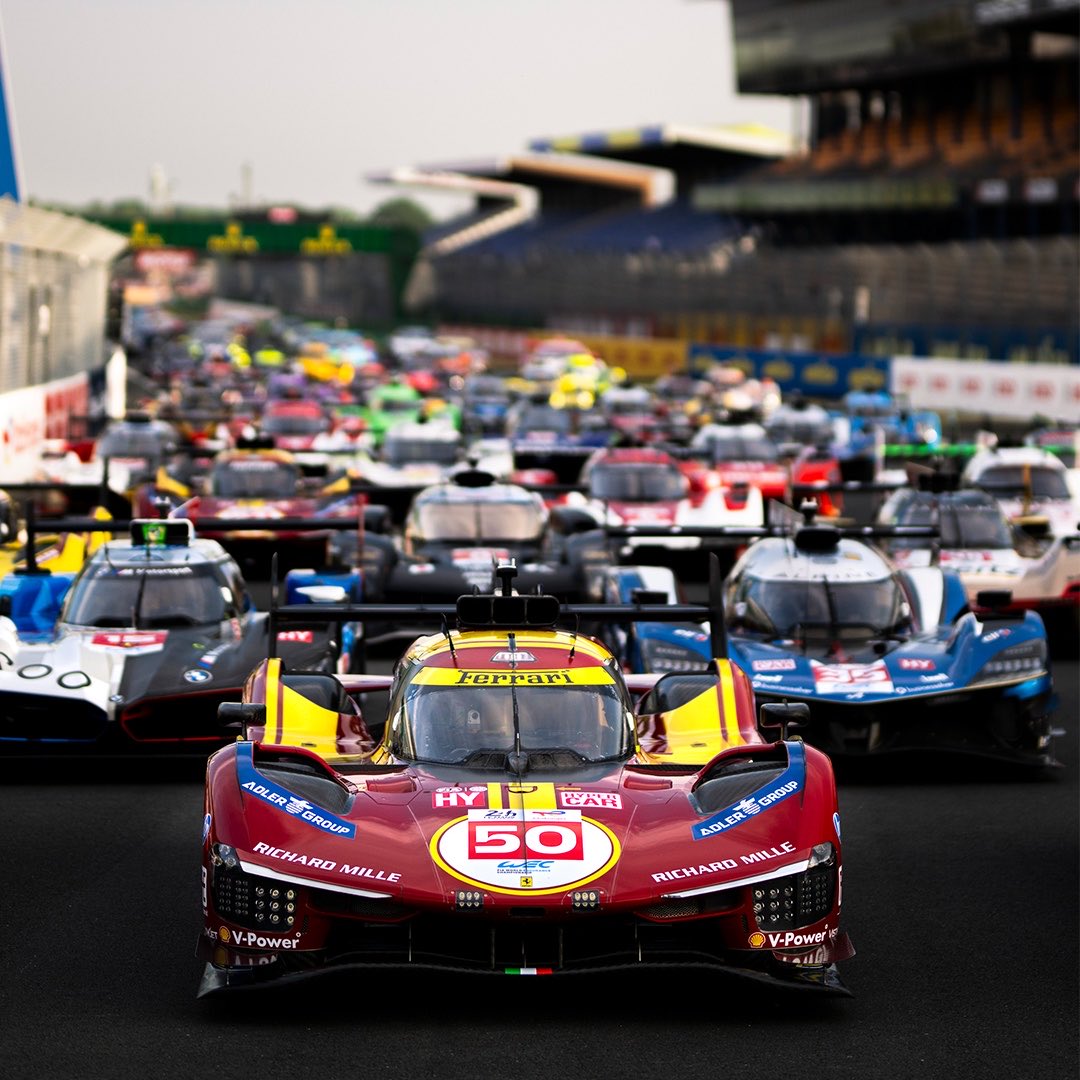
For the teams, this is where race week properly starts. Cars must pass the necessary checks before turning a competitive lap. For fans, it is an early chance to see the machinery up close, especially across the three main categories: Hypercar, LMP2 and LMGT3.
Test Day begins the technical work
After scrutineering and the city-centre build-up, Sunday, 7 June gives teams their first major running at the Circuit de la Sarthe. Test Day is scheduled across two three-hour sessions, with the first from 10:00 to 13:00 and the second from 15:30 to 18:30.
This day is crucial because Le Mans is not a standard circuit. Its long straights, heavy braking zones, high-speed Porsche Curves and changing grip levels mean teams need time to understand how their cars behave across a full stint. Test Day is not only about speed. It is about checking systems, evaluating tyre performance, confirming aerodynamic balance and giving drivers time to settle into traffic across the 13.626 km layout.
For new drivers, Test Day is especially valuable. Le Mans requires confidence in mixed-class racing, where Hypercars, LMP2s and LMGT3s share the same circuit but operate at very different speeds. The rhythm of overtaking, being overtaken and managing closing speeds is central to surviving the race.
Wednesday brings practice, qualifying and night running
The main competitive programme intensifies on Wednesday, 10 June. Free Practice 1 runs from 14:00 to 17:00, giving teams three hours to work through race setup, long-run balance and driver rotation.
Qualifying follows in the evening. LMP2 and LMGT3 qualifying is scheduled from 18:45 to 19:15, before Hypercar qualifying from 19:30 to 20:00. These sessions determine who progresses to the Hyperpole phase, making them one of the first major competitive turning points of the week.
The day then ends with Free Practice 2 from 22:00 to 00:00. Night running is one of the most important parts of Le Mans preparation. A large portion of the race takes place in darkness, and drivers must adapt to reduced visibility, changing reference points, cooler track temperatures and the added pressure of traffic management at night.
For engineers, this session also provides valuable information. Tyre warm-up, brake behaviour, lighting systems and driver comfort all become more significant once darkness falls. A car that feels manageable in the afternoon can behave very differently at midnight.
Thursday’s Hyperpole sessions set the front of the grid
Thursday, 11 June is one of the most significant days of the week. Free Practice 3 runs from 14:45 to 17:45, before attention turns to the fight for pole position.
The Hyperpole format separates the classes. LMP2 and LMGT3 begin with Hyperpole 1 from 20:00 to 20:20, followed by Hyperpole 2 from 20:35 to 20:50. Hypercar then takes over, with Hyperpole 1 from 21:05 to 21:25 and Hyperpole 2 from 21:40 to 21:55.
Hyperpole is the sharpest single-lap contest of the week. It gives teams a chance to show the outright pace of their cars without the same emphasis on stint management that defines the race itself. However, Le Mans is rarely decided by qualifying pace alone. A strong starting position is valuable, but the race will still depend on reliability, pit work, tyre management, driver discipline and the ability to avoid trouble over 24 hours.
After Hyperpole, teams return to longer preparation with Free Practice 4 from 23:00 to 00:00. This final night session gives crews another opportunity to test race systems and confirm the car’s behaviour in darkness before the pressure of race day.
Friday returns the spotlight to the fans
Friday, 12 June provides a pause from official 24 Hours track sessions, but not from the spectacle of the event. The Drivers’ Parade is scheduled from 16:00 to 19:00, bringing competitors back into the city before the race.
The parade is one of the defining traditions of Le Mans week. It reinforces the connection between the race, the drivers and the city that hosts the event. For fans, it is one of the most accessible moments of the week. For drivers, it is a final public celebration before the focus narrows fully to the race.
This balance between competition and culture is part of what makes Le Mans different from a conventional race weekend. The event is not confined to the circuit. It spreads across the city, giving the 24 Hours its festival-like atmosphere.
Race day begins with final checks before the 16:00 start
Saturday, 13 June begins with a short warm-up from 12:00 to 12:15. Although brief, the session is important. Teams use it to check systems, confirm that any overnight changes are functioning correctly and ensure that the car is ready for the start.
The build-up then moves into its ceremonial phase. The grid walk runs from 13:35 to 15:00, followed by the start ceremony from 15:00 to 15:45. The formation lap is scheduled for 15:51, before the 2026 24 Hours of Le Mans begins at 16:00.
From there, the schedule becomes simple but brutal: 24 hours of racing. The field will race through the afternoon, evening, night, sunrise and the following afternoon before reaching the finish at 16:00 on Sunday, 14 June. The podium ceremony is scheduled for 16:10.
A schedule that reflects what makes Le Mans unique
The 2026 24 Hours of Le Mans schedule shows why the event remains one of motorsport’s most demanding and distinctive weeks. It begins with public tradition, moves into technical preparation, builds through qualifying and Hyperpole, pauses for the drivers’ parade, and then culminates in a full day and night of racing.
Every part of the week has a purpose. Scrutineering introduces the cars and drivers to the public. Test Day gives teams essential circuit time. Practice sessions shape race setups. Night running prepares drivers for one of the event’s biggest challenges. Hyperpole creates the first major competitive drama. Warm-up confirms final readiness.
By the time the race starts at 16:00 on Saturday, the teams will already have completed more than a week of preparation and pressure. That is the nature of Le Mans. The race lasts 24 hours, but the challenge begins long before the clock starts.
Pit Debrief will be providing live updates throughout the race. Follow along via our live blog.