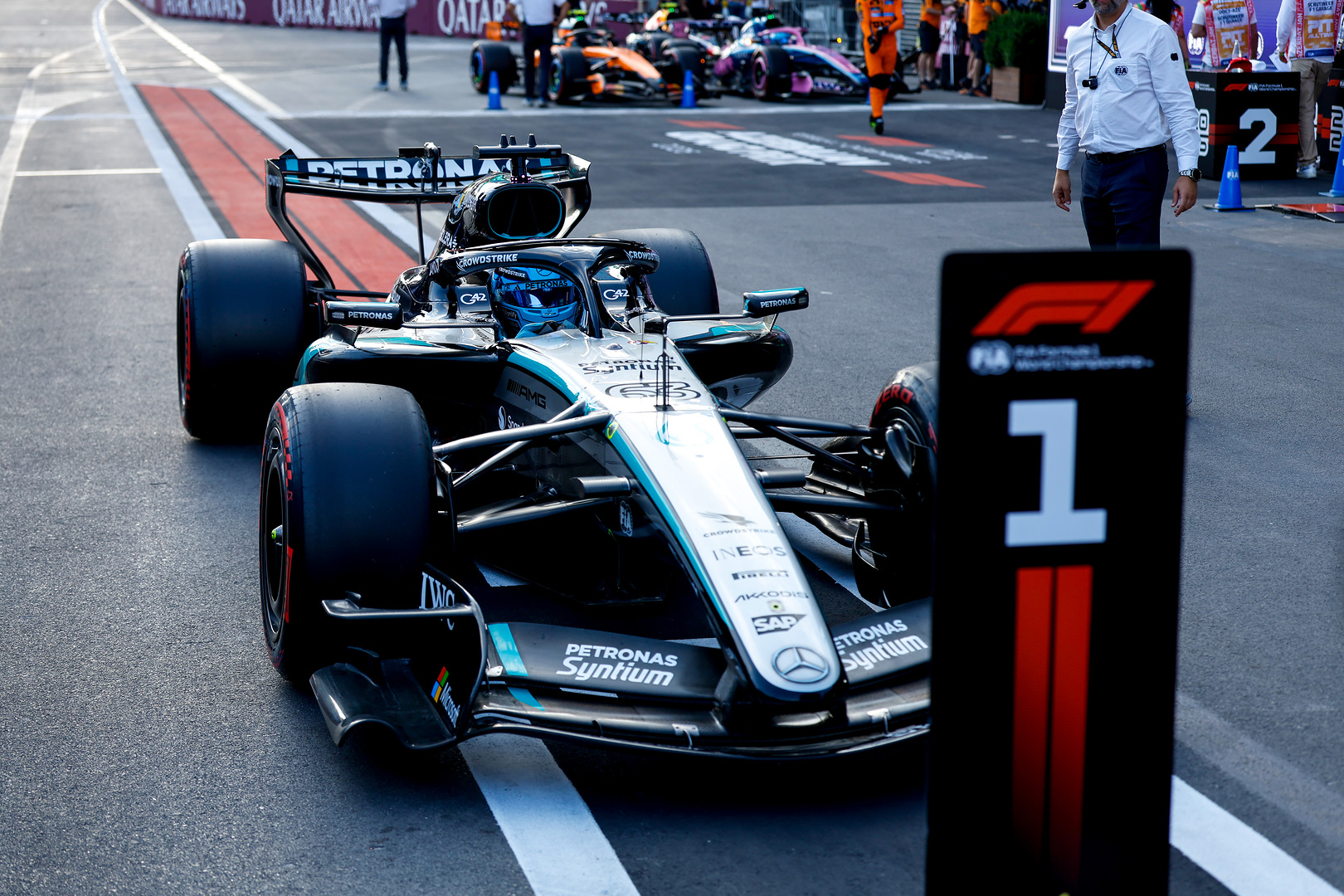
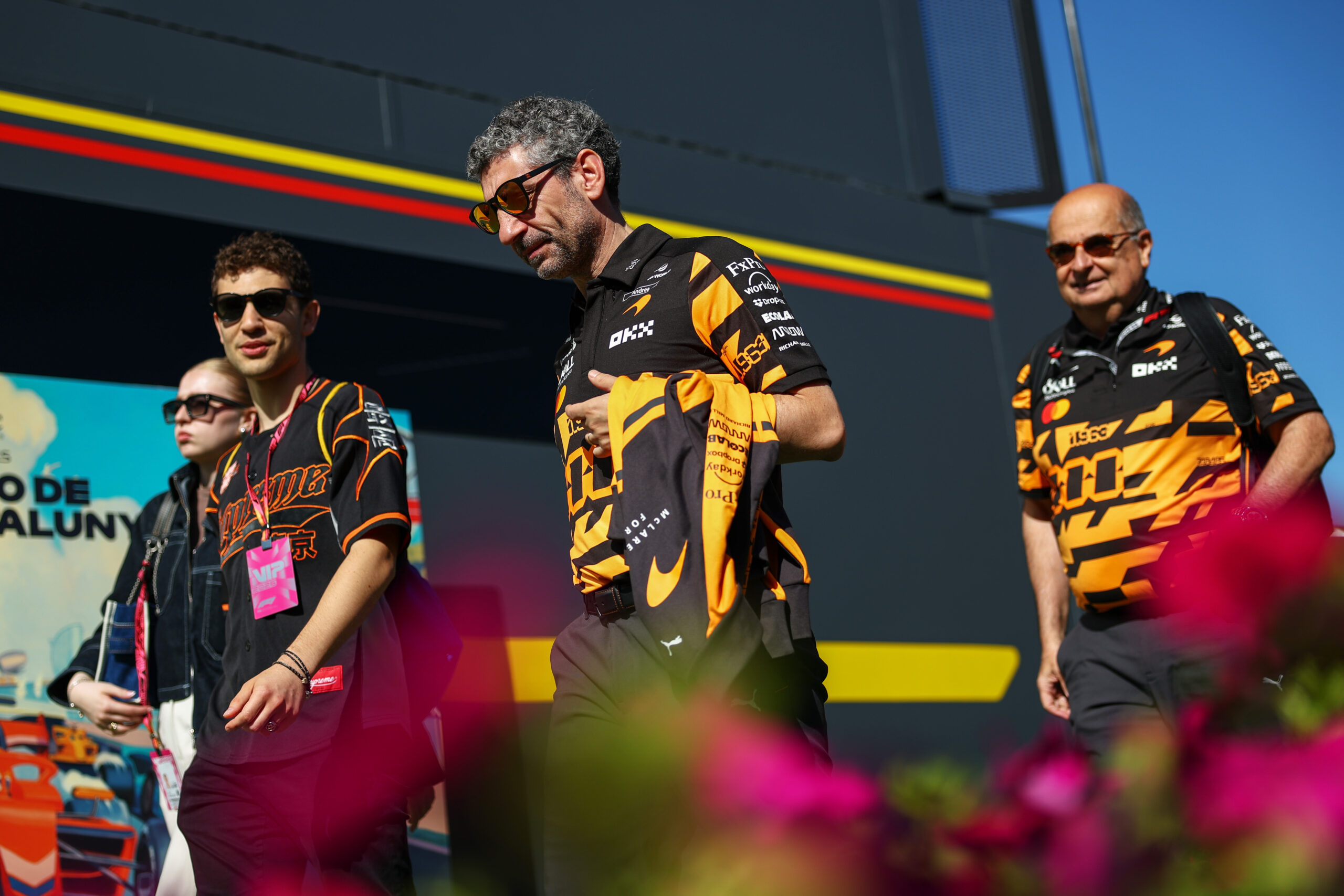
Andrea Stella believes George Russell handled the yellow flags during Qualifying, skilfully on his way to pole position at the 2026 F1 Austrian GP, describing the Mercedes driver’s response as “on the edge” but acceptable.
Russell completed a 1:06.113 during the closing moments of Q3, beating Charles Leclerc by 0.236s. However, Max Verstappen had crashed at Turn 9 moments earlier, triggering a single yellow flag as Russell approached the final sector of his lap.
The Mercedes driver lifted before the corner but continued his attempt and crossed the line fastest. His reaction sparked debate over whether he had slowed sufficiently, although officials accepted the lap and allowed him to retain pole.
McLaren team principal Stella reviewed the GPS data and concluded that Russell had taken clear action without sacrificing more time than necessary.
Stella sees clear action from Russell
Russell faced a difficult balance as he approached the yellow-flag zone. He needed to demonstrate that he had reacted to the danger while preserving enough of his advantage to complete the lap.
Stella said the GPS overlays showed Russell reducing his speed before braking for Turn 9. Although the lift cost him time through the corner, he had built a large enough margin earlier in the lap to remain fastest.
“So for what I saw from the GPS overlays, I think Russell has done a good job of executing a lift. I can only see that the speed reduces before braking, losing a little bit of time through corner nine, at the same time losing little enough to actually be in pole position.”
“This, I think, is subject to the interpretation of the stewards as to the fact that this action complies with the requirements of a yellow flag, but there is action.”
“And I think we have to recognise that while drivers are incredibly able and good in executing the standard driving, sometimes they are also good at executing some manoeuvres that may be required in yellow flag, may give you justification and rational that the stewards can interpret like they did.”
“So I think it was a kind of a case on the edge, but no particular concern with the fact that this has been accepted by the stewards.”
Stella’s assessment focused on Russell’s execution rather than simply the amount of time he lost. The British driver recognised the situation, reduced his speed and still extracted enough performance from the lap to secure pole.
While Stella acknowledged that Russell operated close to the limit of what the stewards could accept, he saw no evidence that the Mercedes driver had ignored the warning.
Russell responds differently to Antonelli
Russell’s approach contrasted with that of Mercedes teammate Kimi Antonelli, who lifted more significantly after Verstappen’s accident and did not improve on his final attempt. Russell instead recognised that officials had displayed a single yellow flag and continued after reducing his speed.
The situation highlighted the judgement drivers must make when responding to yellow flags. They must react visibly and prepare for the potential danger ahead, but a single yellow does not automatically invalidate the lap.
Russell managed that decision in a fraction of a second. Stella suggested that the ability to execute such a precise response formed part of the skill required at Formula 1 level.
The McLaren boss also accepted that the stewards must interpret whether a driver has done enough. In this case, they considered Russell’s reduction in speed sufficient, even though he still completed the lap and took pole.
Stella supports separate single and double yellow requirements
Stella does not believe F1 should remove the distinction between single and double yellow flags following the controversy.
A double yellow creates a much stricter situation and results in the deletion of a driver’s lap time, ensuring that competitors have no incentive to continue pushing through the affected section. A single yellow instead leaves drivers responsible for demonstrating an appropriate reaction.
Stella argued that the system works because race control can choose the warning that best reflects the seriousness of an incident.
“I think because there is an option to go for double yellow flag, it’s useful to retain the distinction between what you are allowed to do on a single yellow flag and what the requirement is, and what you are allowed and the requirement is for double.”
“The double itself and the deletion of the lap is a relatively recent change, and I think this is very welcome. Definitely any driver will have to be absolutely disincentivised to push in a section with a double yellow flag.”
“But if there is a distinction between double and yellow, eventually the stewards or the marshals will have retained or the race director will have deemed that this only requires the single yellow flag. Therefore, this is left to the judgement of the driver, and if the driver pushes too much, it will be penalised. So I personally think that we are in a good situation from this point of view.”
No concern over stewards’ interpretation
Stella’s comments after the 2026 F1 Austrian GP Qualifying session, placed responsibility on both race control and the driver.
Race control must decide whether an incident requires a single or double yellow flag. Once officials make that choice, the driver must react appropriately to the warning shown.
In Russell’s case, race control displayed a single yellow after Verstappen hit the wall. That decision allowed Russell to finish the lap, provided he reduced his speed sufficiently. A double yellow would have created a different requirement and ensured the deletion of his time.
Stella considered Russell’s response during the F1 2026 Austrian GP Qualifying session, marginal but legitimate. The Mercedes driver lifted before Turn 9, gave the stewards evidence that he had reacted and limited the time loss well enough to beat Leclerc.
Rather than viewing the incident as proof of a weakness in the regulations, Stella saw it as an example of a driver making an intelligent decision under pressure.
Russell therefore retained his pole position, while Stella accepted both the Mercedes driver’s actions and the stewards’ interpretation of them.