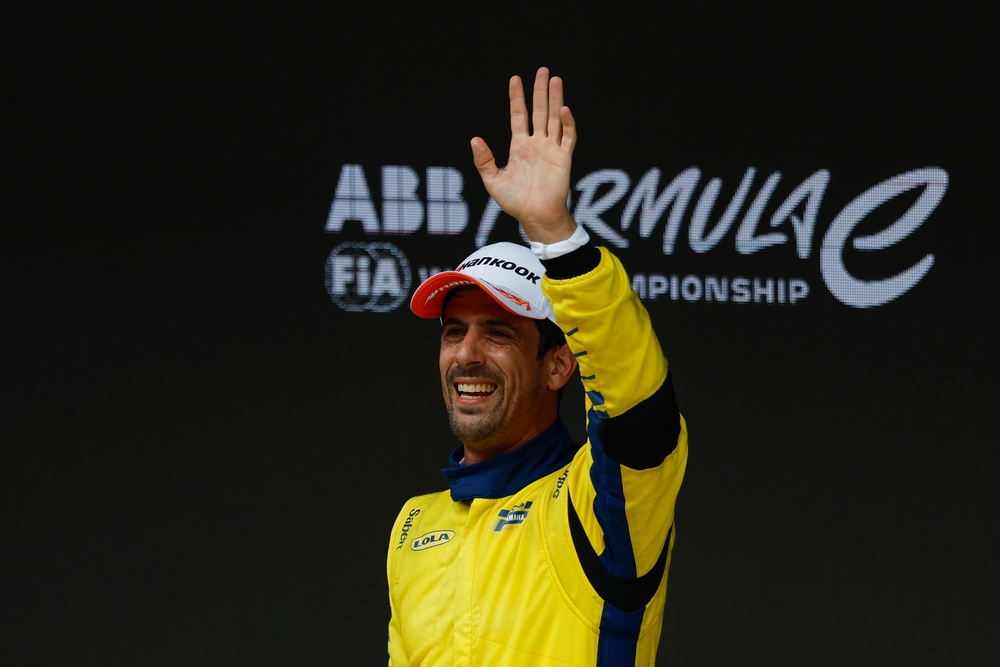
Before Formula E had a race, a calendar, or a reputation, it had an idea. For Lucas di Grassi, that idea arrived before the championship even had its name.
The Brazilian has become one of the defining figures in Formula E history. He was the first driver to commit to the series, helped develop the original prototype concept, won the championship’s first race in Beijing, and later became the 2016/17 Formula E champion. Now, with di Grassi set to end his Formula E career at the conclusion of the 2025/26 season, his story feels inseparable from the championship he helped build.
Speaking exclusively to Pit Debrief, di Grassi looked back on the beginning of Formula E, the risk he took by committing to an all-electric championship, the moments that still stay with him, and why retirement from racing does not mean stepping away from motorsport.
Di Grassi knew Formula E before it had a name
For many drivers, Formula E began when the first season started in 2014. For di Grassi, it began earlier than that.
Asked whether he remembered the first time he heard about Formula E, he explained that the concept still sat at a much earlier stage.
“Well, because the problem is that when it was pitched to me, it was not even Formula E yet,” he said. “It was a licence to create an electric racing series that Alejandro [Agag] got from FIA. So, well, I knew Formula E before Formula E existed.”
“Then I helped Alejandro to build this championship, so it was great.”
Agag, one of Formula E’s co-founders, helped to turn the idea of an all-electric racing series into a global championship.
That early connection gave di Grassi a different relationship with Formula E. He did not simply arrive as a driver looking for a seat. He joined as someone who believed the concept could become something bigger, even when the championship still looked uncertain from the outside.
“I could bet my career on Formula E”
Formula E’s early years required belief. The series had no history, no established audience and no guarantee that electric racing would capture the imagination of teams, fans or manufacturers.
Di Grassi believed in it because he trusted both the people behind the project and the direction of technology.
“Well, the people involved. I could really believe Alejandro could pull it off because I really believe in his potential to make this happen.”
“But also how the world, how the future would look like. I believed that the future would look more electric back then.”
He continued, “One thing that I learned in life, at least, is that you could be wrong in timing, but the direction in technology always improves in the direction that physics points the technology to evolve.”
“And the only way to make cars better, at one point, was to make them electric. So it was kind of clear that the direction was good, everything was going in the right way, so I could bet my career on Formula E, it’s what I did.”
It was not a passive decision. Di Grassi did not see Formula E as a finished product that could offer him an easy opportunity. He saw something he had to help create.
“I had to build it up. So it didn’t offer me anything. I offered Formula E, actually, back then,“ he stated.
“But I had to build it up because I believed in the story and I believed in how it would turn to.”
That belief became one of the foundations of his career. Di Grassi’s name now sits among the championship’s most important records, but his impact stretches beyond results. Formula E’s own biography describes him as a founding figure of the championship alongside Agag, underlining how closely his career became tied to the series from the beginning.
The moments that shaped Formula E’s growth
Over more than a decade, Formula E has changed almost beyond recognition. The championship moved from Gen1 cars and mid-race car swaps to Gen2, introduced Attack Mode as a new strategic layer, reshaped qualifying through its Groups and Duels format, and pushed energy management further with the Gen3 era.
Regenerative braking became a defining part of the racing, while Pit Boost later added fast-charging strategy to selected events. Gen4 now represents the next major step, with more power, greater performance and another leap in electric racing technology.
For di Grassi, some milestones stand above the rest.
“I think one of the key benchmarks was the first race. It was the first race, it was a good benchmark, and then, when we went from Gen 1 to Gen 2, it was a great start.”
“I think then the next big step is Gen 3 to Gen 4.”
The Gen1 era also came with one of Formula E’s most unusual features: car swaps. Drivers had to jump from one car into another during the race, adding a physical and strategic element that divided opinion.
Di Grassi still remembers it fondly, when asked by Pit Debrief whether he missed swapping the cars.
“I do. I really do, I liked it,” he said.
“I know that was a bit controversial, but I think it created a very special entertainment part of the race. It was up to the driver to be quick, right?”
“It was up to us to not only be quick at the track, but be agile as an athlete, to jump out of a car and into another in less than ten seconds.”
“It was interesting, to say the least. I miss it. I don’t think it should come back.”
“But I definitely miss it, yeah.”
It says a lot about di Grassi’s view of Formula E. He recognises what the championship had to leave behind, but he still values the strange, experimental features that helped give it an identity in its early years.
Pride beyond results
Di Grassi’s competitive story in Formula E already stands on its own. He won the first-ever race, became champion, fought through several eras of machinery and remained present long enough to see the series mature.
Yet, his pride in Formula E does not only come from trophies. It also comes from watching a project survive its first decade and grow into something more stable.
“It’s very interesting to see a business complete its first ten years of existence and to grow and to have more revenue and be more stable and have credible partners.”
“So, from one side, there is, let’s say, my competitive story. Like, I like being here and driving and winning races.”
“But on the other hand, when the championship is getting better, I also feel proud,” he said.
“So, if this becomes a monster in ten years, I will not be sad that I missed Formula E, let’s say, becoming the number one worldwide racing series in the world.”
“I will be proud that this started as a project and then went to become what it is today and what it will be in the future.”
That answer captures the unusual nature of di Grassi’s Formula E career. He has been a competitor, but also a builder. He wants to win, but he also cares about the championship’s direction.
Retirement was “a long time coming”
Di Grassi announced earlier this season that he will retire from Formula E at the end of the 2025/26 campaign. The decision will close one of the championship’s longest-running driver stories, but he does not describe it as sudden.
Instead, he says he spent years processing the idea before deciding the time was right.
“It’s been a long time coming. I tend to digest these important decisions of my life. Like, for example, when to get married, when to have babies,” he told Pit Debrief.
“I try to digest and try to think for a while. And stop driving was a very big decision.”
“But I’ve been thinking about it for a few years, to not say the least.”
“When was the timing going to be right? I really think the timing is right now for a series of factors, but for me it was actually a good… The timing could not be better.”
There is no evidence that di Grassi has lost interest in racing or Formula E. Instead, his decision appears to come from clarity. After helping build the championship and competing through every phase of its existence, he has chosen the timing of departure on his own terms.
Mexico 2019 still stands apart
Across his Formula E career, di Grassi has collected victories that carry historic weight. He won the first ever race in Beijing and, more recently, added another remarkable chapter in Shanghai by winning for Lola Yamaha ABT from 19th on the grid. The FIA described the Shanghai result as Lola Yamaha ABT’s first Formula E victory under the Lola brand.
However, when asked which race moment best captured what Formula E has meant to him, di Grassi went back to Mexico City in 2019.
“I think the Mexico 2019 victory in the last metres that I passed [Pascal Wehrlein], which is one of the best drivers in Formula E.”
“Just passing him in the last few metres and winning that race. The rush of adrenaline was so high that it took me a week to be able to sleep well again. Literally.”
“I had to take sleeping pills. Some days after that. So much adrenaline that it got into my brain.”
That memory has lasted because it carried everything Formula E promises at its best: energy management, pressure, timing and a finish decided in meters rather than seconds.
Di Grassi continues to consolidate his legacy
It would be easy to frame di Grassi’s retirement as the end of an era. In many ways, it is. Few drivers have shaped Formula E as directly or as consistently as he has.
However, di Grassi does not speak like someone preparing to disappear from motorsport. When asked what legacy he hopes to leave behind, he resisted the idea of looking backwards for too long.
“I hope they remember, I don’t know, what made them happy or any good moment is already in life.”
“And honestly, I don’t care a lot about my legacy,” he stated. “What I care about is building, to continue to build on into motorsport, to make motorsport better.”
“So I think my legacy, I really believe my legacy is I will still build a far better legacy than what I did in the past 30 years. So that’s what I’m working to do.”
“So maybe like an own team? Maybe my own team, my own car brand. Maybe my, I don’t know, create a new championship. Running FIA, running Formula E.”
“Who knows?”
That answer brings di Grassi’s Formula E story back to where it started. Before there was a championship, he believed in an idea. Before there was certainty, he chose to build.
Now, as he prepares to end his driving career, he is still thinking about what can come next. Formula E may remember him as a champion, a pioneer and its first race winner. Di Grassi, however, seems more interested in the future than in the monument.