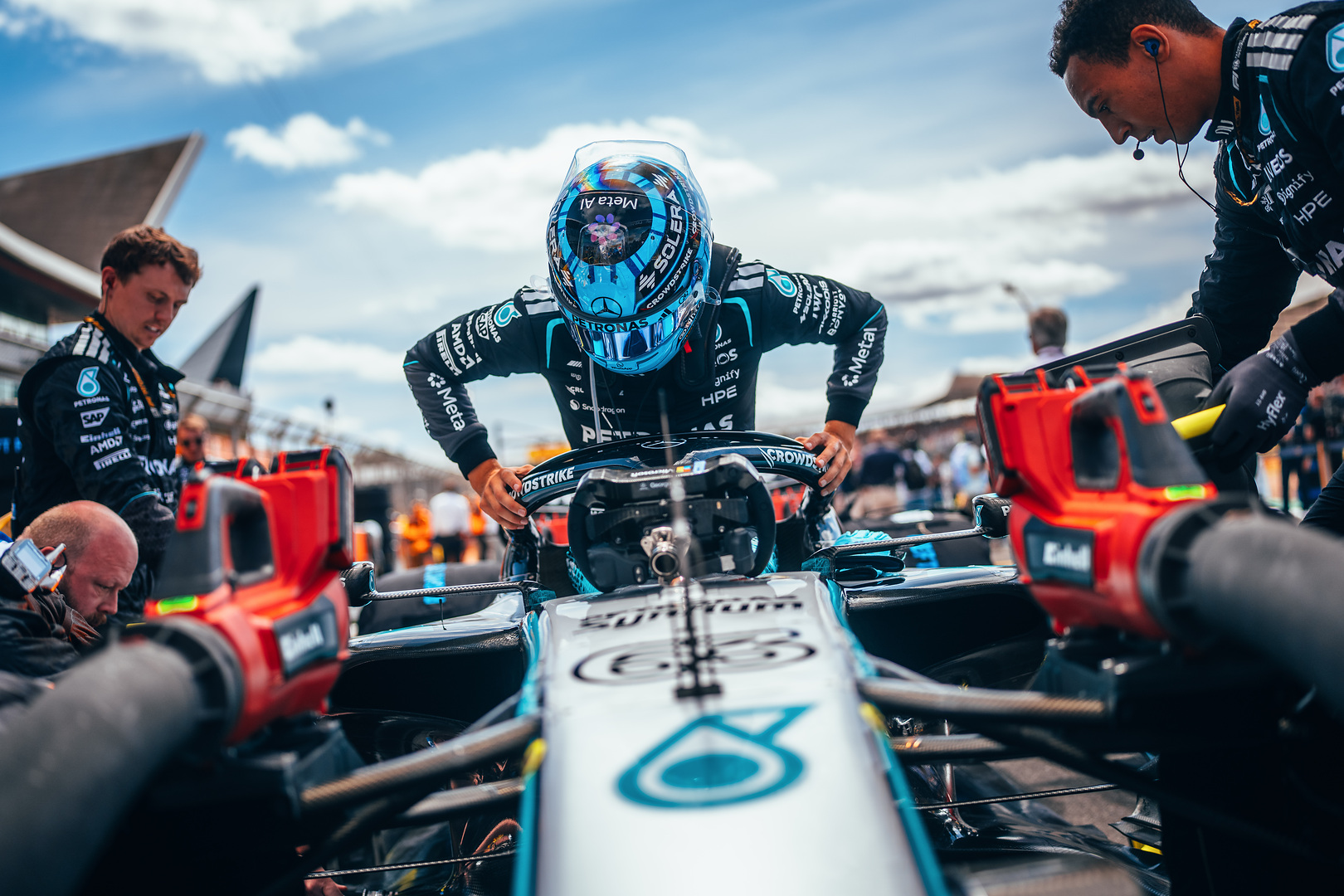
George Russell arrives at the 2026 F1 Belgian GP still searching for consistency, despite standing on the podium last time out at Silverstone.
The Mercedes driver finished second at the British GP after a chaotic late Safety Car finish, with Charles Leclerc winning for Ferrari and Lewis Hamilton completing the podium. However, Russell left his home race with mixed feelings, admitting afterwards that Mercedes still had work to do and that he also needed to improve his own execution.
Russell had looked set to miss out on the podium after a difficult race that included a suspected slow puncture and a second pit stop. Late drama, including Max Verstappen’s spin and the final Safety Car, promoted him back into second, but the result did not hide the underlying pace concerns.
Speaking ahead of the F1 Belgian GP in a print media session, Russell expanded on those comments and explained why his focus remains internal rather than on Ferrari’s growing threat.
Russell: “I know exactly why”
After the British GP, Russell said he was not thinking about Ferrari because he had his own areas to improve. Asked to clarify what those areas were, the Briton gave a direct answer.
“I’m just going faster, to be honest. It’s as simple as that,” he stated.
“The good thing is I’ve not left a single tough weekend confused where the pace is.
“It’s been so clear on the data. Sometimes it’s been so obvious that our chief engineer almost called it a car problem. It’s so clear on the data and it can be solved.
“Whereas I’ve seen in the past from other drivers or previous teammates where if you’re off the pace, it’s like scratching your head to understand why. I know exactly why.
“If I don’t win or if I’m not on pole, it’s clear on the data why that is and what I need to do to improve that.
“When I am on pole, it’s clear why that is. It’s not a case of I’ve suddenly forgotten how to drive one day and I remember the next. It’s just not getting the car in that sweet spot.”
Russell’s answer points to a problem of execution rather than confusion. He does not believe Mercedes has lost direction completely. Instead, he feels the team and driver combination has not consistently put the car in the right operating window.
Lower hit rate compared with 2025
Russell compared his current situation with last season, when he felt he could regularly extract the maximum from the Mercedes package. The results and dominance over Kimi Antonelli was evidence to that.
“Last year, I felt I had a very high hit rate of how often I could get the full potential from the car, the set-up, the tyres with my engineers,” he admitted.
“This year, that hit rate is far lower and that’s what I’m working on to make it more consistent.”
That consistency issue has shaped Russell’s 2026 campaign so far. He has still produced strong results, including his Silverstone podium, but he has not always felt fully connected with the car across a weekend.
At the British GP, he admitted that some issues sat within his control while others did not. He also said that, if he wanted to fight for the championship, both he and Mercedes needed to improve how they maximised each weekend.
Russell adapting to a different driving style
Russell was then asked why the answer has been so difficult to apply, especially if the data clearly shows where the time is missing. He compared the challenge to trying to recreate a masterpiece, even with the original in front of you.
“It’s like if somebody asked you to draw the Mona Lisa and you’ve got the Mona Lisa next to you, do you think you could achieve it straight away? Maybe with practice, you will.
“With these new power units, with these new tyres, with these new cars, I’m having to set the car up in a way that has not been suited to my driving.
“I’m having to drive in a way that I haven’t driven in my whole career and I’m having to adapt to this.
“I know exactly what I need to do, but going out and then achieving it when I’ve driven for 20 years in a certain way, and even more so, it’s been working for 20 years and now suddenly it’s working 50% of the time, but 50% of the other time it’s not working.
“Trying to recognise, ‘okay, is it going to work this weekend my normal way or do I need to adapt my approach?’
“If I need to adapt my approach, how do I do that and how do I do it and be quick?”
Turning technique into instinct
For Russell, the difficulty does not come from a lack of understanding. It comes from turning a conscious adjustment into instinct.
“When I’ve performed at my very best, I’ve just been performing subconsciously, not even been thinking about driving and now you’re having to think, trying to make these new techniques become subconscious techniques and that is the challenge.
“Everyone here is at the top of their game and it goes back to this conversation with [Leclerc] and also some of the challenges he’s having.
“It doesn’t make a lot of sense one day we’re so competitive and the next day we’re not.”
Ferrari threat not his main focus
Russell’s Silverstone podium came in a race won by Leclerc, while Hamilton also reached the podium for Ferrari. The result strengthened Ferrari’s momentum and put Mercedes under pressure in a close fight at the front.
However, Russell repeated that he cannot afford to focus too much on Ferrari while he still wants more from himself and Mercedes.
At Silverstone, he said he had his own issues to deal with before worrying about Ferrari. He also pointed out that he had reduced his points deficit significantly in recent races, but warned that results would not continue improving unless performance followed.
Ahead of the F1 Belgian GP, Russell’s message remained similar. The priority is not the colour of the car in front. It is understanding how to make his own car work more often. On race wins, he is 2-5 down against his Italian teammate.