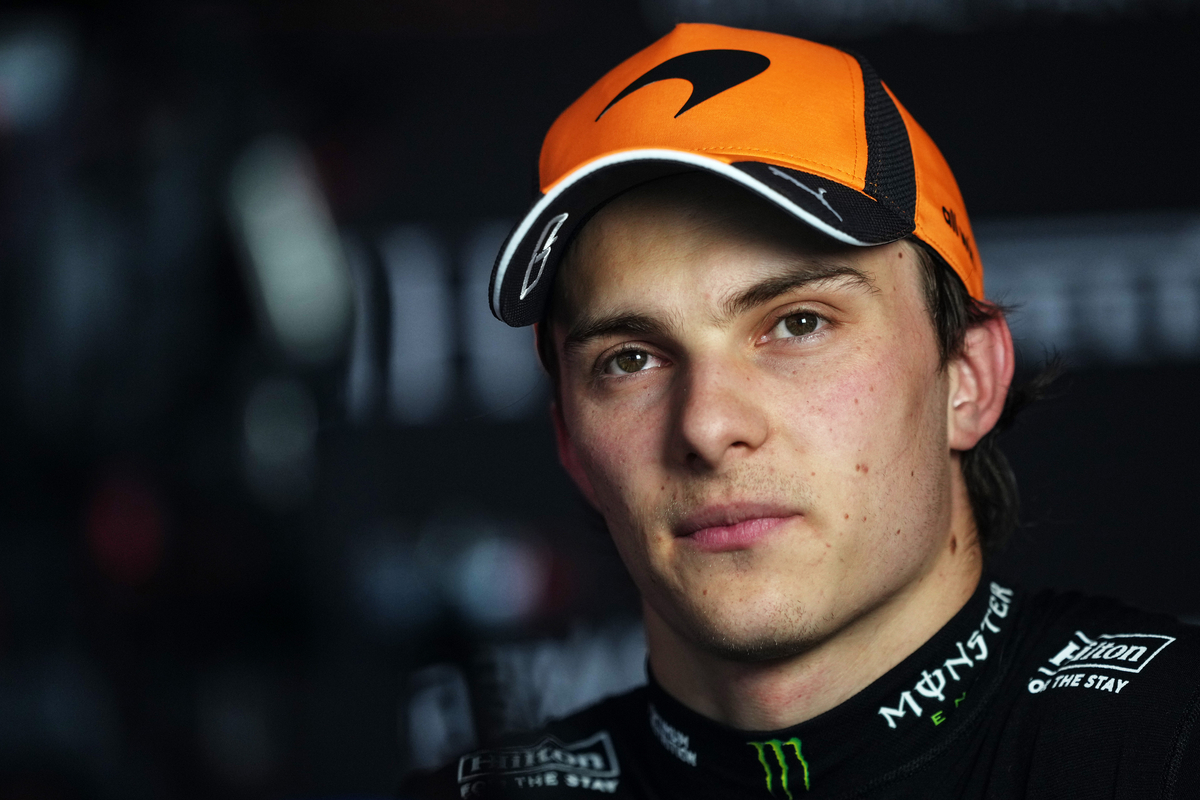
McLaren F1 driver Oscar Piastri opened up about how his damaged MCL40 impacted his race stints, Charles Leclerc’s aggressive defence, the inexplicable loss of straight-line speed, if there are short-term solutions for the deployment discrepancies, and whether it’s concerning that even Mercedes HPP have been unable to remedy the issue so far following his fifth-place finish at the 2026 Belgian GP on Sunday.
After setting the seventh-fastest time in qualifying at Spa-Francorchamps, Piastri gained a position on the grid due to teammate Lando Norris’s penalty.
The 25-year-old made a solid start from P6 on Sunday, evading a collision between George Russell and Lewis Hamilton directly in front of him at the Les Combes chicane. He found himself in fourth at the end of the opening lap, with a Safety Car neutralising the action.
As the race resumed, Piastri ended up sustaining bodywork damage due to contact with Leclerc on Lap 8. He slipped back to P5 on the subsequent tour, passed by the other Ferrari of Lewis Hamilton.
Although the Australian took the place back through his pit stop on Lap 20 under the Virtual Safety Car—when he switched from the medium compound to the hard—the seven-time world champion passed him once again for the position with four laps to go.
In the end, Piastri took the chequered flag in fifth place, 1.743 seconds adrift of Hamilton in fourth.
Impact of the damage on Piastri’s race stints
Speaking in the print media pen after the 44-lap F1 race, Oscar Piastri shed more light on the impact his damaged MCL40 had on his two race stints at the 2026 Belgian GP.
Noting the loss of substantial downforce, the nine-time race winner emphasised how the damage adversely affected the car’s balance during the first stint. He also explained how he fared relatively better in the second stint following a change of the front wing during his only pit stop.
While he revealed that his troubles resurfaced when he found himself stewing in the dirty air of Hamilton’s Ferrari, Piastri added that dropping back slightly resulted in his pace stabilising once again. Reiterating how the damage he had sustained compromised his race, he surmised that his McLaren was more competitive in the first half of his race stints than in the latter.
“The first stint I think the damage was a big player because I lost a decent bit of downforce. It impacted the balance of the car a fair bit. So, I was struggling a lot from then on until we could change the front wing and compensate a little bit. I think the second stint looked a fair bit better.
“Just once Lewis [Hamilton] got ahead, like I mean the car was tricky to drive in clean air, and once Lewis got ahead and I was in the heavy following it was incredibly tough again. And once I kind of dropped back a second and a half or two seconds the pace stabilised again.
“But then even still you know the car was still damaged. So, I think that was definitely a factor, but I agree we looked very competitive at the start of the stints and maybe not quite as good at the end.”
Piastri on Leclerc not leaving him enough space at the 2026 Belgian GP
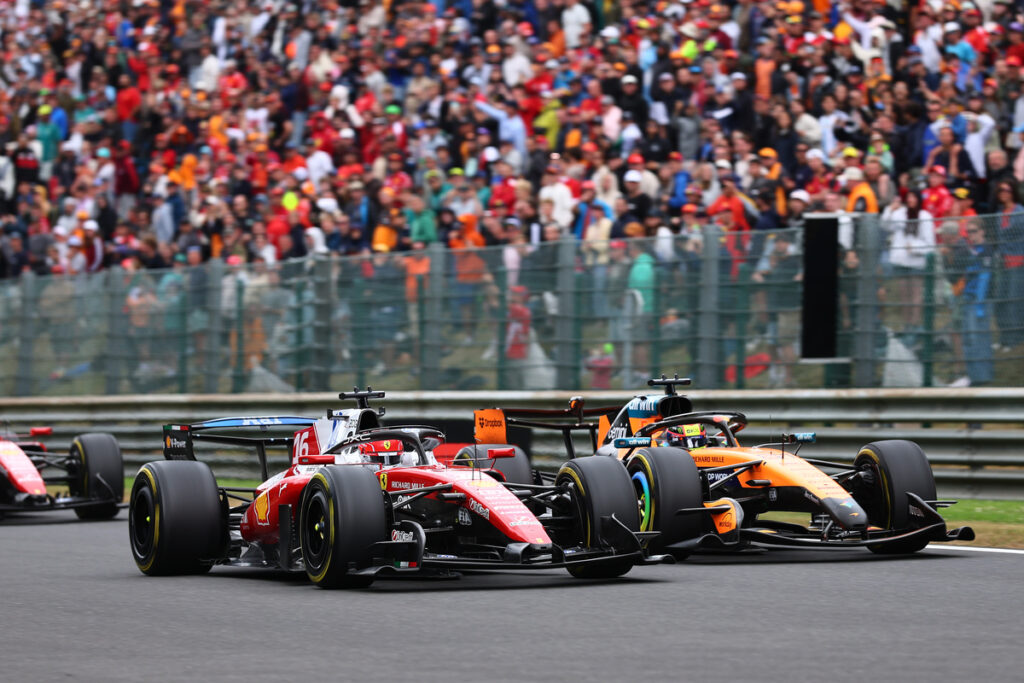
Asked to share his stance on Leclerc’s aggressive defensive move and the resulting contact on Lap 8 of the 2026 Belgian GP, Oscar Piastri claimed that he was on the white line at the edge of the track and that the Ferrari driver had squeezed him further. Additionally, he reckoned that they were both fortunate to dodge a bigger collision after banging wheels under braking.
Although he conceded that a penalty wasn’t entirely essential, the Melbourne native maintained that the F1 Race Director should’ve shown Leclerc a black and white driving standards flag. He argued that the ‘unsportsmanlike conduct’ flag would serve as a warning that drivers cannot get away with crowding while defending against their opponents.
“From where I was at, I was on the white line and got squeezed. I think we were both very lucky not to have a bigger crash because, you know, we touched wheels in the start of the braking zone, basically.
“I don’t really know where I was supposed to go. I’m not saying it needed to be a penalty necessary, but at least a black and white flag or something like that.
“Because if we think that that’s fine, you know, it’s one thing having touches like that, but even just the incentive of knowing that you can leave everyone the absolute bare minimum space and get away with it, that’s not the nicest place to be.”
Piastri sheds more light on the loss of straight-line speed during the 2026 Belgian GP weekend
Andrea Stella had stated on Saturday that the reason Oscar Piastri lacked straight-line speed during the 2026 Belgian GP weekend had nothing to do with his driving. He had confirmed that there was only a minor deviation in the usage of the Mercedes power unit between the McLaren cars during qualifying.
With regard to the Woking-based outfit’s inability to come up with potential solutions and how frustrating it is knowing that the power unit quirks might catch him out inadvertently, the Australian underlined how Russell and several other drivers on the grid have encountered similar issues.
Piastri delivered a damning verdict on the 2026 technical regulations following Sunday’s Belgian GP, proclaiming that software algorithms determining the deployment and their tendency to go haywire have undermined the essence of F1 qualifying. While conceding that Stella might’ve exaggerated the issue a bit, he added that it’s rather frustrating to be on par with his teammate in the corners, only to end up losing a massive chunk of time on the straights.
“I can’t really say it any other way than that. You know, I said we wouldn’t have been the only person.
“I know George [Russell] has had a lot of issues with that this weekend and maybe the last couple of weekends and speaking to some others it’s a similar story.
“So, when you’ve got qualifying [and] it’s decided by computers behaving or misbehaving, it’s a pretty crap way of going racing.
“So, he [Stella] is obviously going to exaggerate it a lot and make it worse but yeah, when you come in from a qualifying session you look at all the corners and go ‘I’m on par with my teammate and I’m two tenths behind at the end of it,’ it’s not a very nice feeling.”
If there are short-term solutions
In terms of whether there is a possibility of McLaren resolving the discrepancies in the short term, Oscar Piastri clarified that any changes to fuel flow or deploying less energy wouldn’t remedy the existing limitations.
Despite commenting on how it’s the respective power units and their learning modes that trigger the inconsistencies in the lap times between teammates, the 25-year-old expressed optimism that the manufacturers would get on top of the issue once they gain a better understanding of their engines.
Reiterating that it’s not a problem specific to the Mercedes power units, Piastri, nonetheless, mentioned how exasperating it is that such a widespread issue exists in the first place.
“Yes, I mean it’s all to do with just how the systems manage things. The change in fuel flow and less deployment are not going to fix those discrepancies. It’s to do with how the engine’s calibrated, how the engine learns. Yeah, it’s kind of ingrained into these engines.
“Obviously, it will get better as all the manufacturers understand the engines more. And it’s not just a problem for us or Mercedes. It’s a problem with all the engines, speaking to some of the other drivers. But I think the fact that it’s even a problem is pretty annoying for more than just myself.”
Whether it’s worrying that even Mercedes haven’t been able to resolve the issue
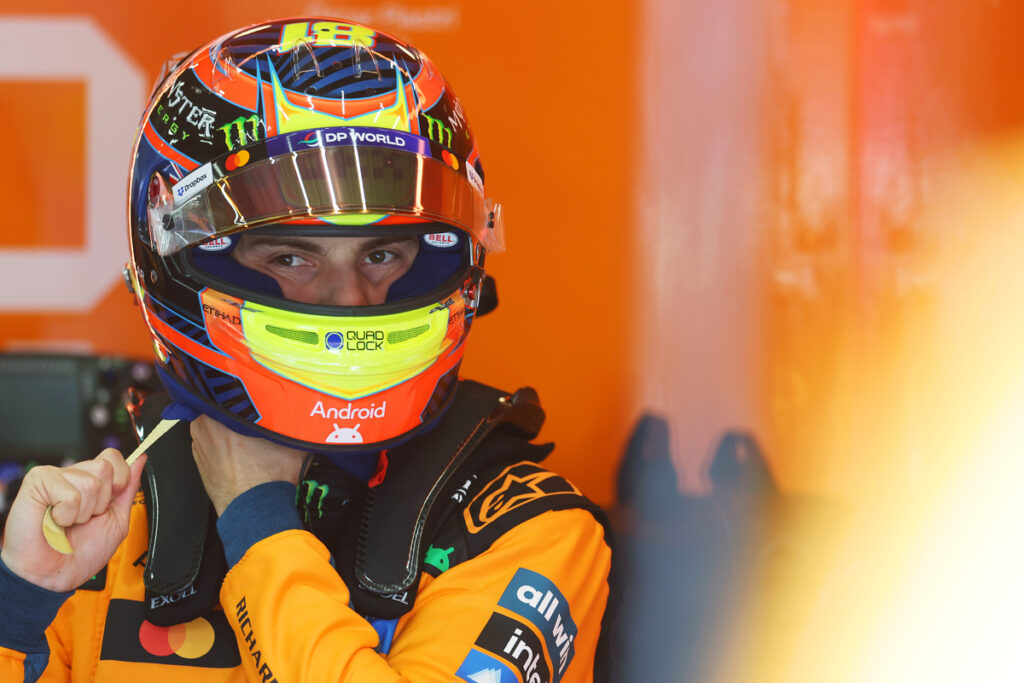
With respect to Russell experiencing similar problems and whether it’s concerning that even Mercedes AMG High Performance Powertrains are struggling to get to grips with the disparities in deployment, Oscar Piastri responded, “Yes, it’s not ideal.”
Mentioning once again how different engine manufacturers across the F1 grid are struggling to achieve uniform deployment between their two cars, the nine-time race winner attributed the problem to the 2026 power units being too intricate and sensitive.
Explaining that even slight changes on an out lap have a consequential impact on where the energy is dumped on the subsequent fast lap, Piastri stated post-Belgian GP that these complications have made racing trickier in 2026.
“I think it’s just happening for everyone. I mean it’s not just happening with HPP teams. It’s happening with other engine manufacturers as well.
“So, it’s not a specific problem. But the engines are so complicated. They are sensitive to everything, and even things you do on an out lap can dictate what happens. So, it’s a very tricky way of going racing but it’s what we’ve got.”