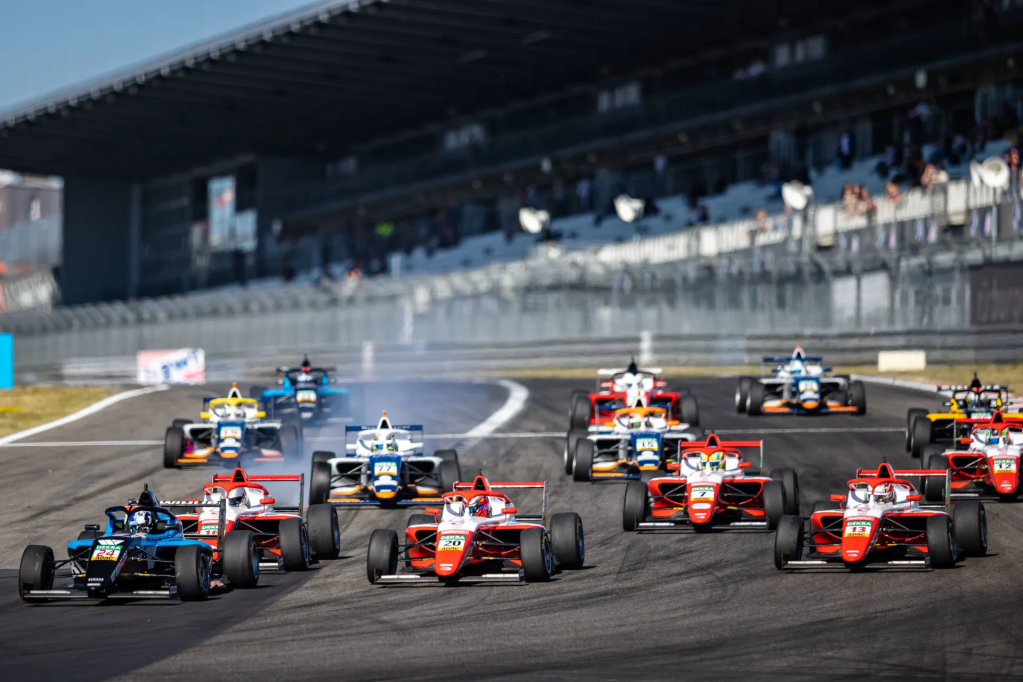
Germany will regain a national Formula 4 championship in 2027 as Gedlich Racing launches a new FIA-certified F4 Germany series with support from the Deutscher Motor Sport Bund (DMSB).
The championship will feature seven rounds and 21 races between April and September. Five events will support the Deutsche Tourenwagen Masters, while two will join ADAC Racing Weekend programmes.
Gedlich will operate the series after building four years of Formula 4 experience through the Formula Winter Series. The organiser will also introduce a €500,000 prize pool, cap the grid at 36 cars and award FIA Super Licence points.
DTM platform provides prominent stage for F4 revival
F4 Germany will use the DTM as its principal platform, giving young drivers access to one of Europe’s most prominent domestic racing championships.
DTM attracts more than 300,000 spectators across its eight-round season and brings together major manufacturers, professional teams and experienced motorsport personnel. Therefore, the partnership should provide F4 drivers with greater exposure than a standalone championship could offer.
DTM will also manage live streaming, which will strengthen the new series’ media reach.
Gedlich Racing Head of Operations and Racing Series Stefan Lehner believes the platform can support both young drivers and Germany’s wider single-seater revival.
“The DTM is Europe’s number one motorsport platform. Having the opportunity to race on such a high-profile stage, with its outstanding spectator numbers and media attention, is a tremendous opportunity for young talent and for the return of formula racing to Germany.
“For the majority of its calendar, the F4 Germany will race as part of the DTM platform on its renowned circuits. A small number of additional events will be held within the framework of the ADAC [Allgemeiner Deutscher Automobil-Club] Racing Weekend.”
Consequently, five of the seven rounds will place the championship directly in front of DTM teams, manufacturers and supporters.
Meanwhile, the two ADAC Racing Weekend appearances will give the series additional track time within Germany’s established national racing structure.
Seven-round calendar covers leading German circuits
Hockenheim will host the opening round before the championship visits an international circuit for its second event.
Gedlich will select Spa-Francorchamps, the Red Bull Ring or Zandvoort for that round. The series will then return to Germany for events at the Lausitzring, Norisring, Motorsport Arena Oschersleben, Nürburgring and Sachsenring.
The provisional schedule therefore combines permanent circuits with the Norisring’s demanding street layout.
Gedlich plans to publish the final calendar in September.
Provisional 2027 F4 Germany calendar
- Round 1 — Hockenheimring
- Round 2 — Spa-Francorchamps, Red Bull Ring or Zandvoort
- Round 3 — Lausitzring
- Round 4 — Norisring
- Round 5 — Motorsport Arena Oschersleben
- Round 6 — Nürburgring
- Round 7 — Sachsenring
The Nürburgring will carry particular significance because the circuit hosted the final ADAC F4 event in 2022.
F4 Germany will now return to the venue during its first season, creating a direct link between the former championship and Gedlich’s revival.
Three-race weekends create 21-race season
Each F4 Germany round will feature three races. Most weekends will begin with optional Thursday testing. The drivers will then contest two official 30-minute Free Practice sessions on Friday.
Saturday will feature two 15-minute Qualifying sessions and Race 1. Subsequently, Race 2 and Race 3 will complete the weekend on Sunday. Organisers will run each race for 30 minutes plus one lap.
The two Qualifying sessions should allow the championship to determine separate starting orders rather than rely completely on reverse grids or second-fastest lap times. However, Gedlich has not yet detailed the full grid-setting procedure.
Testing restrictions aim to control preparation
F4 Germany will offer up to four pre-season test days at championship circuits.
Furthermore, Gedlich plans to organise two-day collective tests approximately two weeks before each round whenever circuit availability allows. Teams can also use the optional Thursday sessions at selected events.
However, the championship will limit each team to a maximum of 20 test days during the season.
The regulations will also prohibit private testing at circuits that appear later on the championship calendar. Therefore, teams cannot gain unrestricted experience at an upcoming venue before an official collective test or race weekend.
This structure should give drivers substantial mileage while preventing teams with larger budgets from conducting unlimited private programmes.
Nevertheless, the amount of official running will still contribute significantly to each driver’s overall season cost.
F4 Germany adopts FIA technical package
Unlike the Formula Winter Series, F4 Germany will operate with FIA certification.
The championship will follow the FIA’s standard Formula 4 sporting and technical regulations. Consequently, eligible drivers will compete for FIA Super Licence points alongside race victories and the title.
Teams will use the second-generation Tatuus F4-T421 chassis, while Pirelli will supply the tyres and TM will provide the braking system.
Additionally, Tatuus and Autotecnica engineers will provide technical support at each event.
Teams can enter up to four cars, while Gedlich will cap the overall grid at 36. Each car will receive three sets of tyres per race weekend.
The regulations therefore align F4 Germany with championships including Italian F4 and F4 CEZ, which use the same chassis.
Entry fee reaches €35,000 per car
Gedlich will charge teams an entry fee of €35,000 per car for the full season and all official sessions.
By comparison, F4 CEZ charged between €14,300 and €17,300 in 2026, while Italian F4 charged €25,000.
However, the championship entry fee represents only part of a driver’s total budget. Teams must also cover staff, engineering, car preparation, damage, travel, accommodation, testing and other operational expenses.
Therefore, each team will determine the final price it charges drivers.
F4 Germany’s DTM support package, track time and testing programme could push total budgets towards Italian F4 levels despite the new series’ potential to reduce travel for German competitors.
€500,000 prize fund offers additional incentive
Gedlich will introduce a €500,000 prize pool consisting of what it describes as ‘prize gold’.
Top G Racing, which Gedlich describes as a partner specialising in environmentally friendly gold extraction, will supply the prize.
Organisers have not yet announced the detailed distribution. However, they expect the Drivers’ Champion to receive the largest share.
Gedlich also plans prizes for selected race-weekend performances, the highest-placed rookie and the leading female driver.
The fund could provide meaningful support for drivers seeking to progress beyond Formula 4. Nevertheless, the final value to each recipient will depend on how Gedlich divides the €500,000 pool.
Growing European demand creates space for German series
The European Formula 4 market has changed significantly since ADAC F4 ended in 2022.
Italian F4, Spanish F4, F4 CEZ and French F4 have all faced substantial demand. Several organisers have struggled to control grid sizes and have rejected teams or drivers after reaching their capacity.
Gedlich encountered similar demand in the Formula Winter Series. The organiser placed prospective competitors on waiting lists in both 2025 and 2026.
For 2027, the Formula Winter Series will introduce a heat-based structure similar to those used in Italian F4 and F4 CEZ. The system will divide the entry into groups before drivers qualify for a final race.
Therefore, F4 Germany could absorb teams and drivers who cannot secure places elsewhere.
Gedlich served 11 teams during the 2026 Formula Winter Series. Although the organiser has not confirmed the F4 Germany entry list, several existing customers could expand into its summer championship.
Furthermore, teams that lose places in oversubscribed European series could use Germany as an alternative.
Championship rebuilds Germany’s domestic pathway
Germany has lacked a national Formula 4 championship since ADAC F4 folded after the 2022 season.
The absence created a significant gap between the Deutsche Kart-Meisterschaft and higher single-seater categories. Young German drivers needed to move abroad immediately or join an international championship to continue their development.
Germany also retained only a small group of active Formula 4 teams. US Racing and PHM Racing operate substantial multi-car programmes, while Mathilda Racing and Dutt Motorsport run smaller family-led operations.
F4 Germany will now give those teams a home championship while creating opportunities for new organisations to enter the category.
The domestic calendar should also reduce some travel demands for German drivers and teams. However, the championship’s international second round and extensive testing schedule will still require significant budgets.
Former ADAC F4 produced seven Formula 1 drivers
ADAC launched its Formula 4 championship in 2015 as the successor to ADAC Formel Masters.
The inaugural campaign attracted 51 drivers, compared with 16 during the final ADAC Formel Masters season in 2014. It quickly became one of Formula 4’s strongest championships.
Several future Formula 1 drivers competed during its opening season, including Lando Norris, Zhou Guanyu and Mick Schumacher.
Liam Lawson and Jack Doohan followed in 2018. Meanwhile, Ollie Bearman and Kimi Antonelli won the final two Drivers’ Championships in 2021 and 2022 respectively.
Overall, seven ADAC F4 graduates progressed to Formula 1.
However, entries steadily declined after the championship’s successful launch. Although 33 drivers contested at least one event during 2022, only five completed the entire season.
Calendar clashes with Italian F4 contributed to the decline, while the 2021 and 2022 rounds attracted an average of only 16 drivers.
Rising costs also strengthened the championship’s reputation as an expensive addition to an Italian F4 programme rather than a standalone destination.
Ultimately, uncertainty surrounding ADAC Motorsport’s future, the organisation’s DTM takeover and limited team interest prevented the series from continuing in 2023.
ADAC sought alternatives after championship collapse
After ADAC F4 ended, the ADAC partnered with the Fédération Française du Sport Automobile to establish the ADAC Formel Junior Team in French F4.
The programme ran for three seasons from 2023. However, Montego Maassen’s eighth place in the 2024 standings represented its strongest championship result.
Among the programme’s graduates, Aston Martin junior Mathilda Paatz remains in single-seater competition through F1 Academy and F4 CEZ. Meanwhile, 2023 participants Finn Wiebelhaus and Tom Kalender have progressed into the DTM.
In 2025 and 2026, the ADAC continued supporting drivers through Stiftung Sport’s Motorsport Team Germany initiative in Italian F4 and F4 CEZ.
That programme will continue in 2027 as Germany welcomes back a domestic championship. However, Gedlich has not confirmed whether the ADAC will take a formal role beyond hosting two rounds through the ADAC Racing Weekend platform.
ADAC highlights single-seater affordability problem
Although Germany’s new series will restore a domestic pathway, concerns surrounding the overall cost of junior single-seater racing remain.
ADAC Motorsport Head Thomas Voss previously stressed that promoters and governing bodies must prevent financial barriers from determining which drivers progress.
“If I were to [target F1] with my own money – to make it to the top – I’d have had to sell a huge villa or somehow manage to scrape it together,” Voss said. “That means we’re talking about €10 to €15 million if you want to go down that route – Formula 3, Formula 2, including Formula 4 assuming I’m coming from karting. And even in karting, it’s already expensive enough to compete in the DKM at a six-figure level.
“So our aim as promoters – and I’m not just talking about us at the ADAC here, but particularly the FIA and everyone involved – should actually be to make this motorsport more affordable again and not let it become elitist. After all, we don’t want to be golf on four wheels. It has to be accessible to everyone. And I believe we’re working very hard on this – including the DTM – to make everything a bit more affordable again so that we’re really nurturing talent rather than those with the fattest wallets.”
Motorsport Team Germany will continue supporting selected drivers, and the €500,000 prize pool could help successful competitors progress.
However, neither initiative guarantees a broadly affordable season for the entire grid.
Costs remain central to F4 Germany’s prospects
The revival gives German drivers a domestic FIA-certified Formula 4 championship, significant DTM exposure and a recognised route towards higher categories.
Moreover, the championship enters the market during a period of strong demand. Oversubscribed European series and Formula Winter Series waiting lists suggest that Gedlich could attract a healthy grid.
Nevertheless, the programme must convert that interest into sustainable full-season entries.
The €35,000 entry fee exceeds those charged by Italian F4 and F4 CEZ in 2026. Additionally, teams will determine their own driver packages, which means the total cost could remain comparable to other leading European championships.
Therefore, F4 Germany’s success will depend on more than its grid size during the opening rounds. The championship must retain drivers throughout the season and establish itself as a primary programme rather than an expensive supplement.
Still, Germany will regain a crucial step between karting and higher single-seater competition in 2027. With FIA certification, DTM support, 21 races and substantial prize incentives, Gedlich Racing has created a prominent platform on which the country can begin rebuilding its Formula 4 pathway.