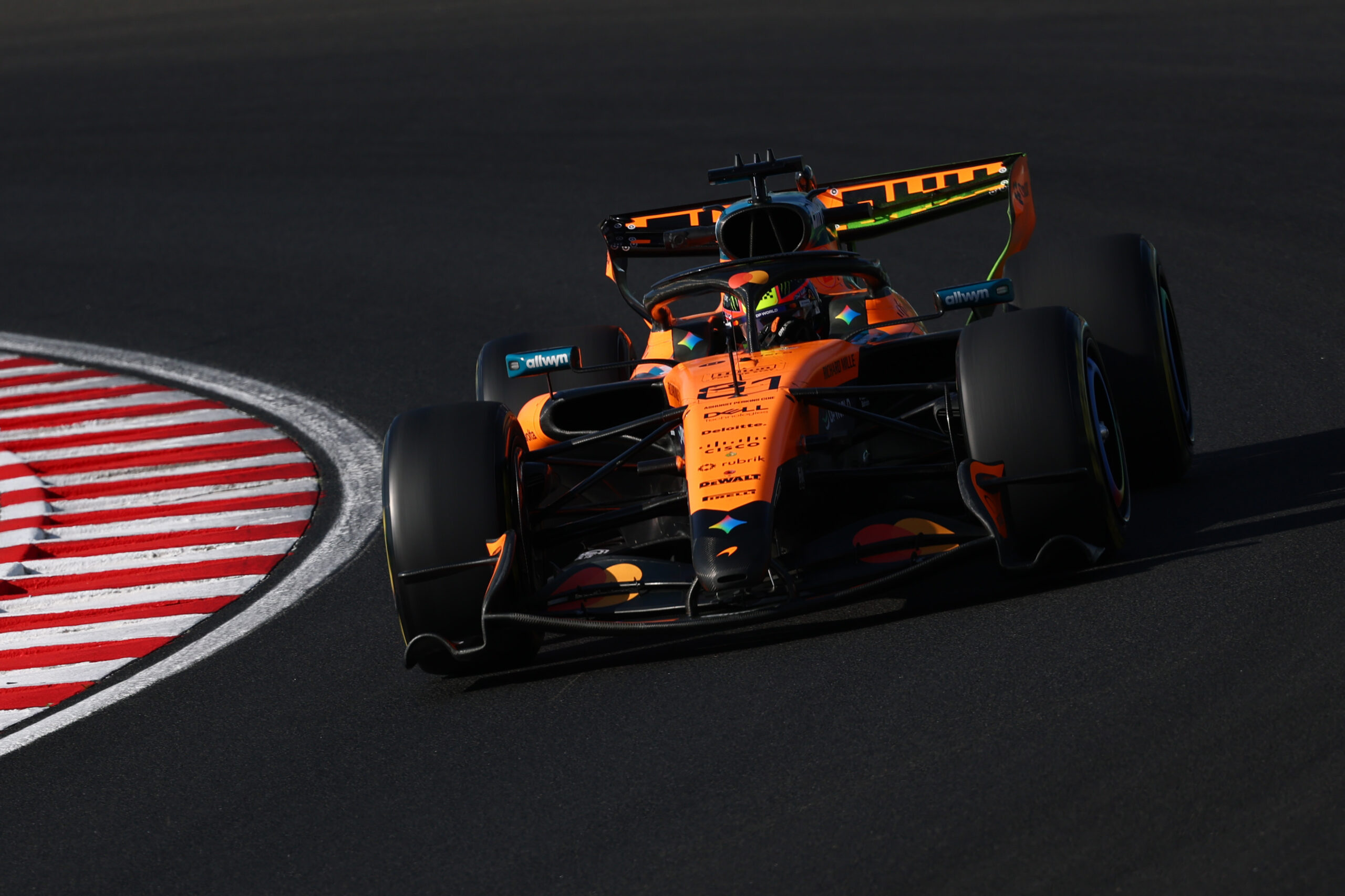
McLaren Technical Director – Performance, Mark Temple, outlined the challenges the team has faced as an engine customer, the working relationship with engine supplier Mercedes, and how the team has responded to new role requirements arising from the 2026 F1 regulations.
With the introduction of the 2026 F1 regulations, customer teams, such as McLaren, started the season with a slight disadvantage compared to works teams, who were able to gear their power unit and deployment strategies for the new hybrid unit to be in sync with their aerodynamic and overall car platform.
While McLaren, as a customer of Mercedes High Performance Powertrains (HPP), the engine department of the Mercedes F1 works team (MGP), can share feedback and make requests, the final decision on design and development remains with the works team. Especially at the beginning of the 2026 F1 season, this put McLaren in a challenging position, having to figure out the optimal way to extract performance from the power unit.
McLaren’s Technical Director – Performance, Mark Temple, explains that the team shares a close working relationship with HPP, and is thus in a position to influence the processes even if the final decision always remains with the works team.
Challenges of F1 customer teams in the 2026 F1 season
“I think some of it comes from how much influence you have over the design and the installation. We do have considerable input, but ultimately MGP have the final say with HPP on what happens. That shouldn’t be taken to mean we’re ignored – we’re ultimately just not the ones in complete control.
“The way HPP work on a race weekend is with a main team and customer support teams. We work very closely with our customer support team and have good relationships with people in the main programme. From that, we have influence on what’s happening within the main programme – but we don’t have guarantees they’ll accept things we request.”
According to Temple, the downside of not being in the driver’s seat when it comes to the configuration and development of the Power Unit is that McLaren, at times, has to deal with a package that is not entirely suited to their overall platform. As a response, the team uses data collected across the 2026 F1 season to “improve” their processes, making it a less limiting factor going forward.
“We’re a little out of the main loop in that respect, working in a side loop that feeds into the programme, but it means we don’t always get the configurations we want and that would suit us.
“It’s the same with the timeline. In the run-up to a race, we receive information from HPP, but there’s decision-making and evolution we’re not part of. When we find out what we’ve got, there’s often not a huge amount of time to react and respond – so part of what we’re trying to do this year is build and improve our process to make this less of a limitation.”
McLaren’s working relationship with engine supplier HPP
The 2026 F1 calendar presents a new challenge for F1 teams, as the varying circuits demand optimized PU deployment strategies to extract maximum performance from their packages.
Ahead of GP weekends, HPP provides McLaren with multiple deployment strategies, which are then evaluated and tested using McLaren’s technical infrastructure to determine the optimal settings for each race weekend. By working in close collaboration, McLaren engineers and HPP engineers settle on the most efficient settings for the race weekends ahead, explains Temple.
“It’s a group of people at McLaren who work very closely with HPP. As a normal activity, HPP will do simulations and come up with a configuration for a particular event and a given session, and present a multitude of different options of how best to use energy around the lap.
“We want to then check that against our tools and the specific requirements of the MCL40, plus variables like the wind direction, the grip level, the amount of fuel in the tank, and so on.
“So, we explore all of those things and compare them against what we think is optimal and then make recommendations to our race engineers alongside the HPP engineers. It’s a very collaborative process – but we use some of our tools differently – and indeed have slightly different tools – to HPP, so it’s a combination of the two approaches.”
Temple on how McLaren responded to new personell requirements born out of the 2026 F1 regulations
Since the introduction of the 2026 F1 regulations, finding the most efficient deployment strategy for each circuit, and thus enabling the maximization of the performance of the new PU, has become a key factor that has not been one in the previous regulation cycle.
In response to this new key element, McLaren has formed a new “power unit performance team”, which is tasked with extracting the maximum “performance” from the PU, by using the team’s “tools” and “simulator”, says Technical Director – Performance, Mark Temple.
“There are new roles. We have a power unit performance team now, which we didn’t have before. They’re focused on understanding how we get the most out of the power unit. They’ll study track data and work with race engineering, but also use our simulator and offline tools to maximize our performance.
“It’s definitely a new set of skills, and a new way of working – because these are things we didn’t really need to worry about before.”