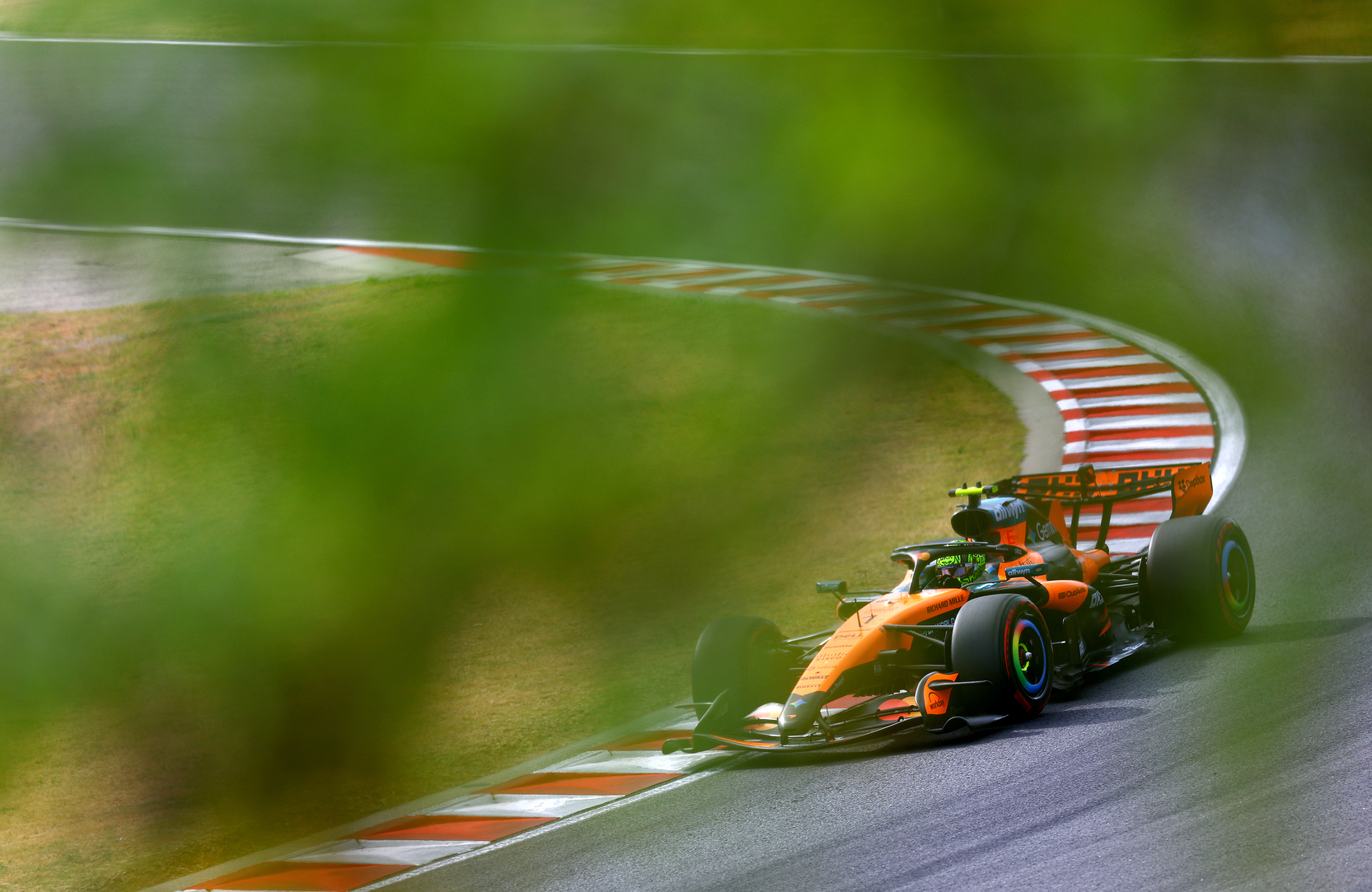
McLaren technical director Neil Houldey stated that the team is continuing to uncover performance from its 2026 car, with further upgrades planned for the second half of the F1 season.
Houldey, McLaren’s Technical Director – Applied Engineering, reflected on the ongoing development and explained how the team evolved the car after starting the season with a heavier-than-target specification. He acknowledged McLaren needed to catch up in some areas after prioritising its 2025 championship campaign.
“I think the launch car was a good base to work from,” Houldey told the media in a Q&A session just before the summer break.
“I think we made good decisions on concepts, on layout, things that were fixed for the year, like the suspension geometries. All-in-all, we were pretty happy.
“Obviously, it wasn’t as quick as we wanted it to be, and I think that partly came from decisions we made in 2025 to ensure we won the Drivers’ Championship, while other teams potentially started earlier on their 2026 cars—and that in turn led to us needing to do a little bit of catch-up at the start of the year.
“When the car was launched, we could have been a bit more developed in a few areas.”
McLaren had to address MCL40 weight before season opener
Houldey explained that the team had to spend development resources to reduce the weight of the car before the first race, which took some capacity away from potential performance improvements.
“We were a little bit overweight on the launch car and had to spend some time managing this before the first race in order to get the car down to the limit,” he said.
“Of course, that takes resource away from other areas where we could have been adding performance.”
Asked how McLaren balanced reducing weight with maximising performance, Houldey said: “You don’t wish to be overweight but equally, if the car is underweight, then that means you’re not maximising performance, because you can always put something on the car that adds performance, whether it’s parts or perhaps just extra stiffness.
“There’s no reason to make the car excessively light, so we’re always targeting to be very slightly under the weight limit; but hitting that number requires a lot of predictions and designers’ approximations on what things are going to weigh.
“Once we started receiving parts, we calculated the launch car was going to be a little over, but we were content with that, knowing that once we’d tested the car in Barcelona, we’d see the opportunities to take material out.
“We’d also see places we needed to put material in—but overall, it worked out as planned, and we were on the limit for the first race of the year, which was the important thing for us.”
Houldey explains why the 2026 McLaren F1 car retained familiar traits
Despite the major regulation changes introduced for the 2026 F1 season, the MCL40 shares certain characteristics with its predecessor. Houldey said that consistency reflects both the preferences of McLaren’s drivers and the way its technical organisation searches for performance through development.
“We ask ourselves this internally, and honestly, I’m not sure we get all the answers, but it’s really interesting,” he replied.
“In part it’s what the drivers ask for, and in part it’s how we run our CFD, how we run our wind tunnel, how we inherently develop performance. If we produce a car that always does XYZ, it’s probably because we always do ABC in development—because we think ABC is the right thing to do. We see where lap time performance can be found and develop our car in those directions.”
He added that rival teams could follow similar patterns, even when they reached them through different technical philosophies.
“Other teams have different views on where to find performance and they go in that direction, and they also produce a car with the same traits, year-on-year, irrespective of the era.”
MCL40 understanding evolved throughout the first half of 2026 F1 season
McLaren headed into the summer break buoyed by Lando Norris’ win at the Hungarian GP, topping off a competitive weekend for the team, suggesting positive progress had been made since March.
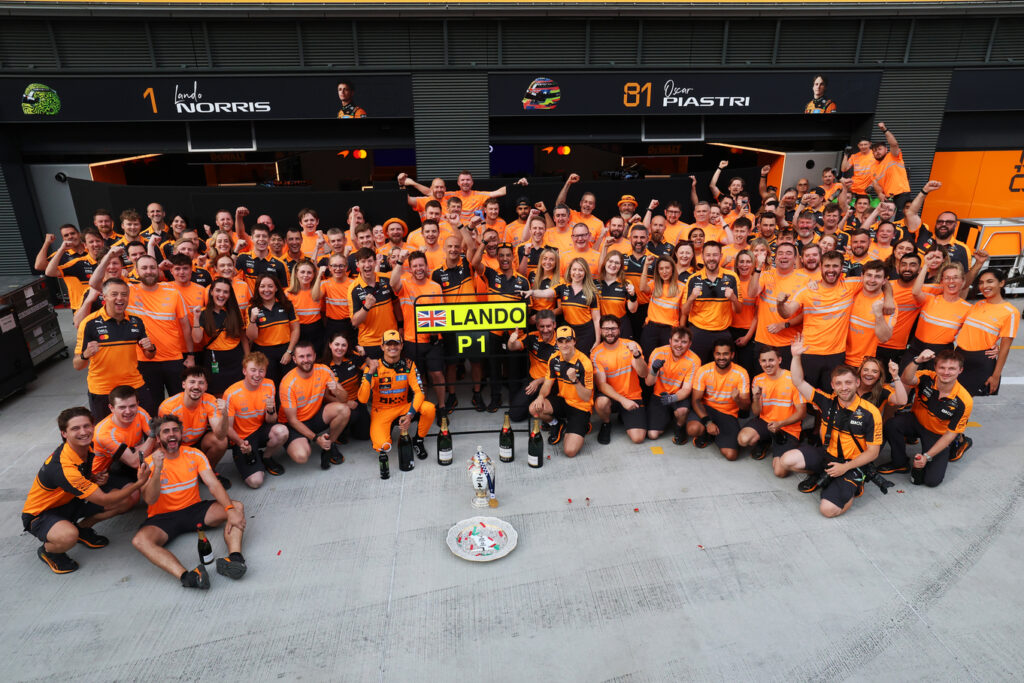
Asked how McLaren’s understanding of the 2026 F1 car had evolved since the start of the season, Houldey pointed to both the major aerodynamic areas the team had expected to develop and the smaller opportunities it had uncovered organically through running.
“I think, from an aerodynamic perspective, you’ve got front wing, rear wing, floor and bodywork, and you know you’re going to be looking for upgrades in all of those areas,” Houldey noted.
“I don’t think that really changed. These were things we knew we needed to focus on, and the team was rewarded by finding performance in those areas.
“I suppose since launch we got a better understanding of what the ‘bolt-on items’ were worth.
“The floorboard was one; the spat area was something else that you can develop during the season without affecting the base floor. We found good performance there.”
Tyre behaviour findings “influenced some of the upgrades”
The team also learned more about tyre behaviour and applied that knowledge when introducing subsequent upgrades.
“And then we also learned a little about how the tyres were working, what they needed in terms of heating and cooling, and that’s influenced some of the upgrades we’ve made,” Houldey continued.
“Those areas we only knew required our focus when we started to run the car, understood where we were, understood where we needed to be.”
Houldey acknowledged that the 2026 McLaren F1 challenger suffers from handling issues, something Lando Norris and Oscar Piastri had raised in their feedback.
“The drivers have given good feedback, from a handling perspective, and it’s clear the car isn’t easy to drive.
“Obviously, it was pleasing to see where we were at the last race, but there are development opportunities that would mean we can drive base car performance by adding overall load but also make it easier for the drivers to get the lap-time performance, both in qualifying and in the race.”
More McLaren upgrades to come in the second half of the 2026 F1 season, says Houldey
Houldey revealed McLaren will continue developing the 2026 car after the summer break, with a more significant package planned for the Azerbaijan GP in late September.
“At the moment, we’ve got smaller upgrades arriving at the next sequence of events, and then potentially something more substantial for Baku,” he said.
“After that, it really will depend on whether we find something substantial in aero after the summer break, and whether we think there’s value in doing an end-of-season package or fully switch to next year’s car.”
Asked how the team will decide when to shift focus to the 2027 challenger, Houldey pointed out that McLaren intends to weigh its own development potential against the progress made by its rivals.
“It’s an open point at the moment. We’ll be looking at where we are, where our competitors are, and where we see the opportunities,” he said.
“I think there’s a good chance we’ll have upgrades beyond Baku that can dig more performance out of this car, without impacting 2027.
“It’ll be things like I just mentioned, that can be bolted-on, or bonded-on, rather than the big, wholesale bodywork upgrades, but still areas in which there’s good performance opportunities there for the taking.”
Still looking for more straight-line speed and power unit gains
Houldey also identified further potential in MCL40’s straight-line performance and the power unit.
“We’re always trying to understand this—and I think it looks like a bit of both,” he said.
“We know there’s a little bit more performance to be found in that space, because our top speeds aren’t always the same as those of Mercedes. But this is something we’re working on, trying to put a bit more load on the car without adding drag.”
Asked how much performance McLaren can still realistically gain from the PU this season, Houldey stated that the team has progressively been learning how to extract performance from its power unit at each round, especially when it comes to energy harnessing and deployment—key aspects of the 2026 F1 regulation philosophy.
“From a PU perspective, we’ve learned so much this first part of the year,” he said.
“Every event we’ve done, we’ve learned a little bit more about how to fully utilise the PU, how to harness the energy in the best way, how to make sure we’re recovering the most amount of energy to deploy that energy in the most efficient way.
“I think that learning will be taken on into the second part of the year, and I think there’s still some lap time in that area without having to make any fundamental changes.”
Houldey also expects power unit development to continue across the second half of the season, with upgrades from suppliers potentially providing further performance.
“I don’t see development tailing off,” he continued. “We know through ADUO there’ll be PU suppliers bringing upgrades during the second half of the year.”
“That’s really for HPP to deliver to us but I’m sure we’ll see Ferrari, Audi, Honda bringing performance to their teams that way.”