The long-standing partnership between the FIA and Automobile Club de l’Ouest (ACO) could be approaching a critical juncture, with a report from German publication Auto Motor und Sport claiming that the two organisations remain without renewed agreements governing the FIA World Endurance Championship (WEC).
According to the report, two contracts underpinning the relationship have expired. One appoints ACO subsidiary Le Mans Endurance Management as the organiser and promoter of WEC, while the other secures the 24 Hours of Le Mans as part of the world championship.
No separation has been announced by either organisation, and Le Mans remains on the official 2027 WEC calendar. However, Auto Motor und Sport reports that negotiations have become increasingly difficult and raises the possibility that the FIA could seek a new promoter if no agreement emerges.
Such a move would carry significant consequences. While the FIA controls the world championship designation, the ACO owns and organises Le Mans. Any breakdown in the partnership could therefore leave WEC without the race that has served as its centrepiece since the championship launched in 2012.
Existing agreements reportedly remain unresolved
The current WEC structure divides responsibility between the two organisations.
The FIA sanctions the championship and oversees its sporting and regulatory framework, while LMEM handles much of its organisation and commercial operation. The ACO, meanwhile, brings Le Mans into the championship and has long played an influential role in shaping endurance racing’s technical direction.
Auto Motor und Sport reports that the agreements governing those responsibilities expired in June and have yet to be renewed.
The German publication also claims that the FIA could eventually open a public tender for WEC’s promotional rights if the impasse continues, potentially replacing LMEM with another organisation.
That would not automatically give a new promoter control over Le Mans.
The distinction lies at the heart of the uncertainty. The FIA can determine who promotes its world championship, but the ACO retains ownership of the 24-hour race and could withhold it from a future WEC structure if the organisations no longer work together.
No split has been announced
Despite the report, the existing sporting framework remains in place.
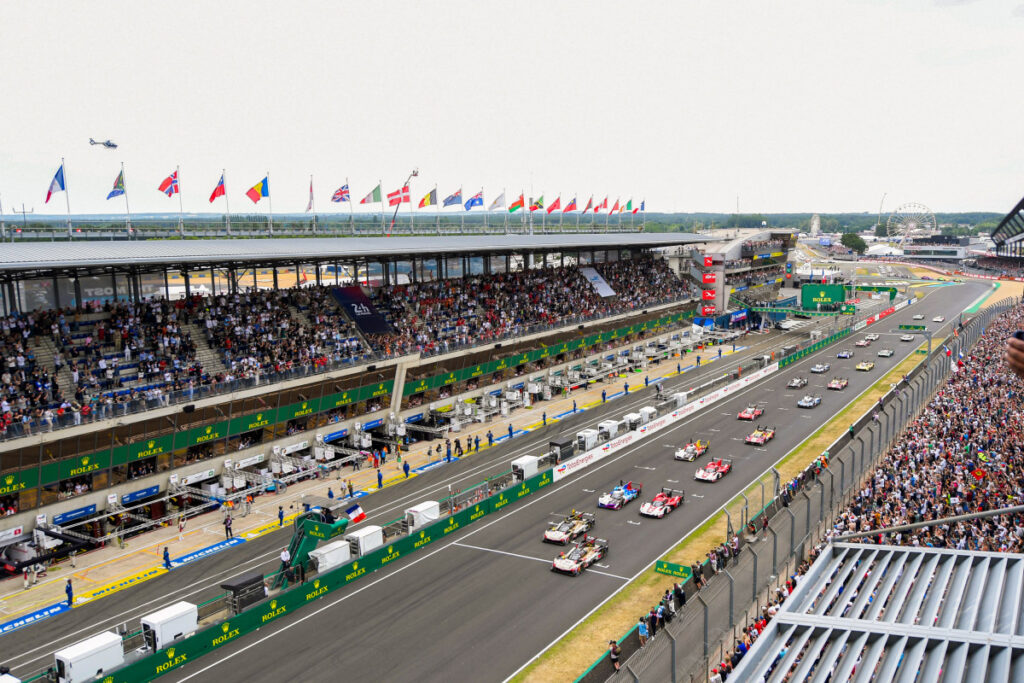
The 2027 WEC calendar continues to feature Le Mans, with the race scheduled for June as part of an expanded nine-round season. The ACO has separately announced the 95th edition of the event for 9-13 June 2027.
The FIA and ACO have also continued to appear publicly alongside one another on matters concerning the championship and its future.
That makes an important distinction necessary: the reported dispute concerns unresolved contracts and the possibility of a future change, rather than an announced decision to separate WEC and Le Mans.
The championship therefore remains set to continue in its present form unless either organisation confirms otherwise.
A WEC without Le Mans would reshape the championship
If the FIA ultimately appointed another promoter without reaching a separate agreement with the ACO, WEC could theoretically continue without Le Mans.
That outcome would fundamentally alter the identity of the championship.
Le Mans provides WEC with its most recognisable event and remains the primary target for many manufacturers competing in Hypercar. The race also carries greater championship weight than a conventional six-hour round and attracts an audience far beyond the regular WEC fanbase.
The current world championship grew directly from the ACO’s Intercontinental Le Mans Cup, which operated in 2010 and 2011 before the FIA and ACO created WEC for 2012.
A separation would therefore do more than remove one event from the calendar. It would break a connection that has shaped the championship since its creation.
ACO could retain Le Mans outside WEC
The reverse scenario would leave the ACO with its flagship race but without the FIA world championship attached to it.
Le Mans could remain a standalone event or potentially become the centrepiece of another ACO-led competition. No such championship has been announced, but Auto Motor und Sport raises the possibility when considering what a complete breakdown between the two organisations could mean.
Sport Auto Editor-in-Chief Marcus Schurig highlighted the scale of the uncertainty surrounding such an outcome.
“This would turn the world order in endurance racing upside down, raising numerous questions: Can an endurance world championship function without Le Mans?
“What will the ACO do if it has to relinquish the world title? Will there be an ACO [breakaway] series, centered around the 24 Hours of Le Mans? And if so, what technical regulations will govern the prototype and GT race cars?
“What are the car manufacturers doing? Are they withdrawing? Or are they showing solidarity with the ACO – or with the FIA? What will happen to the regulatory cooperation between the ACO/FIA and the IMSA championship?
“The American LMDh concept clearly has the upper hand in terms of manufacturer support, with a 9:4 margin [over LMH]. If the alliance between the ACO and FIA breaks down, then the boom in endurance racing could also come to an abrupt end.”
For now, those possibilities remain speculative. However, they underline how difficult it would be to separate organisations whose roles have become closely intertwined.
Negotiations reportedly extend beyond promotion
Auto Motor und Sport reports that the dispute goes beyond the simple renewal of LMEM’s promotional agreement.
FIA President Mohammed Ben Sulayem has spent his current term renegotiating agreements surrounding several FIA world championships, with WEC reportedly the only major series yet to secure a new arrangement.
The report claims that discussions involve financial contributions, commercial rights, visibility for the FIA and its level of influence over technical regulations.
The existing WEC model gives the ACO an unusually prominent position compared with promoters of some other FIA championships. That reflects both the commercial strength of Le Mans and the ACO’s long-standing role in developing endurance racing regulations.
Ben Sulayem publicly played down suggestions of a serious disagreement during Le Mans in June and indicated that a new contract was close. No agreement has subsequently been announced.
Auto Motor und Sport also reports that FIA Endurance Commission President Richard Mille is expected to leave his position at the end of the year, although the FIA has not confirmed such a change.
Hypercar regulations add another layer to dispute
Any breakdown in the FIA-ACO relationship would also create questions about the technical structure underpinning the current endurance racing boom.
The FIA, ACO and IMSA jointly oversee a system that allows LMH and LMDh cars to compete against one another in WEC’s Hypercar category.
That convergence has played a major role in attracting manufacturers to the top class. Ferrari, Toyota, Peugeot and Aston Martin compete with LMH machinery, while BMW, Cadillac and others use LMDh platforms.
The three organisations have also already agreed the broad direction of new top-class regulations for 2030.
A separation between the FIA and ACO would therefore raise questions over who would control those rules and how cooperation with IMSA would continue.
Nothing has officially changed in that area. The FIA, ACO and IMSA remain committed to the existing regulations and continue working towards the next technical cycle.
Nevertheless, regulatory cooperation represents one of the areas where a wider governance dispute could have consequences beyond the promotion of WEC itself.
Manufacturers would face difficult decisions
The timing of the reported disagreement is particularly notable because WEC is enjoying one of its strongest periods of manufacturer involvement.
Eight brands currently compete in Hypercar, while McLaren and Ford will join the category in 2027. Nine manufacturers also compete in LMGT3.
Those programmes have largely been built around a combination of two objectives: competing for an FIA world championship and trying to win Le Mans.
If those targets became separated, manufacturers could face a difficult choice.
An FIA championship without Le Mans would retain world championship status but lose endurance racing’s biggest event. An ACO competition centred on Le Mans could offer the race manufacturers value most while lacking the FIA title.
Teams could theoretically contest both, but that would depend on calendars, regulations and costs aligning sufficiently to make dual programmes practical.
No manufacturer has suggested that it intends to alter its current plans, and a split remains unconfirmed.
Current 2027 plans remain unchanged
For now, WEC continues towards 2027 under the structure already announced.
The calendar begins in Qatar before visiting Imola, Silverstone and Spa-Francorchamps. Le Mans follows in June, with São Paulo, COTA, Fuji and Bahrain completing the season.
McLaren and Ford are preparing new Hypercar programmes with Le Mans forming a central part of their respective plans, while the existing manufacturers continue to develop their cars around the current FIA-ACO framework.
That makes stability particularly important at a time when endurance racing has reached a level of manufacturer participation rarely seen in the modern era.
The report from Auto Motor und Sport therefore raises significant questions, but it does not yet provide answers.
The FIA could seek another WEC promoter. The ACO could keep Le Mans outside any future championship structure. Technical cooperation with IMSA could become more complicated, and manufacturers could eventually face difficult strategic decisions.
None of those outcomes has been confirmed.
At present, Le Mans remains part of WEC, LMEM remains the championship’s promoter and the FIA and ACO continue working together publicly. What happens beyond that will depend on whether the two organisations can agree on how one of motorsport’s most important partnerships should operate in the years ahead.