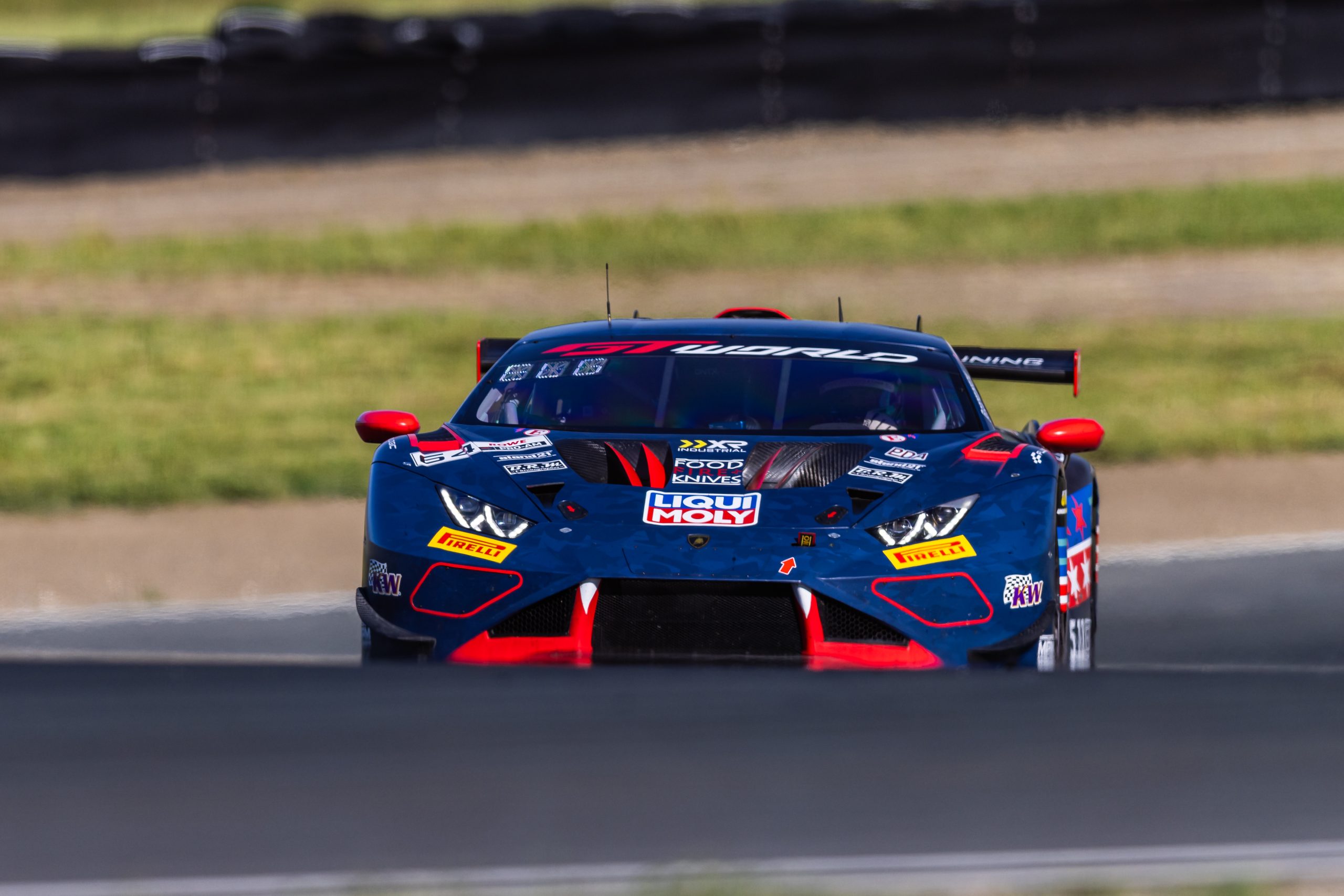
Motorsport rarely offers a straightforward route from one level to the next, and Chicago Performance and Tuning Co. has followed a particularly unconventional path into GT World Challenge America.
The Chicago-based organisation spent more than two decades building its reputation through club racing, vintage competition and high-performance tuning before gradually expanding into professional motorsport. After entering GT America powered by AWS with a KTM X-BOW GT2 at Indianapolis Motor Speedway in 2023 and contesting Pirelli GT4 America in 2025, the team stepped into GT3 competition this season with a Lamborghini Huracán GT3 EVO.
Mads Siljehaug and Nicolai Elghanayan share the No. 64 Lamborghini across a partial-season programme featuring Sonoma, Road America and the Indianapolis 8 Hour. However, Team Manager Christopher Lester explained that the opportunity emerged with little warning and required the organisation to move quickly.
A familiar motorsport story creates the opportunity
Chicago Performance and Tuning Co. had not originally planned its 2026 season around a Lamborghini GT3 programme. Instead, circumstances created an opening for both the team and the manufacturer, while Lester’s previous working relationship with Automobili Lamborghini America Senior Manager for Motorsport Erik Skirmants helped bring the two sides together.
“For this program specifically, it’s a very typical kind of motorsport story,” Lester said. “We had a gap, and Lamborghini had a gap. Erik Skirmants, the Senior Manager for Motorsport at Automobili Lamborghini America, and I had worked together at Porsche Motorsport North America, and we’d always kept in touch.
“We had a really cool GT4 program, but they had some things come up and decided to take a break from racing this year. Erik basically said, ‘I actually have a gap too, and I need a team to run a Lamborghini in SRO. Can you guys put a budget together and make it happen, even if it’s a partial season?’”
That conversation quickly produced a three-event GT World Challenge America schedule. However, securing the opportunity only created the next challenge: preparing a GT3 car from almost nothing in just over a month.
Five weeks to build a GT3 programme
Chicago Performance and Tuning Co. received little more than a bare chassis and a collection of components before its planned debut at Sonoma. Consequently, the team needed to assemble the Lamborghini, establish its operating procedures and prepare for a new level of competition within an extremely compressed timeframe.
“We had five weeks to build it from the ground up,” Lester shared. “It was essentially a bare tub when we got the car, with a pile of parts. It’s like the world’s most complicated Lego set. Going through and figuring that out, there were lots of people from other teams as well, which we’re super grateful for, that came over to help us build the car out. It was a real Herculean effort to get the car done and in the trailer for Sonoma.”
Support from outside the immediate organisation therefore played an important role in getting the Lamborghini ready. The team not only had to understand how every component fitted together but also needed to ensure the finished car could complete a professional race weekend reliably.
Simply arriving at Sonoma with a functioning GT3 car already represented a significant achievement. Once there, however, the team faced another steep learning curve.
Manufacturer support helps accelerate Sonoma learning
Siljehaug brought previous GT3 experience into the programme, including work with Reiter Engineering and development experience with the previous-generation Lamborghini Gallardo GT3. Elghanayan, by contrast, arrived at Sonoma without prior GT3 race experience.
The team therefore placed heavy emphasis on preparation. Elghanayan completed extensive simulator work with the engineering group beforehand, while Lamborghini also made factory driver Loris Spinelli available during the test sessions and throughout the weekend.
“Loris stayed the entire weekend to work with us and the team,” Lester explained. “He was constantly helping us with the driver feedback and the setup direction of the car.”
Chicago Performance and Tuning Co. also used the simulator it normally carries in its transporter as another learning tool. Spinelli and Elghanayan worked together whenever Elghanayan stepped out of the car, allowing the team to connect real-world feedback with simulator preparation and speed up his adaptation.
Sonoma offered more than a first result
The team approached Sonoma with several objectives. It needed to understand the Lamborghini, establish itself within GT3 competition and prove that its rapidly assembled programme could function reliably under race-weekend pressure.
However, Chicago Performance and Tuning Co. also wanted to represent Lamborghini strongly within SRO America and demonstrate that the manufacturer remained a credible option for teams considering GT3 machinery.
“For us, the main impetus behind the program, aside from us wanting to race on a personal front, is to represent Lamborghini in SRO America and remind people that that brand is active in the SRO space, that it can be competitive and that it can be a solution for teams if they’re looking for options in the future,” Lester shared. “We want to do the best job possible to showcase what Lamborghini is capable of.”
Completing the weekend without a mechanical failure provided an important early validation of the work that preceded Sonoma.
“Luckily we were able to walk away from Sonoma with zero mechanical issues with a car that was built from the ground up in an accelerated timeframe,” he continued. “We were super pleased with ourselves for that and proud of what we were able to accomplish.”
Nevertheless, the team also left California believing it had failed to maximise the Lamborghini’s potential.
Sonoma exposes areas for refinement
Chicago Performance and Tuning Co. finished eighth in class and 12th overall at Sonoma, but Lester viewed the result as bittersweet. The car showed enough pace to suggest a stronger finish remained possible, while smaller execution errors during pit stops and driver changes cost valuable time.
Rather than treating those mistakes as isolated incidents, the organisation used the gap before Road America to review virtually every area of its programme. The team examined the car, internal communication, paddock organisation, race-weekend procedures and even the physical arrangement of its working areas.
“It’s all a game of marginal gains,” Lester said. “It’s been a lot of really small stuff, and we’re hoping that a thousand small things will add up to something greater.”
That philosophy now shapes the team’s development. After each event, Chicago Performance and Tuning Co. conducts detailed debriefs that cover both sporting performance and operational execution, ensuring even apparently minor problems contribute to future improvements.
Road America adds home-race motivation
Road America now provides the next opportunity to test whether those refinements have made a difference. Although the circuit sits across the Wisconsin state line, it lies only around two hours from the team’s Chicago base and already forms a familiar part of its club and vintage racing activities.
The organisation experienced that home-event atmosphere when it raced a Toyota Supra in GT4 America last season, and Lester expects the proximity to once again bring additional support.
“We were lucky enough when we competed last year with our Supra in GT4 America that we had that home-race kind of feel again,” Lester smiled. “Just knowing that there’s familial support for everybody there, I think means a lot.”
The familiarity extends beyond geography. Many team members know Road America well through other forms of competition, but returning as part of a professional SRO GT3 programme gives the weekend greater significance.
That anticipation has also grown internally throughout the summer, with crew communication increasing as the event approaches and team members regularly checking on the Lamborghini’s preparation.
Performance potential matters more than an arbitrary target
Despite the excitement surrounding Road America, Lester does not want to judge the weekend solely against one predetermined finishing position. Instead, he wants the team to understand the Lamborghini’s performance ceiling and determine whether it can extract the maximum from its overall package.
“There’s going to be an apparent ceiling to the car from a performance potential in the data after the first few sessions of us running and seeing where we’re at,” he said. “As long as we’re getting close to that potential and we’re extracting everything that we can out of our collective package, I’ll walk away from that event happy. On a personal note, for sure I want to improve from our results at Sonoma. I want to be knocking on the door of a top five and seeing if we can pick up some hardware.”
That approach reflects the broader philosophy behind the programme. Chicago Performance and Tuning Co. knows it cannot shortcut the experience that established GT3 operations have accumulated over multiple seasons, but it can control how effectively it learns from each outing.
A top-five challenge would provide a clear competitive step from Sonoma. However, proving that the team has improved its execution may carry even greater value as it works towards a more permanent future.
Partial-season programme forms part of bigger ambition
The team never viewed its three-race schedule as an isolated experiment. Instead, Chicago Performance and Tuning Co. has already begun strengthening the commercial side of the organisation, developing sponsorship packages and building the infrastructure required to support a sustained presence in SRO competition.
Its progression from club racing and vintage competition into GT America, GT4 America and now GT World Challenge America has developed gradually, even if the latest step came together in only five weeks. Each stage has expanded the organisation’s experience while bringing professional GT racing closer to the centre of its operation.
Road America therefore represents much more than the second event of a partial campaign. It gives the team another opportunity to demonstrate what its Lamborghini package can achieve, apply the lessons it learned at Sonoma and compete in front of a home crowd that has followed its growth through the Midwest racing scene.
For Chicago Performance and Tuning Co., the immediate target involves extracting more from the Lamborghini than it managed on debut. Beyond that, the larger challenge involves turning an unexpected three-race opportunity into the foundation of a lasting professional motorsport programme.