The Adelaide Street Circuit hosted 11 Formula 1 races in total from 1985-1995 with the most recent serving as the 1995 season finale in an event which would break the official race attendance record with 210,000, a record that stood until the 2000 F1 United States Grand Prix.
Apart from 2006, 2010 and a COVID-affected period from 2020-2024, the F1 Australian Grand Prix at Albert Park in Melbourne has become synonymous with hosting the opening event of a new F1 season, including the upcoming 2026 campaign.
However, pre-1996, this was not the case at all as it was instead Adelaide, South Australia, which would host the yearly F1 race “Down Under.”
What was left to fight for in F1 1995 at Adelaide?
Nine wins in 16 races for Michael Schumacher had already crowned him as the 1995 world champion, but he would’ve been desperate to earn a strong result in his final race for Benetton before making his move to Ferrari for 1996.
Benetton had also already sealed their championship-winning fate, claiming the World Constructors’ Championship in the previous race at Suzuka.
Damon Hill had locked down second, but David Coulthard was still left holding onto third place in the standings as Johnny Herbert and Jean Alesi would hope to apply some pressure on the Scot in the 17th and final race of the season.
Benetton led Williams and Ferrari among the top three constructors, whilst McLaren and Jordan would be hoping to stop Ligier from advancing in the race for the top five places.
Mika Häkkinen’s scary shunt
In Friday’s qualifying session, a nasty accident at Brewery Bend overshadowed the timesheets when Häkkinen crashed his McLaren.
His car had suffered a rear-left puncture on entry to the corner, causing him to lose control and head straight into the tyre barrier at a terrifying 120 mph.
He thankfully survived the crash but suffered a fractured skull after his helmet had struck the steering wheel of his spinning McLaren.
Doctors later revealed that Häkkinen had lost consciousness after the impact and that they had performed an emergency tracheotomy to open his blocked airway.
He would inevitably go on to miss Sunday’s GP but would return for the 1996 season and later claim two world titles in 1998 and 1999.
Willaims’ unstoppable showing
The two Williams drivers both set their fastest laps on Friday with Hill claiming pole position for the Australian GP by +0.123s ahead of his teammate Coulthard with a lap time of 1:15.505.
Third and fifth fastest drivers Schumacher and Alesi, respectively, were stronger on Saturday with the champion in-waiting missing out on the front row by just over two tenths of a second.
Alesi’s Ferrari teammate Gerhard Berger qualified in fourth as Heinz-Harald Frentzen’s Sauber completed the provisional points-scoring positions in sixth.
The race to turn one in Adelaide
The final F1 GP in Adelaide for the foreseeable future took place on November 12th, 1995, under the heat of the bright Australian sunshine as two Williams looked set to battle it out for the final race victory of the season.
At the start, it was the man in second Coulthard who got the better launch, taking the lead off Hill almost immediately.
Schumacher had initially lost ground from third on the grid but recovered by passing Alesi and Berger within the opening five laps.
The time lost by the German was costly as the two Williams already seemed out of sight for a driver hoping to claim his tenth victory of the season.
Pit wall drama
Coulthard led the opening 19 laps of the Australian GP up until the first round of pitstops where the Scot arrived at the pitlane with too much speed, locking his front tyres and crashing straight into the pit wall.
The damage forced him to retire from the race, and Hill inherited the lead from his teammate.
Forti’s Roberto Moreno would share Coulthard’s fate just a few laps later as he also suffered terminal damage for a crash upon pit entry.
A roster of retirees
After making their first pitstops, Schumacher and Alesi came together in a terminal collision for both of their races.
Berger was briefly running in second but would join the retirees thanks to an engine problem.
Frentzen then reached second place until a gearbox issue spoiled his afternoon.
Herbert’s hopes of claiming third in the World Drivers’ Championship were dashed with a driveshaft failure as Eddie Irvine also dropped out of the race due to a complete loss of pneumatic pressure.
A new-look F1 top three at the Australian GP
Despite enduring a 22-second pitstop, all the retirements had left Hill with a substantial lap and a half lead of the Australian GP.
Ligier’s hopes of gate-crashing the World Constructors’ Championship top five were strengthened by Olivier Panis who now ran in second.
Footwork’s Gianni Morbidelli ran in an unlikely third for a team that had not yet stood on a F1 podium since its inauguration in 1991.
Hill’s redemption “Down Under”
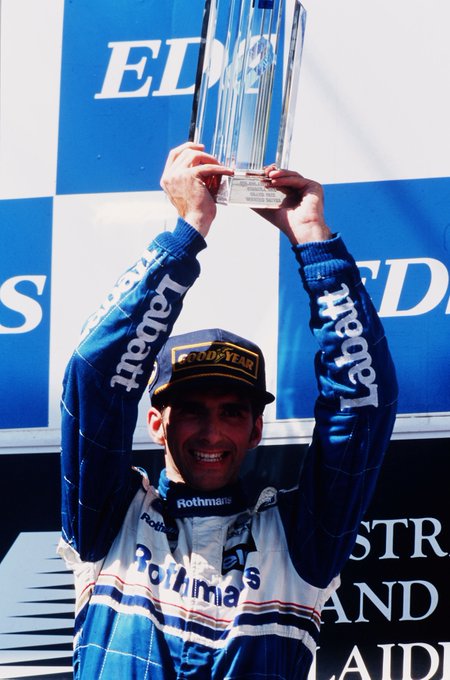
After missing out on the 1994 world championship in Australia due to a crash with Schumacher’s Benetton, Hill’s fourth win of the season tasted so sweet for the Briton.
He crossed the line over two laps ahead of Panis to win the Australian GP and equal the record for the largest winning margin set by Jackie Stewart at the 1969 F1 Spanish Grand Prix.
Panis and Morbidelli rounded out the top three with the Italian securing his first (and only) F1 podium finish.
Mark Blundell, Mika Salo and Pedro Lamy completed the points-scoring positions as only eight drivers managed to finish Adelaide’s final race.
Adelaide’s impact on the F1 standings
All the top seven, from Schumacher to Häkkinen, remained unchanged in the drivers’ standings as Panis’ podium rose him to an eighth-placed finish.
Podiums for Ligier and Footwork were pivotal as they moved to fifth and eighth in the constructors’ standings respectively.
Hill’s victory encapsulated the fact that he had finished second in the championship for the second successive season, a trend he would buck in his winning season the following year in 1996.
The 21st century view on F1 in Adelaide
The late Eddie Jordan spoke about Adelaide on a 2023 episode of his Formula for Successpodcast with Coulthard, he said: “I was sad when Melbourne [got the Australian GP]. They had the power, the political power, the cash, and a lot of things going for them. And I love what they did in Melbourne.
“But I also loved if we could have two races in any one country like that. I’d love to go back to Adelaide, it was fantastic.”
1995 was Coulthard’s only race at Adelaide so he didn’t comment too much in his reflection, but he said: “Anywhere where you can be in the city and close to the racetrack,” which is something that Adelaide certainly was.