Aston Martin will be down on power and lap count in F1 Australian GP, as Adrian Newey and Honda’s Koji Watanabe answers about ongoing issues.
Leading up to the F1 Australian GP, reports indicated that Aston Martin will be down on power in the grand prix and there are chances that they may not complete the full distance. The worst case scenario has come true for the Silverstone-based outfit, even before the start of the season.
In their pre-weekend media gathering, Aston Martin team principal Newey confirmed the limitations stemming from vibrations in the car. It is not only affecting the Honda power unit, but also drivers Fernando Alonso and Lance Stroll, to drive for longer period of time.
Nerve issues for Aston Martin drivers
Newey revealed that Alonso’s threshold is about 25 laps consecutively, while Stroll’s is 15 laps. While the veteran designer didn’t specifically mentioned that they will only run for these many laps, the indication is towards limited running and not taking it as a proper race outing.
They are yet to find the source of the vibration, despite having some idea about it. “So that vibration into the chassis is causing a few reliability problems,” said Newey on Thursday ahead of the F1 Australian GP. “Mirrors falling off, tail lights falling off, all that sort of thing, which we are having to address.
“But the much more significant problem with that is, that the vibration is transmitted ultimately into the driver’s fingers. So, Fernando is of the feeling that he can’t do more than 25 laps consecutively before he will risk permanent nerve damage to his hands. Lance is of the opinion that he can’t do more than 15 laps before that threshold.
“So, I think there’s no point in being open and honest in this meeting on our expectations. It’s something that unfortunately Koji and I haven’t had a chance to discuss properly prior to this meeting. We are going to have to be very heavily restricted on how many laps we do in the race until we get on top of the source of the vibration and improve the vibration at source,” summed up Newey.
PU amplifies vibration into chassis
The post-Bahrain analysis highlighted battery issues on Honda’s power unit side and not as much on the chassis developed by Aston Martin. Newey affirmed that the ICE and MGU works as an amplifier of the vibration into the chassis, which is where they haven’t made any progress to restrict it.
However, they have managed to reduce the vibration into the battery after running a solution on the dyno for the F1 Australian GP. He reiterated that work on 2026 car was delayed to begin with, resulting in further delays. Despite the problems, Newey believes that they have potential to excel.
If the reliability issues are solved, they can be up in the mix – being the fifth best team. “I think the important thing to understand though is that the battery is the thing that we have been focussing on because that’s the critical item on life,” he continued.
Vibration into battery reduced significantly
“So without, as we say, giving away any technical details, what we have achieved for this weekend, it tested on the dyno over the course of the weekend and got to the solution which we will be using here in Melbourne. So that has successfully, significantly reduced the vibration going into the battery.
“But what is important to remember is effectively the PU, i.e. the combination of the ICE and possibly the MGU as well, is the source of the vibration, it’s the amplifier. The chassis is, in that scenario, the receiver. A carbon chassis is a naturally stiff structure with very little damping. So the transmission of that vibration into the chassis, we haven’t made any progress on.
“On the chassis side, I think it’s well known that we faced a very condensed period of development. We didn’t get a model into the wind tunnel until mid-April, so quite a long way behind our competitors. That’s just a fact of life. So what we tried to concentrate on was having a good, sound architectural package.
Aston Martin — fifth best team on the chassis side
“By architectural package, I mean the parts that we can’t easily change in the season. I think we’ve achieved that. I look at our package and I don’t feel as if we’ve particularly missed anything. So therefore, I believe that the car has huge, tremendous development potential in it. It will take, of course, a few races for us to fully realise that potential.
“We’ve got quite an aggressive development plan underway. So I think it’s fair to say that here in Melbourne, we are a bit behind the leaders. Probably, I would say we’re maybe the fifth best team. So sort of potential Q3 qualifiers on the chassis side, obviously not where we want to be. But with the potential to be up front at some point in the season,” summed up Newey ahead of the F1 Australian GP.
Gap to leaders
When pressed further to elaborate on their positioning without the reliability issues, Newey stressed that from chassis point of view, Aston Martin is in the middle of the group. He assessed that the gap could be three quarters of a second to a second from the leaders, reiterating of aggressive development plan.
“My assessment, obviously, I’m going to ask Koji in a second what his feeling is, so, dividing up into chassis, as I say – I think I could be horribly wrong – but my assessment would be that we are, from a chassis performance view, kind of in that middle group, so definitely behind the leaders,” he claimed.
“What’s that gap? I don’t know, I’m guessing somewhere around three quarters of a second, maybe a second. We have an aggressive development plan in place. Already with what we have, where we’ve got to in the factory with that development plan, had we had time to bring it here to Melbourne, we would be significantly ahead of where we will be over the weekend.
“And hopefully at the moment that’s on quite a good trajectory. So, given a bit of time, I see no inherent reason within the architecture of the car why we can’t become on the chassis side close to, if not fully competitive,” summed up Newey.
Countermeasures from Honda
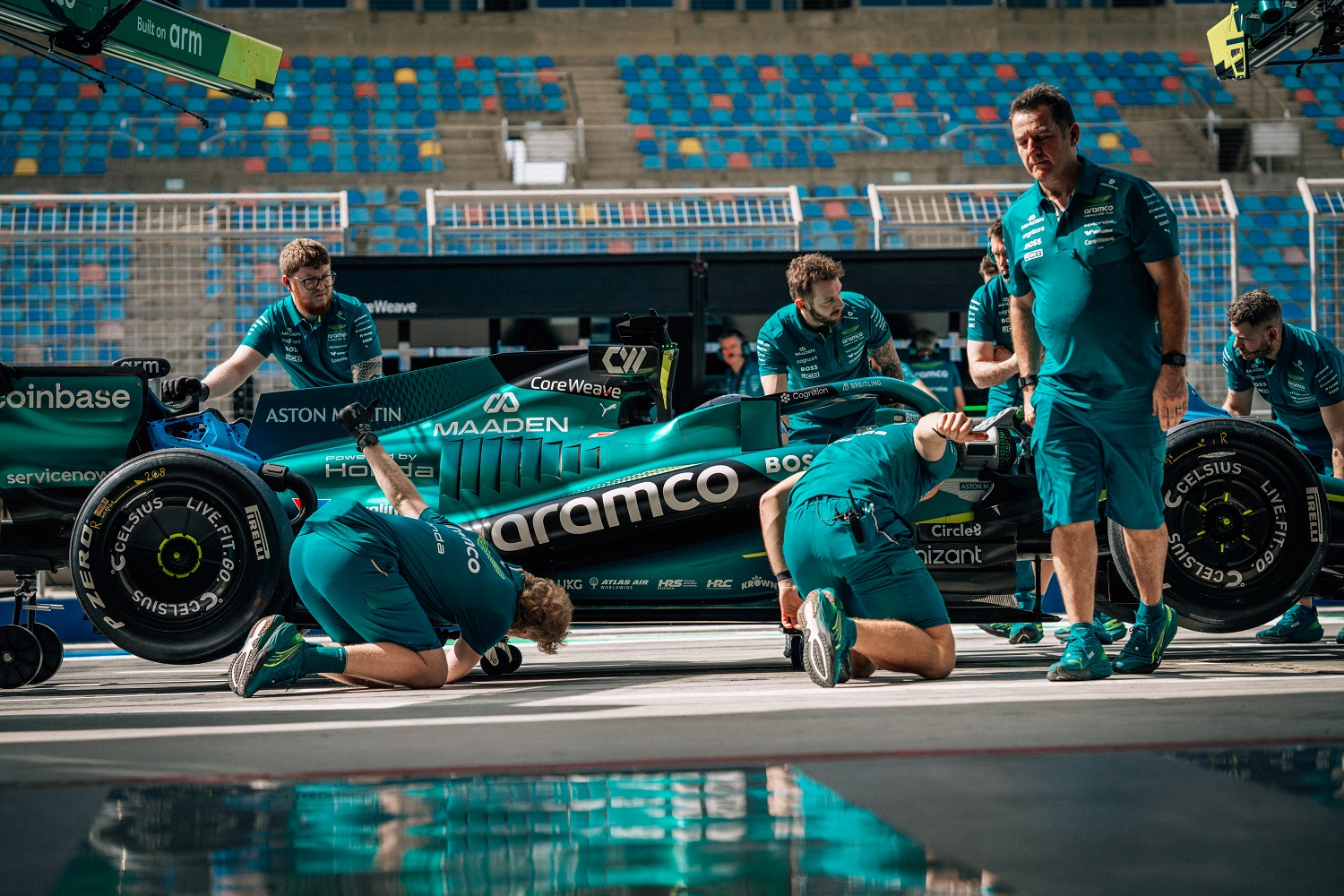
From Honda’s point of view, president of HRC, Watanabe noted about countermeasures put in place after extensive testing on the dyno. They are still assessing the root cause of the problem, but the time between Bahrain and Australia and the data from limited running, helped them devise a new plan.
The Japanese manufacturer has already put up the plan in execution, but there is no timeline on positive results from it. They first have to get things right in at the F1 Australian GP and if it works, they will take further steps.
“During the Bahrain pre-season test, we experienced unexpected vibration, which caused damage to battery-related components of the power unit,” said Watanabe in the same Aston Martin press conference.
Assessing effectiveness in Melbourne
“As a result, we were unable to complete the mileage we had originally targeted. The engineers from HRC and Aston Martin Aramco Formula One team are working closely as one team to develop and evaluate multiple countermeasures to issue highlighted during the test.
“Based on the extensive dyno testing, we will introduce countermeasures, what we believe to be the most effective solution at this stage, starting this week. However, its effectiveness cannot yet be fully guaranteed under the real track condition. So certain conditions will be applied to power unit operation this week.
“We are closely working together to find what is the root cause, we are also discussing intensively many dyno testing. We choose some options, what kind of countermeasures are necessary together with Adrian. So we are always working closely together. Of course I want to hurry up, but at this moment it’s quite difficult to say when and how,” summed up Watanabe.
Strong raw power of PU
While Newey seemed excited about Honda’s actual power unit performance, Watanabe remained cautious in his assessment. The Brit noted that everyone can make their own judgment looking at the GPS data, with regards to Honda’s raw power.
“I think on the PU side, if we simply talk about kilowatts, pure raw power, then there’s no point in speculating because once we have GPS and sound analysis from the Formula One TV coming in over the weekend, then that’s very easy for FOM, for the teams, etc, to measure to quite a high degree of accuracy what power each PU is producing,” said Newey.
“And from that, of course, you can work out the extent you can then start to work out the lap time deficit. One of the problems with these regulations is that the shorter you are on ice power, the more you have to make up for using electrical energy to cover for that lack of ICE power, which means that by the time you really want that electrical energy on the straights, your battery’s gone flat.
“So it becomes a self-fulfilling downward spiral. So the straightforward calculation of what ICE power means on lap time is compounded by the effect of lack of electrical energy. As I say, there’s no point in speculating because we’ll find out, particularly on Saturday, when everybody has their engines at full beams,” summed up Newey.
Honda cautious
Meanwhile, Watanabe added: “From Honda’s point of view, unfortunately we have not yet been able to run the power unit at the maximum RPM. So it’s quite too early to say about performance yet. So that’s the situation. During the pre-season test at Bahrain, we’ve got a lot of data.
“We are analysing slowly all of the data we got from the testing. So at this moment, I’m sorry, but we cannot tell the performance at this moment.”
When asked if Honda were forced to make layout changes on power unit side after request from Aston Martin, Watanabe put down any significant change on that end, stating ‘no big layout change’.
Aston Martin and Honda together in this
While the problems continue on, both Newey and Watanabe highlighted the strengthening of the ties between Aston Martin and Honda in the period. The former has full faith on the Japanese manufacturer to come good, having worked with them at Red Bull and delivered F1 titles.
“I think the positive out of this is that our relationship has strengthened, the relationship between Honda and AMR,” said Newey. “We are working very much as a partnership now and that’s good, clearly. And I think we are able to help each other.
“Do I believe that in our partners and Honda’s ability to bring that power up and to be competitive? Absolutely. They have a proven track record and we have total faith.”
And Watanabe added: “HRC and Aston Martin Aramco Formula One team will continue to work closely together as one team, and further measures are already under consideration. We are not able to share the technical details, so we ask for your patience as we continue working towards unlocking our full performance potential.”