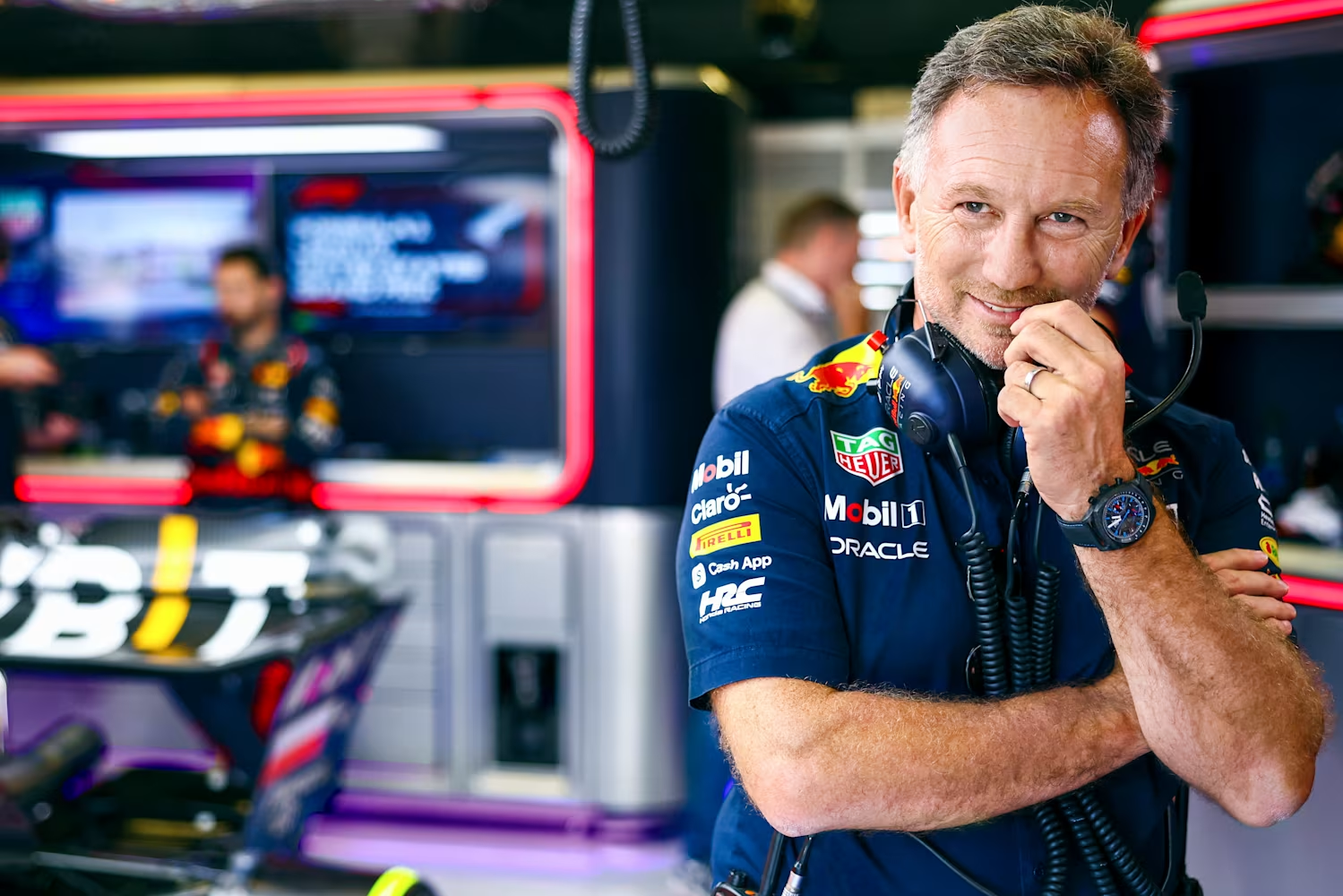
Former Red Bull Racing F1 Team Principal & CEO Christian Horner has described creating the team’s own Formula 1 powertrain as arguably the biggest challenge of his time with the team, reflecting on the risks of building an engine programme from scratch.
Speaking to Autosport in an exclusive interview for his memoir, the former team principal discussed how the project required the Austrian team to develop their own facilities, assemble experienced personnel and produce a competitive power unit despite having no previous experience as an engine manufacturer.
He also delved into how the team overcame internal doubts, why their deal with Porsche ultimately fell through, their agreement with Ford, and how the development of their powertrain and the achievement of the people behind the programme remain a source of pride.
Christian Horner talks building an engine operation from scratch
Red Bull’s decision to build its own engine programme came after Honda’s withdrawal as a full works manufacturer at the end of 2021. Although Red Bull received support from the Honda Racing Corporation during the transition, the team began developing the infrastructure and workforce for its own powertrain.
Building an F1 power unit from scratch meant they needed people who already understood the complexities of engine development. Recruiting experienced personnel from rival manufacturers was crucial, but the team also had to bring that expertise together to build its own powertrain operation.
Horner recalled how references to Mercedes as an example became a recurring theme during the early development of their Powertrains, he shared that this prompted a ban on referring to the rival manufacturer in meetings by their name. In the end, they signed some hugely important figures from Mercedes, such as Ben Hodgkinson.
“There was too much talk of, well, at Mercedes, we did this. At Mercedes, we did that. So in the end, he got banned from meetings. We’re not going to mention Mercedes. It became Team B. And within a year, we had our first prototype engine up and running.”
Why Red Bull’s Porsche deal fell through
Porsche emerged as a potential partner in 2022, offering the prospect of combining its automotive and engineering expertise with Red Bull’s growing powertrain operation. Developing a F1 engine independently was an enormous financial and technical undertaking, and a partnership could help share the burden.
Horner admitted that doubts remained within Red Bull about its ability to produce a competitive engine, making Porsche’s involvement an appealing possibility.
“But I think there was still some nerves within the group, within Austria, that really, could we produce a competitive engine? And then Porsche suddenly came as a possibility. And I think in Dietrich’s mind, by this stage, he wasn’t in great shape. But he saw the benefit of the Porsche brand, an amazing brand. A Red Bull Porsche was really premium. They make engines. We don’t. And so we explored that.”
The negotiations progressed to visits to Porsche’s facilities in Weissach, but Horner said Red Bull had already advanced considerably in preparing its own engine programme. The proposed 50-50 partnership also raised questions about decision-making and whether the two organisations would agree on the direction of the project.
“I went to Weissach and saw some of their facilities and recognised that we were miles ahead in terms of what we were doing in preparation for Formula One than where they were.
“And it felt like there was going to be a lot of compromises bringing these two entities together with perhaps there’d be challenges in the direction in a 50-50 partnership. And so that deal didn’t go through in the end. But we needed a partner, because it was a big burden.”
The burden of finding an alternative partner
Walking away from Porsche meant Red Bull retained control of its engine programme, but it also assumed the financial responsibility for delivering it. The team had to continue investing in its powertrain operation while maintaining its two F1 teams and managing the transition from Honda’s previous arrangement.
Horner described the multitude of responsibilities that came with doing this on their own.
“I was very conscious that in turning the Porsche deal down, the whole engine check was sitting on Red Bull’s hands. So not only were they paying for Honda to stay in Formula One, they were paying to build their own engine. And of course, they’ve also got two Grand Prix teams.”
The inception of the Ford x Red Bull partnership
Ford eventually came along and provided the partnership the Austrian outfit was searching for, with the agreement announced in February 2023. The American manufacturer committed to supporting Red Bull Powertrains ahead of the new engine regulations, bringing additional technical resources to a programme that Red Bull had already begun developing independently.
Horner shared that he visited Detroit to meet Ford executive chairman Bill Ford and then-chief executive Jim Farley. He said the enthusiasm he encountered, along with Ford’s willingness to let Red Bull lead the technical programme, helped lay the foundation of the partnership.
“Ford Motor Company were looking at around Formula One at the time. And I went to Detroit and had a meeting with Bill Ford and Jim Farley. And straight away, you could see there was an enthusiasm for them to come.
“And having been involved in the team in its previous iteration, you know, Bill Ford said to me, we’re going to let you guys, you’re the specialists. The learnings that we had from our last experiences, we don’t want to get, you know, we don’t want to over-involve ourselves in your business. How can we help you? How can we support you?
“And so that partnership, you know, got going in time for the ’23 season. So yeah, it was arguably the biggest challenge I had in my time at Red Bull, because it was from nothing.”
Building the facilities and the workforce
Red Bull now had to build the manufacturing facilities needed to produce components, invest in specialist machinery and establish processes that could handle F1’s exceptionally tight tolerances — a substantial project for a team that had previously depended on external manufacturers for its power units.
Horner said the operation’s progress was especially rewarding given the scale of the initial investment and the work required to turn the project into a functioning manufacturer.
“There was nothing there. There’s a complete startup. And so therefore, to see the milestones that that engine was achieving and, you know, producing, we built our own manufacturing facility and manufacturing pistons and machining cylinders and, you know, the solid blocks and all it was amazing, the commitment that went into that project.”
The team’s investment also mirrored the demands of the 2026 regulations, which introduced a revised power unit with a much greater electrical contribution and the removal of the MGU-H.
The Briton acknowledged that building an engine without prior experience was daunting and “scary as hell”, making their achievement all the more memorable.
“And, you know, it was scary as hell, because we had no experience of building engines, but bringing it again, backing the right talent, giving them people the chance, the satisfaction of seeing that engine win in its 16th race, in its first year. Yeah, I take great pride in that.”
A defining achievement of Horner’s tenure
Red Bull’s powertrain project represented a different kind of challenge from the championship campaigns that had defined much of Horner’s leadership.
He highlighted that his greatest joy was not simply the creation of a new PU, but the ability to bring together a workforce and aptitudes capable of competing with established manufacturers. It required Red Bull to move beyond its traditional role as a racing team and take on the massive undertakings of an engine producer.
Horner said the result was a source of “pride” not only for the organisation but for the people who had taken on the challenge of building an engine from scratch.
“And I think tremendous pride in the people, what they’ve, you know, what they’ve done and achieved, because I think in many respects, it’s easy to underestimate the challenges of taking an engine from scratch, particularly within the most complex set of engine regulations in the history of the sport, and beating, you know, teams and manufacturers with so much more experience.”