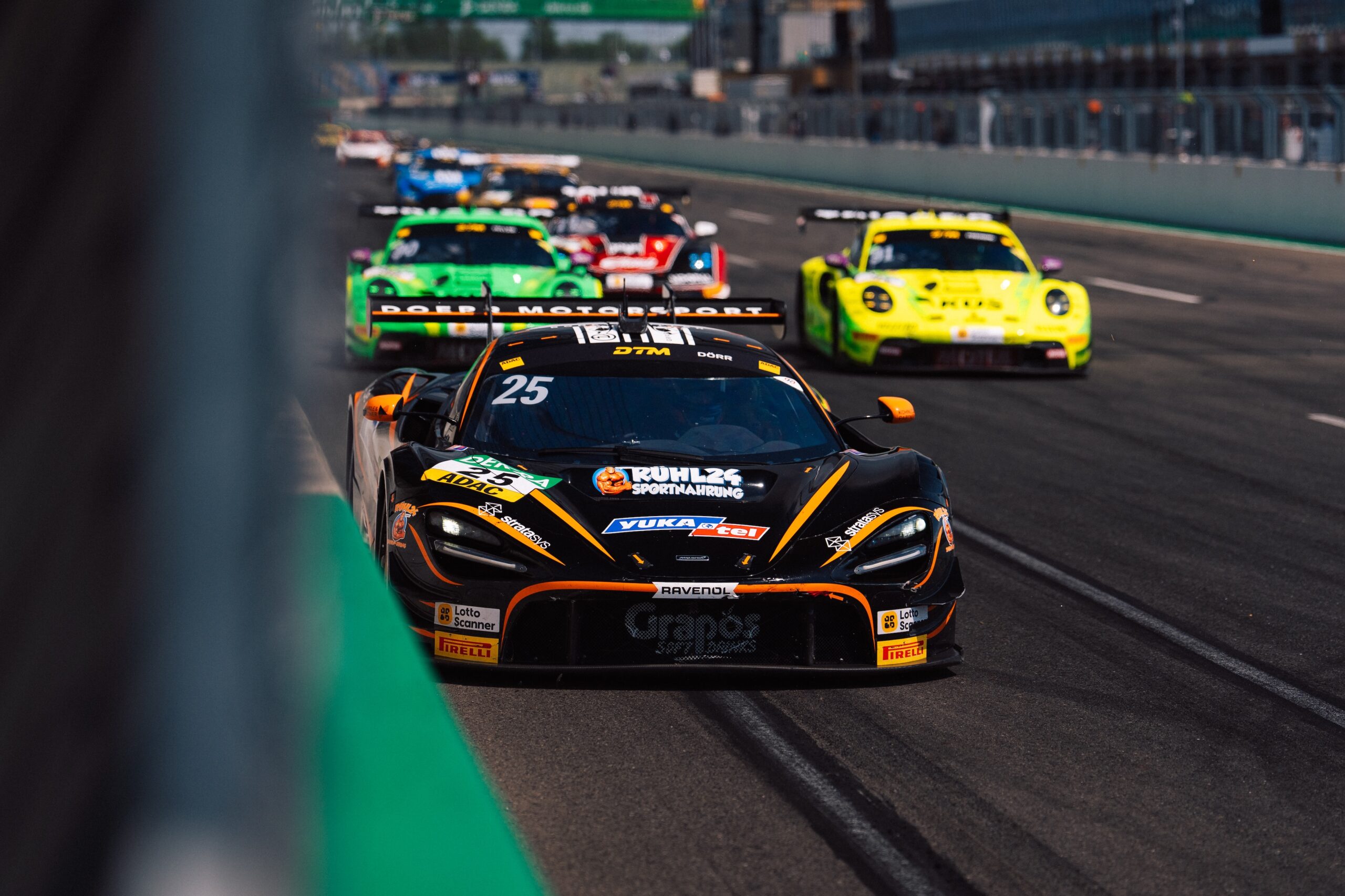
The Norisring forces DTM to treat Qualifying differently from every other circuit on the calendar. Instead of sending the full field out together, organisers split the drivers into two groups to reduce traffic and give each competitor a better chance of finding clear air.
That matters more in Nuremberg than almost anywhere else. The Norisring measures only 2.162 kilometres, but its concrete walls, braking zones and uneven street-circuit surface create a demanding challenge. Therefore, a clean lap can make the difference between a front-row start and a midfield grid slot.
Why the Norisring needs a different Qualifying system in DTM
DTM uses the special format because the Norisring creates heavy traffic in a normal session. The short lap means drivers complete more tours, while low tyre degradation encourages teams to keep cars on track for longer runs.
As a result, interference becomes difficult to avoid. One slow car, a mistimed warm-up lap or a driver preparing tyres can quickly disrupt another driver’s flying lap. By splitting the field, DTM reduces congestion and improves the chance that each driver can attack without constant traffic.
The venue’s characteristics add another layer of difficulty. The Norisring rewards late braking, strong traction and straight-line performance, yet the walls leave little margin for correction. Consequently, drivers need rhythm and track position as much as raw speed.
How DTM decides the two Qualifying groups at the Norisring
DTM has used two Norisring Qualifying groups since 2022. However, since 2023, Friday Free Practice has decided the group allocation rather than the championship standings.
The system works simply. Drivers who finish Friday Free Practice in odd-numbered positions go into Group A. Drivers in even-numbered positions go into Group B. Therefore, Friday pacesetter Ben Dörr enters Group A in the Dörr-McLaren, while second-placed Lucas Auer heads into Group B with the Landgraf-Mercedes.
If the field loses Friday Free Practice entirely, the championship standings decide the groups instead. For drivers without points, the starting number decides the order, with lower numbers taking priority.
How the grid comes together
On Saturday, Group A runs first in a 20-minute Qualifying session. After a short break, Group B completes its own 20-minute session.
The fastest driver across both groups takes pole position. However, DTM then places the fastest driver from the other group second. After that, the grid alternates between the two groups.
For example, if the fastest Group A driver takes pole, the fastest Group B driver starts second. The second-fastest Group A driver then starts third, while the second-fastest Group B driver starts fourth. The pattern continues until organisers complete the starting grid.
This approach prevents one group from filling one entire section of the grid and balances the outcome across both sessions. It also means every driver must beat their direct group rivals as well as monitor the overall benchmark.
Why the running order still matters
The running order can still influence the final result. On Saturday, Group B usually benefits from running later, as the circuit often gains grip with every lap completed. To balance that, DTM reverses the order on Sunday, with Group A running later for the second race’s Qualifying session.
However, weather can complicate that logic. If rain arrives or track conditions change sharply, the advantage can swing quickly. In that case, one group may gain better conditions twice despite the reversed order.
The wider Norisring picture can also make Friday pace harder to read. Balance of Performance does not rely on one adjustment alone, as weight, ballast, ride height, wing angle, restrictors and boost limits all shape how each GT3 car produces lap time. At the Norisring, braking stability, traction and straight-line efficiency can make those trade-offs especially important.
What happens with lap deletions and penalties
Race control treats lap deletions within the group structure. If officials delete a driver’s Qualifying laps at the Norisring, they place that driver behind the other competitors from the same group at the back of the grid.
Grid penalties work differently. DTM applies those drops to the combined starting order, even if that move changes the driver’s original group side on the grid. Therefore, a penalty can move a driver away from the side created by the alternating group format.
That distinction matters because the Norisring grid does not come from one single session. Instead, the final order blends two separate Qualifying results, lap deletion rules and any additional penalties.
Official 2026 DTM Norisring Qualifying groups
Group A
- Ben Dörr — Dörr-McLaren
- Jules Gounon — Winward-Mercedes
- Maro Engel — Winward-Mercedes
- Thierry Vermeulen — Emil Frey-Ferrari
- Matteo Cairoli — Emil Frey-Ferrari
- Marco Mapelli — Abt-Lamborghini
- Luca Engstler — Abt-Lamborghini
- Nicolas Baert — Comtoyou-Aston Martin
- Finn Wiebelhaus — HRT-Ford
- Ricardo Feller — Manthey-Porsche
- Marco Wittmann — Schubert-BMW
Group B
- Lucas Auer — Landgraf-Mercedes
- Tom Kalender — Landgraf-Mercedes
- Mirko Bortolotti — Grasser-Lamborghini
- Maximilian Paul — Grasser-Lamborghini
- Nicki Thiim — Comtoyou-Aston Martin
- Arjun Maini — HRT-Ford
- Timo Glock — Dörr-McLaren
- Kelvin van der Linde — Schubert-BMW
- Thomas Preining — Manthey-Porsche
- Bastian Buus — Land-Porsche
Why this format suits the Norisring
The two-group system gives the Norisring a Qualifying structure that fits its layout. It reduces traffic, creates clearer laps and adds an extra strategic layer to the weekend.
It also makes Friday Free Practice more meaningful, as every position determines which group each driver joins. With Ben Dörr and Lucas Auer leading the split, the 2026 Norisring weekend now has two separate Qualifying battles before the final grid comes together.