
DTM growth remained a central topic as Maro Engel and Jules Gounon considered how the championship could build on its strong crowds and competitive racing.
Both Mercedes-AMG Performance Drivers believed the series still had opportunities to reach a wider audience. While they praised the atmosphere at the circuits and the accessibility of the racing, Engel and Gounon believed further DTM growth would depend on greater mainstream media exposure and more immersive coverage.
In an exclusive interview with Pit Debrief, the pair discussed the championship’s growing popularity, the need for increased television coverage and how live onboard cameras could bring supporters closer to the action.
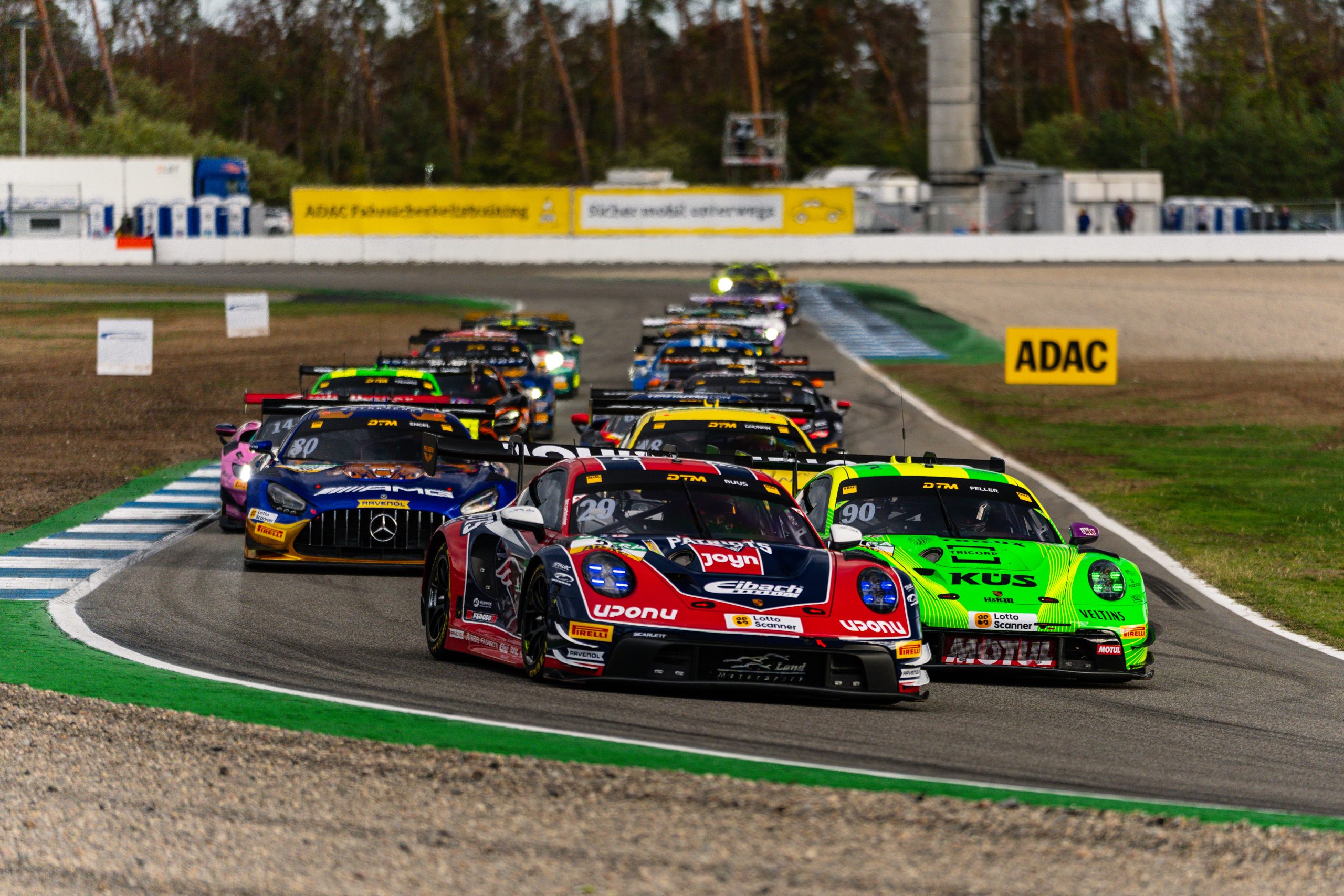
Engel praised DTM’s growing crowds and on-track action
Engel believed DTM already offered the quality of racing needed to attract and retain spectators. He highlighted the growing attendance figures and felt the championship had consistently delivered exciting action in recent seasons.
He pointed to the previous season’s finale as a particularly strong example and believed DTM’s main challenge involved spreading awareness of the series. Engel felt people who attended races generally left impressed by both the competition and the overall experience.
“I mean, to be honest, it’s amazing how many people are at the track and how many fans are coming. Year on year, it’s just been growing. Honestly, I think it’s hard to produce better on-track racing than we’ve seen over the past few years in DTM. Especially the championship finale last year—it was crazy.”
“So, on that level, it’s just about spreading the word that DTM racing is awesome. Everybody who comes here is fascinated by it and loves it.”
Engel called for greater mainstream media attention
Despite the strong trackside support, Engel believed DTM deserved greater recognition outside its established motorsport audience.
He argued that sporting events attracting crowds of more than 100,000 people should receive more attention from mainstream media in Germany. Engel added that DTM needed to continue showcasing the quality of its racing and encourage more people to follow the championship.
For Engel and Gounon, DTM growth also required stronger coverage that could introduce the series to people beyond its existing motorsport audience.
“From my perspective, I think a bit more mainstream media could pay attention to it because there aren’t that many sporting events in Germany that draw crowds of over 100,000 people.”
“I think it’s top-notch racing, and I hope we can continue to show that, impress people and get them to tune in. Certainly, for the people who are at the racetrack, I really get the feeling that motorsport, and DTM in particular, is absolutely top-notch. They’re super happy to be there and witness it.”

Gounon highlighted DTM’s football-like atmosphere
Gounon agreed that DTM’s fans represented one of the championship’s greatest strengths, although he felt limited media coverage prevented the series from reaching its full potential.
He recalled entering the Hockenheim stadium section from the back of the field after penalties had affected his race. Despite the difficult result, he could feel the crowd’s reaction from inside the car as spectators stood and responded to the action.
“I fully agree with Maro, to be honest. The fans are really great in DTM. Like Maro said, I feel we are maybe lacking a little bit of media coverage. But, to be honest, when you look at last year’s event in Hockenheim, like Maro said, I entered the stadium after having a bad race, so I was at the back because I had some penalties. When I entered the stadium, I could really feel, even from inside the car, that people were standing up and that something was going on.”
Gounon added that his friends in the garage later compared the atmosphere to a football stadium because of the noise and energy generated by the fans.
“After watching the replay, even my friends who were in the box said, ‘We felt like we were in a football stadium.’ People were shouting, and it was something really nice.”
Gounon believed DTM’s format suited new fans
Gounon also believed DTM’s straightforward format made it particularly suitable for people discovering motorsport for the first time.
Each car featured one driver, while the relatively short races combined pit stops with regular on-track action. He contrasted that structure with GT World Challenge, where multiple classes, driver changes and different pit-stop strategies could make the running order more difficult for new viewers to understand.
Gounon and Engel linked DTM growth to the championship’s accessible format, which allowed new supporters to understand the racing without extensive knowledge of GT competition.
“I think the DTM format is actually maybe the easiest for somebody who is new to the sport to understand. There is only one driver, the race is short, there is a pit stop and there is action.”
“Whereas, arguably, in GT World Challenge, it is hard to understand the Pro car, the Bronze Cup car, the Silver car and the Pro-Am car. There are three-hour races, sometimes there is a pit-stop schedule, and cars drop from P1 to P25. It is very hard to understand when you are new.”
Gounon backed more live onboard coverage
Gounon believed DTM had consistently produced strong racing at circuits including Hockenheim, the Sachsenring and the Lausitzring. However, he felt greater access to live onboard footage could help supporters feel closer to the drivers.
“But DTM is not hard to understand. Like Maro said, the racing is great. Not only at Hockenheim—I remember racing at the Sachsenring and the Lausitzring, and there were amazing races throughout the season.”
“And yeah, maybe a few more onboard cameras. That is something I saw at the Nordschleife, of course with Max driving. I think when people have access to a live onboard camera, they feel a little bit closer to us, which is something that has always been difficult in our sport.”
Onboard cameras could make DTM more accessible
Gounon felt motorsport remained harder for fans to experience directly than sports they could easily recreate themselves. Football supporters could buy inexpensive equipment and imitate their favourite players, while most people could not understand what driving a Mercedes-AMG GT3 felt like.
He believed live onboard streams could help close that gap. Gounon suggested that DTM could offer footage from every car through its app, allowing fans to follow the action from a driver’s perspective.
“Let’s say you are a football fan: you go to Decathlon, buy a cheap pair of shoes and a small ball, and you can try to be your favourite football player. For a fan to experience what we are feeling in a Mercedes-AMG GT3 is a bit more difficult.”
“So, at least when fans have access to a live onboard camera, it is something you can share together. Maybe DTM could put live onboard cameras in all the cars and do something through the app. I’m sure there are different ways to try to involve the fans more.”
Engel and Gounon saw further potential in DTM’s growing audience
Engel and Gounon believed DTM already had a strong foundation through its competitive racing, accessible format and passionate trackside following. Greater mainstream media attention, even wider television coverage and more immersive digital features could help the championship reach people beyond its established audience.
Ultimately, Engel and Gounon felt DTM growth could continue by making the series easier to discover and giving fans more direct access to the action inside the cars.