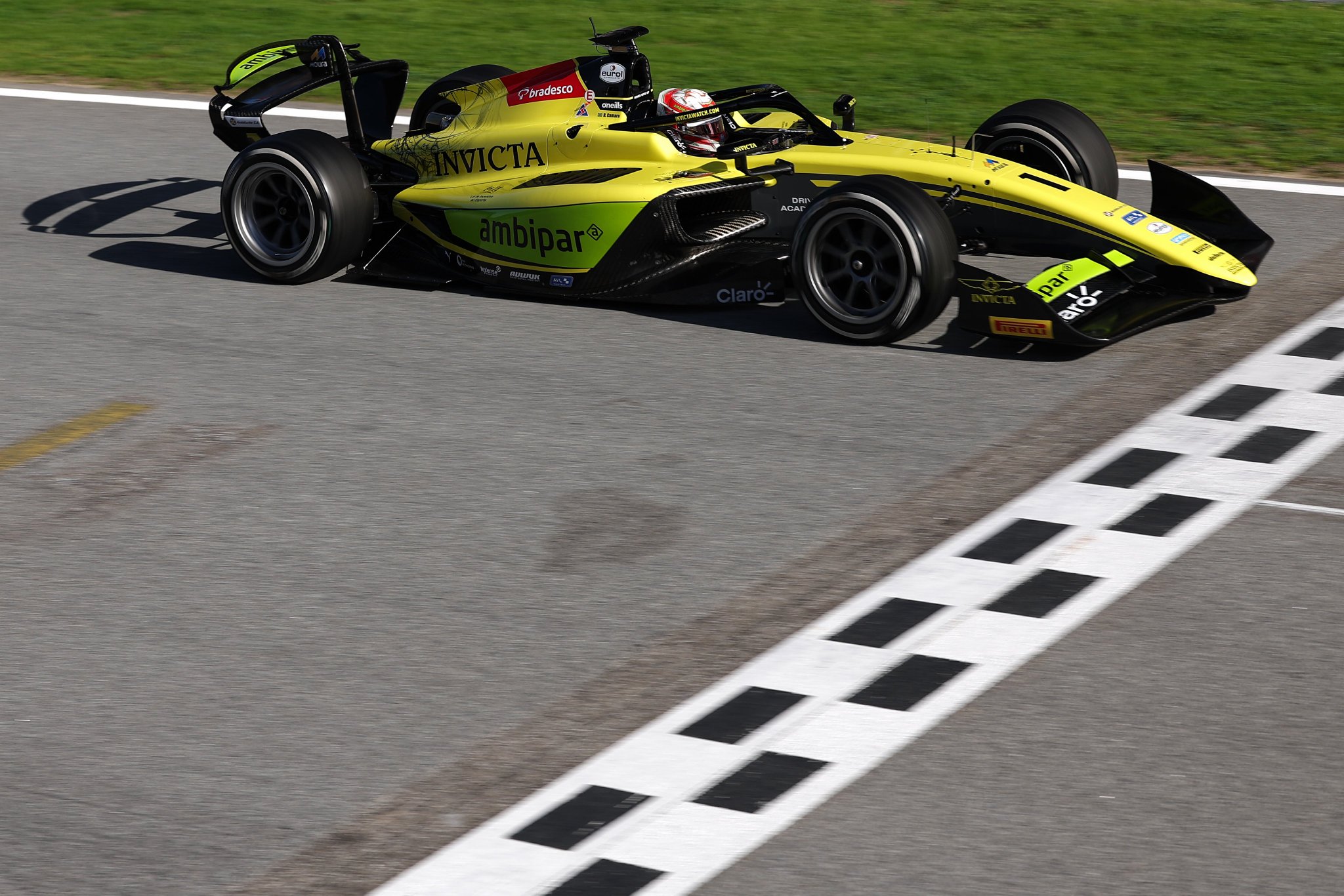
Invicta Racing’s Team Principal James Robinson spoke exclusively to Pit Debrief about the technological advancements in the sport and how they’ve become a vital part of a drivers’ development as they progress through the motorsport ladder.
Over the past two years, the team has established itself as the benchmark in Formula 2, guiding Gabriel Bortoleto and Leonardo Fornaroli to consecutive Drivers’ titles. Alongside those achievements, Invicta Racing also secure the Teams’ Championship in both seasons.
The technical leap from F2 to F1
In 2025, Formula 1 welcomed one of its largest group of rookies in recent years, with four drivers graduating directly from their Formula 2 campaigns. The championship continues to serve as a crucial stepping stone, providing a platform for drivers to develop key skills such as delivering technical feedback and adapting to higher levels of performance.
Robinson explained that the step from F2 to F1 presents a far greater technical leap than from F3 to F2, particularly in terms of car systems and steering wheel complexity. However, he acknowledged that introducing more F1-style technology would significantly increase costs, ultimately limiting how much Formula 2 can replicate.
Robinson said: “Yeah, it’s a challenge for us, especially in Formula 2, where the leap from F2 to F1 is so significant, especially around the car systems. So if you look at the functionality of an F2 steering wheel, for example, and you compare that to Formula 1, it’s a far, far, far bigger jump from F3 to F2.”
“It couldn’t be more different because F3 and the F2 steering wheel is the same steering wheel. And so that’s a huge undertaking for drivers to adapt. But it’s a difficult one because as soon as we started adapting F1 systems, so by that I’m really talking about hybrid power, then the budgets would just go through the roof in our championship. So there is a limit to what we can do.”
The challenges of balancing costs, complexity and driver development
F1 Driver Academies provide another pathway for young talents to develop, but not every driver has access to the backing and support of a Formula 1 team. Robinson noted that certain advanced technical elements must be developed within those academies, as implementing these complex and costly systems in F2 would be “unsustainable”.
“Some of that needs to be onboarded by the F1 academies, because then if it was down to us, then we would need to have certain systems on the car that would just be so expensive and complicated to run. That it would be unsustainable for the championship. But in terms of outside of that, obviously the core skills are very transferable from one to the other.”
Despite certain limitations, he explained that F2 remains as a natural bridge between F3 and F1. He believes the core driving fundamentals remain relatively transferrable and refinable.
“So obviously F2 sits very much as a bridge across from F3 to F1. And it does sit in quite a natural middle place in terms of driving fundamentals of braking, turn and throttle application. So that sort of stuff is actually relatively straightforward just from looking at telemetry and general driver coaching.”