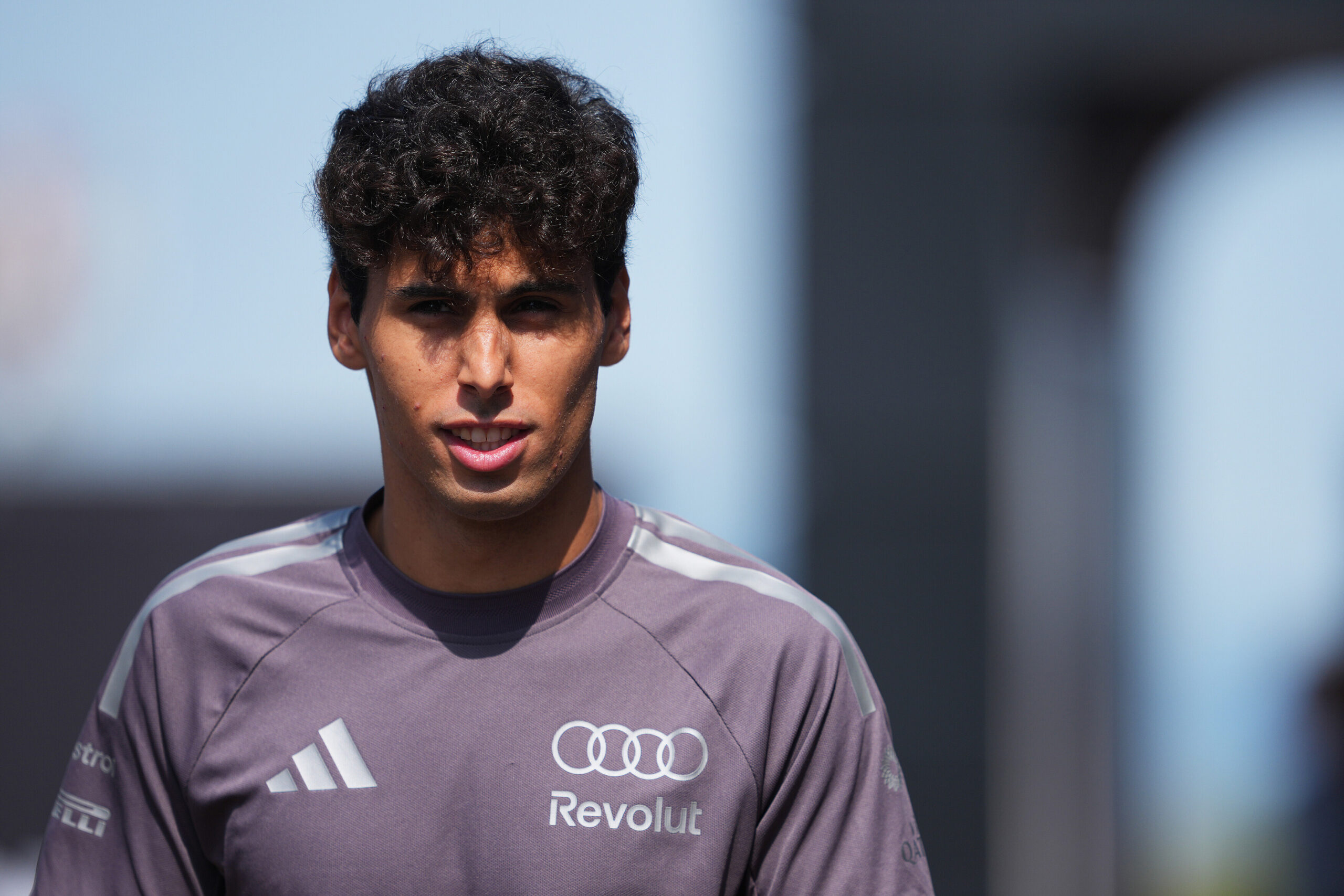
Audi driver Gabriel Bortoleto shares his thoughts on the controversy surrounding the 2026 F1 regulations, particularly on the PU side, with the increasing usage of AI software and its impact on driving and pace.
The 2026 F1 regulations have sparked criticism, particularly the new PUs, which have drawn significant controversy, with energy deployment seemingly affecting the driver’s ability to attack the track in the hunt for fastest lap times. Especially on power-hungry tracks, like Silverstone and Spa-Francorchamps, finding the optimal deployment strategy to prevent running out of energy and thus losing time has become a key strategic factor in the 2026 F1 season.
However, the fact that teams use AI software to optimise deployment over a lap has been scrutinised, as drivers have less influence as a result. In the view of Audi driver Gabriel Bortoleto, F1 is a sport of innovation and “future technology” that, to him, aligns with the increased use of assistive mechanisms such as AI software under the 2026 F1 regulations.
The usage of AI software
“Well, but we are in F1, aren’t we?
“We are developing the future technology. If we are not using all the tools that are available in the world for us to, in our favor, then I don’t know what F1 is about.”
In the past, a point of criticism was the drivers having too much work behind the wheel. Now, the narrative has shifted to the drivers having less control, Bortoleto points out, saying he is “happy” with how the sport is progressing with the 2026 F1 regulations.
“I think people used to complain because nowadays the drivers have too much things to do. Now that there is things doing it for us, we are complaining now that they are doing it for us. So I think I’m happy with the way it’s going.
“I think it’s nice that the software is able to adapt itself and understand what and how much energy you are deploying through the lap and how to evolve through the laps, next laps you are doing. I don’t think it should change. If I’m very honest, that’s my opinion.”
Since energy management has become an important factor with the introduction of the 2026 F1 regulations, drivers, such as Bortoleto, needed to adapt and learn how to optimise deployment across a lap. It is said that certain driving styles may not suit this particular management aspect, but Bortoletto feels that a key skill of an F1 driver is the ability to adapt to the car underneath them. Compared to the previous season, the Brazilian didn’t have to change his driving too much aside from a few refinements and learning the best way to manage his energy across a lap.
Bortoletto didn’t need to change his way of driving to suit the 2026 F1 regulations
“I don’t think I changed much in my way of driving. But again, I don’t like this sentence driving style because I don’t believe that a F1 driver should ever say that, because we should be able to adapt. Even if it’s not natural maybe, but we should be able to adapt to any type of car and the way you need to drive. That’s why we do what we do, and that’s why we are the 22 drivers in the world doing F1.
“So, I think it’s just a matter of what car you have and how you need to drive them. And I think from last year, I didn’t change much the way I drive, but obviously, you fine-tune a bit here and there.
“You know how the energy deploys out of some corners. So, you know if you can push more on the entry and you care about less on the exit because there’s no energy being deployed there, or if you actually need to be a bit more careful on the entry because there’s going to be a long straight and a lot of energy being deployed, so you need to change. Like last year it was always constant, so you didn’t have to do so.”
Bortoletto dismisses the notion that “aggressive” approach is required
Some believe this new generation of cars, born out of the 2026 F1 regulations, requires a more aggressive approach, but Bortoletto dismisses that notion, as he doesn’t view himself as an “aggressive” driver. Instead, the Audi driver believes this narrative derives from the way some drivers attack the corner, though he doesn’t count himself in that category of F1 drivers.
“Look, I don’t know about other cars. I can talk from mine and I don’t think we need to be more aggressive. I think I’ve been doing the same as last year and I don’t judge myself as a driver that is aggressive.
“I think I know what you mean because people have been saying about some drivers really pushing the entries and pushing with the front axle. I don’t think that’s our case. I don’t think I drive like that.
“I think I’m more of a guy that has… I like the rear moving quite a bit, but I don’t like to screw up the front axle, for example, and I don’t think it makes our car quicker if I do that. I already tried as well.
“I think the way we are developing the car and the way we are doing things are not in that direction.”
Detailing different approaches
Going into detail about the particular way some drivers on the F1 grid attack the corners, by attacking the corner entry, as opposed to nailing the exit to carry more speed out of the corner, which some believe is the best approach for this 2026 generation of F1 cars, Bortoleto says that this approach is not used in every corner
“No. No, but again, it’s not like this every corner. It’s different.”
The Brazilian continues, giving his own approach to Turn 13 at Spa-Francorchamps as an example.
“If you want an example, I’m going to give you a good example. So, like out of T13 in Spa, we didn’t have any deployment on the engine. Basically, if you just push a bit more on the corner, you could run a bit wider in T12 and still go full throttle very early for T13 because you don’t have deployments, and we have a lot of downforce. The car was not going to snap or lose the rear because you don’t have enough power.”
Adaptation is key
To Gabriel Bortoletto, the 2026 F1 regulations may require a different approach, repeating his view that being able to adapt to different requirements is a key skill in motorsports, even if the technique needed to be employed goes against what a driver is used to from their first steps into the world of motorsport.
“It’s a different way of approaching. But again, I think motorsport shouldn’t be about only one way of driving, or it’s not because we learned something in go-karting that we need to be doing the same thing for the rest of our lives.
“I think driving techniques needs to be… My engineer is smiling because he keeps pushing me in that direction. And I think it’s important, you know, that you are able to adapt to everything.
“And there is going to be times I’m going to be frustrated because I’m not going to be able to do something. But, you know, that’s the fun part of motorsport as well.”
Fast drivers not slowed down by new 2026 F1 regulations
Since the start of the 2026 F1 season and the introduction of the new regulations, there has been debate over whether the current regulations have affected the pace of drivers like Max Verstappen, Lewis Hamilton, and Charles Leclerc. Given that these drivers are still fast and “very competitive”, Bortoleto does not believe their pace was impacted.
“Do you see Verstappen being slow?
“Do you see a seven-time world champion being slow this year? Do you see Leclerc being slow?” Bortoletto questions.
“I don’t see them being slow.
“I still see them very competitive. So I wouldn’t say fast drivers are slow. Actually, Lewis is a bit better than he was doing last year.
“Max is still performing like crazy, putting that car on the top. Lando, the World Champion, the reigning World Champion, is still quick when his thing [car] doesn’t break.
“I don’t think we have seen slow drivers last year becoming quick and the quick guys slow. I think it’s still racing.”