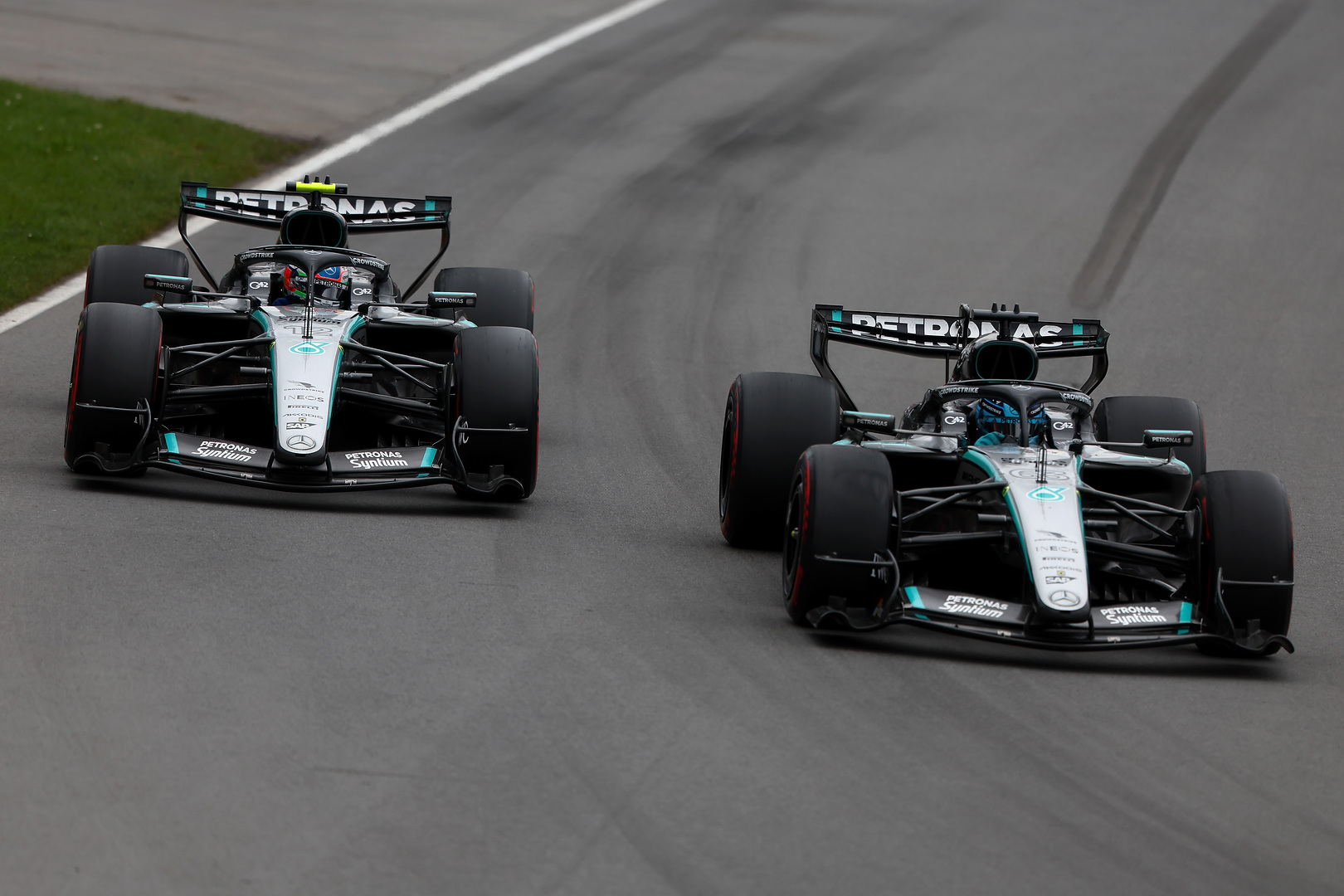
In the latest edition of the NU Silver Arrows Radio Show, Mercedes Technical Director James Allison and Mercedes HPP (High-Performance Powertrains) Managing Director Hywel Thomas looked back on the preparation for the new regulations, a successful first half of the 2026 F1 season, and also gave an outlook on what to expect from the team in the second half of the season.
Mercedes started the 2026 F1 season strong with a 1-2 finish in the season-opening Australian GP and quickly emerged as the favourites to claim both Drivers’ and Constructors’ titles.
Success was not guaranteed
After dominating the Turbo Hybrid era, many anticipated that Mercedes would be the team to beat in the 2026 F1 regulatory cycle. However, Mercedes HPP Managing Director Hywel Thomas notes that the team did not dare to “assume” they would dominate solely on the basis of their past successes.
Even after pre-season testing, which suggested Mercedes was competitive, there was still uncertainty within the team about how they would fare compared to the competition.
Recalling the season opener, where he stood on the podium alongside winner George Russell and second-placed Kimi Antonelli, Thomas notes that it was a “fantastic feeling” to start the 2026 F1 season with such a strong result.“You can always imagine that things might go that well because we’ve achieved similar success in the past.
“But it would have been naïve to simply assume we would arrive and dominate.
“The pre-season testing data suggested we could be competitive, but it didn’t suggest we would be as strong as we were in Melbourne. And throughout development, you never really know what your competitors are doing.
“Even during testing, you’re making educated guesses rather than dealing with complete information.
“So, when the first race arrives, there’s always a degree of uncertainty. To see everything come together as successfully as it did was a fantastic feeling.”
Success in the season opener rewarded years of hard work
Heading into the 2026 F1 season and the new regulatory cycle, Mercedes was acutely aware of how important it was to have a strong car right from the start as it would benefit the team down the road. The successful start to the 2026 F1 season was thus “enormously satisfying” for Mercedes after years of development work for the new Regulations, says Technical Director James Allison.
“One of the messages we’ve repeated internally for several years is that regulation changes of this magnitude can define success for multiple seasons.
“The team that gets it right at the beginning can potentially build a long-term advantage, so we’ve been approaching 2026 with that in mind for a long time.
“As we got closer to launch, the intensity naturally increased because we knew what was at stake.
“Arriving in Melbourne with a genuinely competitive car was enormously satisfying.”
While Mercedes started the season strong and has celebrated many successes since, there is little time to sit back and “enjoy” the accomplishments, as the sport is ever-moving, constantly evolving, and team and drivers are always chasing the next victory, says Allison.
“At the same time, F1 doesn’t really allow you to stop and enjoy it. You immediately move on to the next race, the next challenge and the next opportunity.
“That’s effectively how the entire season has felt so far. We’ve simply been moving from event to event, trying to execute well and make the most of the work we’ve done.”
Competiors closing the gap
Over the course of the first half of the 2026 F1 season, Mercedes has firmly established their place at the top, leading the Constructors’ Championship with 79 points separating them from second-placed Ferrari.
With every new upgrade package introduced, there is the potential for one of Mercedes’ competitors to be closing the gap. In the first half of the 2026 F1 season, only Ferrari and McLaren have managed to get the better of Mercedes on occasion, but the next upgrade package might allow one of the other teams to bring the fight to Mercedes on a more consistent basis.
“Absolutely,” says Allison when asked if the team feels the pressure from other teams mounting. As the new regulatory cycle is still in its infancy, the “development rates” are much higher than in the previous season, when the regulations were, at that point, well established.
“One of the defining characteristics of this regulation cycle is just how immature the regulations still are. Development rates are enormous compared to previous years.
“On the aerodynamic side, the gain rate we’re seeing in the wind tunnel is roughly six or seven times greater than it was last season.
“It’s roughly half a second every couple of months, which is a very significant rate of progress.”
Mercedes started development race ahead of the 2026 F1 season
In preparation for the 2026 F1 Regulations, Mercedes took a huge risk by incorporating several development steps into the base version of the W17. The risk paid off, as Mercedes dominated in the early stages of the season and still holds an overall car advantage over their competitors, who already introduced several upgrade packages in the first half of the 2026 F1 season.
“We made a conscious decision before the season to push the first car harder than we’ve ever pushed one before. We left things later than usual and effectively built a programme with almost no contingency.
“The upside was that we were able to capture as much of that steep development curve as possible before the first race, which is why the car arrived with such a strong level of performance.”
The “downside” to Mercedes’ approach to the development race
While Mercedes certainly got a head start with their risky approach, they are trailing the competition in introducing upgrades. Since the competition has yet to consistently close the gap on Mercedes, their teams’ main goal is to stay ahead until their next upgrade package restores the competitive advantage they had at the start of the 2026 F1 season, according to Allison.
“The downside is that we essentially spent all of that performance upfront. Other teams finalised their cars earlier and were therefore able to begin developing upgrades earlier.
“We’re now slightly out of phase with some of our competitors. They have been introducing upgrades while we’ve been rebuilding our development pipeline.
“What we’re seeing is that everyone is making gains at a broadly similar rate. That means the competitive picture can change very quickly.
“Our objective is simply to keep our nose in front and ensure that the next wave of upgrades restores the advantage we built at the start of the season.
“In the meantime, we just have to ride out those moments when other teams arrive with significant new developments.”
Allison looks ahead to the second half of the 2026 F1 season
The second half of the 2026 F1 season is fast approaching, and Allison expects it to be “fascinating” as teams continue to develop their cars and gaps become narrower. As in every season, there will come a time when teams face the decision to shift their development focus to the 2027 challengers.
Finding the right time for this crossover will be important in the fight for the Championship, says Allison, explaining that it will be key to strike the right balance between pushing developments on the W17 and preparing for next year.
“It’s going to be fascinating.
“Every F1 team faces the same dilemma at some point in the season: when do you stop developing the current car and switch your focus fully to next year?
“The difficulty is that development rates are still exceptionally high. If you stop too early and your competitors continue finding performance, the final part of the season can become very uncomfortable.Our job is to judge that moment correctly.
“We need to continue bringing performance to the track at a rate that allows us to stay ahead of the development race while also making sensible decisions about how much resource we commit to the future.”
Mercedes’ Technical Director is “optimistic” about the team’s prospects for the second half of the 2026 F1 season, given what the team has in store in terms of upgrades, though Allison notes “meaningful performance” is yet to arrive.
“I feel optimistic about our position because I know what we’ve already seen in the wind tunnel and I know what is still making its way through the development pipeline.
“There is meaningful performance still to come.
“The challenge now is executing that programme effectively and ensuring those upgrades arrive at the racetrack smoothly and deliver the performance we expect.”
Allison believes reliability will play key role in 2026 F1 season and title fight
While Mercedes experienced a successful first half of the 2026 F1 season, they also were faced with a number of reliability woes. Especially George Russell has been plagued by minor and major mechanical issues that put a damper on his Championship aspirations.
For the second half of the 2026 F1 season, it is thus expected that reliability will become a factor for teams, with penalties for exceeding the permissible limit for new engine parts looming.
“I think that’s absolutely true,” says Allison when faced with the question about reliability becoming a factor in the title fight. Adding that reliability might play a bigger factor than future upgrades.
“Everyone naturally focuses on upgrades because they’re visible and they’re exciting, but reliability may end up having a much bigger impact on the championship.
“A successful upgrade programme might gain you ten, fifteen or perhaps twenty points over the course of a season, depending on the circumstances.
“A single retirement can cost you that amount in one afternoon.
“So while we’re committed to continuing development, our biggest focus going into the second half of the season is reducing the self-inflicted wounds that have cost us points in the opening races.
“We’ve had reliability issues and operational setbacks that simply shouldn’t happen, and addressing those areas is arguably more important than the next upgrade package.
“If we can continue to improve the car while also delivering clean execution and reliability, then we’ll put ourselves in the strongest possible position for the championship run-in.”
Every point counts
As other teams continue to close in on Mercedes, it will be important for the team to maximize their points haul and avoid setbacks due to reliability woes, confirms Allison, noting that in a tight battle for the 2026 F1 Championship, “reliability and execution” are key factors determining success.
“Exactly. When championships are decided by fine margins, reliability and execution become critical.”