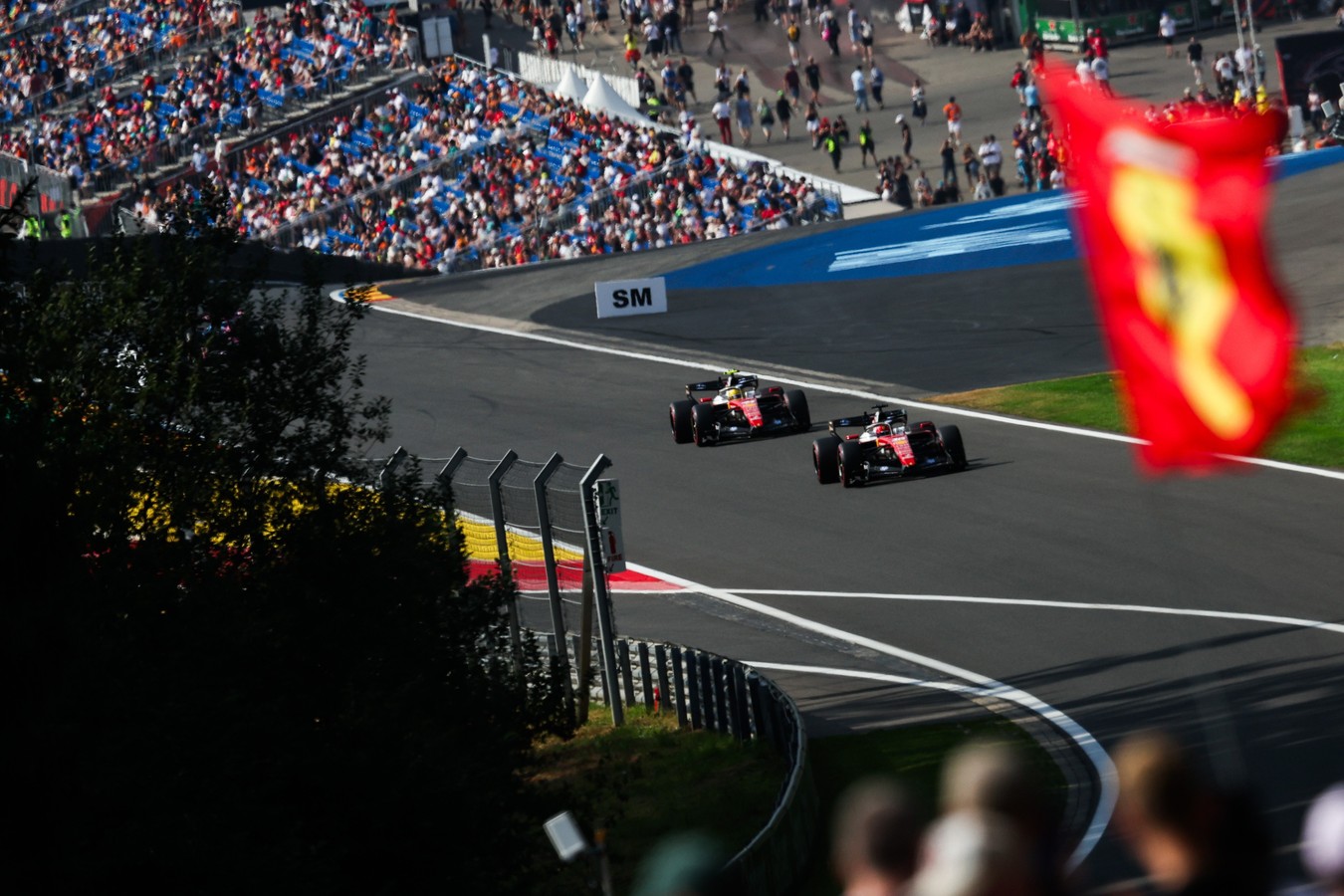
Ferrari endured a mixed opening day at the 2026 F1 Belgian GP as the competitive picture shifted significantly between the two Friday practice sessions. Lewis Hamilton and Charles Leclerc finished second and third behind Max Verstappen in FP1, giving the Scuderia an encouraging start at Spa-Francorchamps.
However, Ferrari slipped back as its rivals improved in FP2. Hamilton took fourth behind Kimi Antonelli, Lando Norris and Verstappen, while Leclerc ended the session outside the top ten as he lost his best time to track limits. Ferrari Team Principal Fred Vasseur and his drivers consequently focused on the challenges posed by energy deployment, the compromise between downforce and straight-line speed, and the work required before qualifying.
Vasseur explains Spa’s unique energy challenge
Ferrari started the F1 2026 Belgian GP weekend strongly, with Lewis Hamilton and Charles Leclerc finishing second and third behind Max Verstappen in FP1. However, the picture changed during the second practice session, as Hamilton dropped to fourth while Leclerc ended the session outside the top ten.
Team Principal Fred Vasseur explained that Spa-Francorchamps has become an even greater challenge under the 2026 regulations due to the circuit’s significant energy requirements and long straights.
“Yeah, but it’s… for sure Spa is a challenge. It was always a challenge, but it’s even more a challenge with the energy requirements. We saw today that on the race mode that you have a huge delta speed between the cars from one straight line to the other, different sometimes that you are 20 kph slower in one straight line and 10-15 faster in the other one. It means that we have a lot of work to do. For sure the energy that you are deploying is the same, but for the preparation of the race it can be a challenge because you have to think about how you attack and how you defend.“
Despite Ferrari’s apparent step backwards between the two sessions, Vasseur warned against reading too much into Friday’s times. He pointed towards the different engine modes and fuel loads used by teams throughout practice.
“Yeah, but if you have a look on the last 3 or 4 Fridays, it’s not always representative of the qualification. I think we are all using different modes, different level of fuel and so on. Let’s see tomorrow afternoon.“
Ferrari weighs deployment trade-off at 2026 F1 Belgian GP
The new generation of power units has made energy deployment an increasingly important factor. At Spa, teams must decide where to use their available electrical energy across a lap, creating significant differences in speed between cars on separate sections of the circuit.
Vasseur revealed that Ferrari’s cars could lose as much as 20 kilometres per hour to their competitors on one straight before gaining the same advantage elsewhere.
“Yeah, because that… without disclosing any secret, but if you have a look on the race pace, we were 20 kph slower than some of our competitors before Les Combes, but we were 20 kph faster in the last straight line. It’s a trade-off for sure. It’s not that you can do a plus 20 at plus 20, but if you have to think about the race, you have to do it properly.“
That trade-off will play a crucial role on Sunday. Teams must find a deployment strategy that allows their drivers to attack effectively without leaving them vulnerable to rivals on another part of the circuit.
Vasseur dismisses Red Bull rear-wing comparisons
Red Bull encountered problems with its rear-wing system during the opening day at Spa, prompting comparisons with the solution Ferrari has used this season.
However, Vasseur rejected the suggestion that the two teams had adopted the same concept. He explained that Ferrari’s design operates differently and has not caused the team any reliability concerns.
“It’s not a similar concept, because it’s not rotating in the same way. We didn’t have any issue. We were a bit slow at the beginning. It’s why we didn’t raise the wing the first 2 or 3 events. And we raised it after race 4.“
When asked whether Ferrari’s experience demonstrated that its own system remained safe, Vasseur highlighted the distance the team had already completed without encountering a problem.
“So far we did 10,000 km without any issue.“
Vasseur declined to speculate about the exact nature of Red Bull’s difficulties, insisting that the two designs remained fundamentally different. The Ferrari Team Principal also urged observers not to overreact to Leclerc’s changing fortunes. The Monégasque returned to the top step of the podium at Silverstone, but Vasseur argued that his performances had remained competitive before that victory.
“Yeah, I don’t want to speak for Red Bull, and I don’t know what’s happened to Red Bull. I have enough to do with my guys. But I don’t know. I think both guys are completely different.
“I’m sure that if tomorrow he’s not performing, you will say the opposite. You have to stay calm, and I’m very happy for Charles [Leclerc] to have Charles back on the top of the podium. But I was the first one to tell you that he was not nowhere before. He was on the first row in Austria. He had some issues with reliability in Spain. In Monaco he was going for the pole. We have to stay calm.“
Hamilton identifies Ferrari’s middle-sector weakness
Hamilton admitted that Ferrari’s performance in FP1 at the 2026 F1 Belgian GP exceeded the team’s initial expectations. However, he felt the second session offered a more representative indication of the competitive order after Ferrari’s rivals made progress.
“Yeah, I think FP1 looked a bit stronger than we anticipated, and then FP2 everyone jumped up and took another step, so that was probably more realistic. And then, the car generally feels good, but we’re lacking a little bit in the middle sector for some reason, so we’re trying to figure out why.“
Although Ferrari struggled to match the leading pace in FP2, Hamilton continued to enjoy the challenge of driving at Spa. However, he expressed frustration with the way the 2026 power units lose performance towards the end of the circuit’s long straights.
“Yeah, it’s still amazing to drive. I mean, through corners and everything, it’s good. It’s just the straights where the engine dies. I don’t know what they’re going to do to fix that in the future, but I hope they do. In the end, you should just keep pulling.“
Ferrari targets overnight improvement at the 2026 F1 Belgian GP
Hamilton suggested that Ferrari had already placed its energy deployment strategy within a suitable operating window. As a result, the team will focus much of its overnight work on improving the car’s performance through Spa’s middle sector.
“I think we’re pretty much there, I think, in the window. So, I don’t know if we’re looking like we’re down in the high speeds on the straights. It’s just that middle sector is looking a little bit slow for us, so we need to just… But, you know, I think tomorrow we’ll hopefully make a step overnight once we’ve done simulations and try and get the car to be a little bit more optimal. It’s a little bit gusty, as you can see, in FP2.“
The seven-time World Champion also noted that changing wind conditions had complicated Ferrari’s work during the afternoon session. The team will now use its simulations and Friday data to identify potential set-up improvements before FP3 and qualifying.
Downforce compromise leaves Ferrari searching for lap time
Hamilton believes Ferrari’s middle-sector deficit primarily relates to downforce rather than an underlying balance problem.
Spa demands an effective compromise between cornering performance and straight-line speed. Adding downforce could improve Ferrari’s pace through the technical middle sector, but it could also make the car more vulnerable on the Kemmel Straight and the run towards the Bus Stop chicane.
“It feels a little bit downforce-related. The balance is good, in general. You would have more load on the car if you could, but then you need the speed on the straights. So, we’ll do a deep dive tonight to figure out how we can pick up that middle sector and not lose, hopefully, maybe, another.“
Ferrari must therefore find more performance without significantly increasing drag or compromising its straight-line speed.
Hamilton expects Mercedes and McLaren to set the pace
Kimi Antonelli led FP2 for Mercedes with Lando Norris second for McLaren and Verstappen third. Hamilton finished fourth, more than seven-tenths of a second behind Antonelli’s benchmark, as Mercedes displayed strong one-lap pace.
Hamilton identified Mercedes as the team to beat due to its performance throughout the season and the characteristics of Spa. He also expects McLaren to pose a considerable threat through the circuit’s faster corners.
“Well, Mercedes is always the team to beat. They have been all year. At a track with long straights like this, you would expect that to be the case. I think they’re going to be very strong. McLaren was looking good. It seems that McLaren are really good at high-speed corners, it seems. Medium and high-speed corners, so they’re looking pretty strong here.”
Leclerc sees further room for improvement
Leclerc acknowledged that Ferrari still needed to improve its competitiveness after a challenging FP2. The Ferrari driver plans to fine-tune his set-up before qualifying as he searches for more performance around Spa.
“We did a lot of work over the course of the day, and there is still some room for improvement in terms of our competitiveness. We will fine tune our set-up ahead of tomorrow and work on finding some more lap time for qualifying.“