Ford Racing has intensified preparations for its highly anticipated FIA World Endurance Championship (WEC) Hypercar debut as the manufacturer approaches the first track test of its 2027 challenger.
The American marque currently competes in LMGT3 alongside Proton Competition, but it will step into the championship’s top category next season. Ford will consequently take on the leading manufacturers in world endurance racing while also targeting another chapter of success at the 24 Hours of Le Mans.
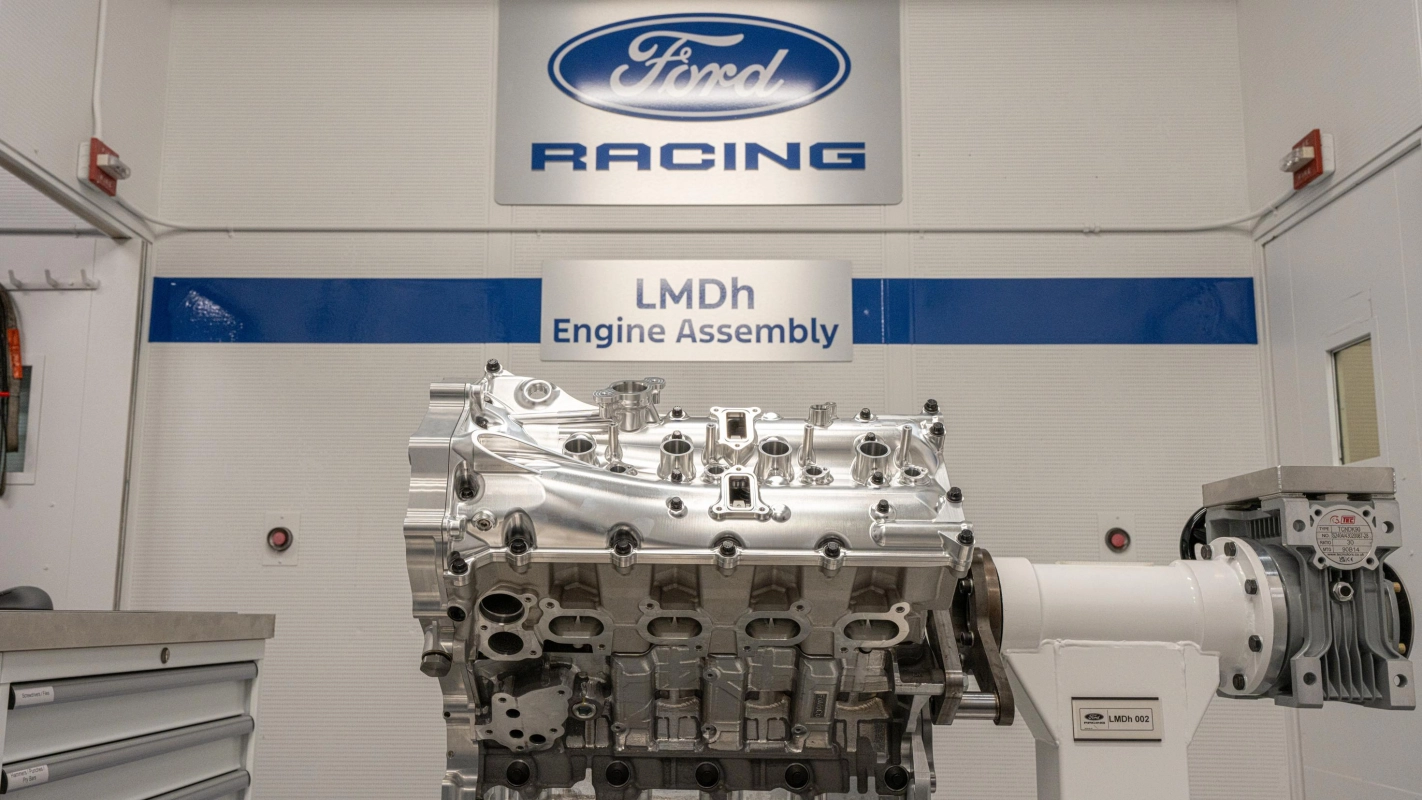
Before the new prototype turns its first competitive lap, however, Ford has already accumulated extensive development mileage away from the circuit. Engineers have tested its 5.4-litre naturally aspirated Coyote V8 in Dearborn, while its Hypercar drivers have supported development through simulator running at Ford’s Technology Centre in North Carolina.
Ford takes Le Mans to the Dearborn dyno
Ford has used its powertrain facilities to replicate the demands of Le Mans before the car reaches a real circuit.
Engineers recreated a complete lap of the 13.626km Circuit de la Sarthe on the company’s Dearborn dyno, allowing the team to expose its new Coyote V8 to the acceleration, braking and gearshift demands that it will eventually encounter during the French endurance classic.
Rather than waiting for physical testing to reveal problems, Ford wants to identify weaknesses through virtual and laboratory development as early as possible.
“We don’t wait for the racetrack to start learning,” explained Ford Racing Powertrain Chief Engineer, Christian Hertrich to FIAWEC.com. “We can’t afford to. Every time we fire up our dyno cell in Dearborn, the room holds its breath. Then the engine catches, the numbers climb and for a few minutes, we’re not in Michigan anymore – we’re at Le Mans, with every gearchange, every braking zone and every full-throttle charge modelled in real time.
“The engine doesn’t know the difference, but your ear can tell when it’s at wide-open throttle and rockets past 9,000rpm. That’s what a world-class virtual proving ground buys you, and this engine work has been going on behind-the-scenes for months. Build the engine, interrogate it and let the data tell us where the real work is – it’s a lesson that Ford Racing has carried over from its various other motorsport programmes into endurance racing.”
That approach gives Ford an opportunity to refine the powertrain before track testing adds further variables to the development process.
It also underlines the scale of preparation behind the programme. Ford does not simply want to reach the opening round of the 2027 season with a functioning Hypercar. Instead, the manufacturer wants to arrive with as much of the early learning process already completed as possible.
Coyote V8 forms heart of Ford’s Hypercar challenge
The 5.4-litre naturally aspirated Coyote V8 sits at the centre of Ford’s return to the top level of world endurance racing.
Ford has already put the engine through months of development work in Dearborn, with engineers using data to identify areas that require further attention before full-car testing begins.
The process also allows the manufacturer to draw knowledge from its wider racing activities. Ford competes across several motorsport disciplines, and the Hypercar programme gives its engineers another opportunity to transfer development methods between categories.
However, the ultimate benchmark remains Le Mans.
The Circuit de la Sarthe places enormous demands on performance and reliability, with long periods at full throttle combining with heavy braking zones, repeated gear changes and the requirement to sustain competitive performance over 24 hours.
By recreating those demands before its prototype reaches the circuit, Ford can begin preparing for one of the programme’s primary objectives long before its first actual visit with the completed Hypercar.
Historic Le Mans success shapes Ford’s new project
Ford’s return to the top category also carries considerable historical weight.
Motorsport played a role in the company’s story from its earliest years. Henry Ford drove his Sweepstakes racer to victory in a ten-lap race around a one-mile Detroit oval in 1901, helping establish the foundations from which the Ford Motor Company later emerged.
However, Ford’s achievements at Le Mans created one of the marque’s most enduring racing legacies.
The GT40 ended Ferrari’s six-year winning streak at the 24 Hours of Le Mans in 1966 before Ford completed four consecutive victories at the event from 1966 through 1969.
More than half a century later, the modern Hypercar programme continues its development close to the place where engineers once refined the GT40.
Ford therefore views its past not simply as a source of inspiration but also as part of a wider engineering culture that connects different generations of its motorsport programmes.
GT40 lessons continue to influence modern programme
The proximity between Ford’s current Hypercar development work and its historic GT40 programme has given the manufacturer another link between its past and future.
However, Ford does not intend to rely on nostalgia as it prepares to compete against the modern WEC field.
Instead, the team wants to apply the same willingness to test, learn and refine that supported its earlier motorsport successes.
“What we learned then [with the GT40] informs what we do today, and what we do today will inform the future,” Hertrich acknowledged. “That’s what makes this programme so exciting. Our Hypercar drivers are feeling the car before they’ve turned a single wheel on-track, and every detail gets refined because when we reach Le Mans, there can be no surprises.
“We’re days from our first test, but every dyno session and every hour [on the simulator] is essential for our preparation. We intend to arrive ready. And ready we will be.”
That final objective sets the tone for Ford’s remaining development programme.
The manufacturer knows that the 2027 season will immediately expose its new Hypercar to established opposition, while Le Mans will provide one of the toughest reliability and performance tests in motorsport.
Ford therefore wants to eliminate as many unknowns as possible before competition begins.
Star-studded driver line-up builds simulator mileage
While engineers continue their work in Dearborn, Ford’s drivers have supported the programme through extensive simulator development in North Carolina.
Logan Sargeant, Mike Rockenfeller, Sebastian Priaulx, Matt Campbell, Tom Blomqvist and Nick Yelloly have all contributed mileage before the prototype’s first physical test.
The group brings experience from several areas of international motorsport, giving Ford access to a broad range of feedback as it develops the behaviour of the car.
Crucially, simulator running also allows the drivers to begin understanding the Hypercar before they experience it on track.
They can assess handling characteristics, work through different set-up directions and provide feedback to engineers while the team still retains considerable freedom to make changes.
Once track testing starts, Ford can then compare real-world behaviour against the extensive data it has already accumulated virtually.
First track test marks next major milestone
Ford now stands on the verge of one of the most significant stages of the programme.
Dyno work can validate the powertrain, while simulator sessions can accelerate vehicle and driver development. However, the first physical test will finally allow Ford to assess how the complete package behaves on track.
That stage will introduce new challenges.
Engineers will need to correlate simulator predictions with actual performance, assess reliability across the entire car and begin refining the details that laboratory testing cannot fully reproduce.
Nevertheless, Ford’s work before that first outing should give the team a valuable starting point.
Rather than using its earliest track days to begin the development process, the manufacturer intends to use them to validate and build upon months of preparation.
Ford sets its sights on 2027 WEC challenge
Ford’s return to WEC’s top category carries expectations that extend well beyond simply joining the Hypercar grid.
The manufacturer wants to challenge for world championship honours, while Le Mans inevitably stands among the programme’s defining objectives because of Ford’s history at the race.
However, the scale of the challenge means heritage alone offers no guarantee of success.
Ford will face manufacturers that already possess extensive experience with contemporary Hypercar regulations and the demands of the current championship. As a result, preparation before its debut could prove crucial to how quickly the programme becomes competitive.
For now, Ford continues to build that foundation through engine testing, simulator mileage and an intensive development process that reaches back to lessons learned across decades of competition.
The first track test will provide the next major measure of that work. Beyond it lies an even greater challenge: arriving at the opening round of the 2027 FIA WEC season ready to compete rather than simply ready to participate.