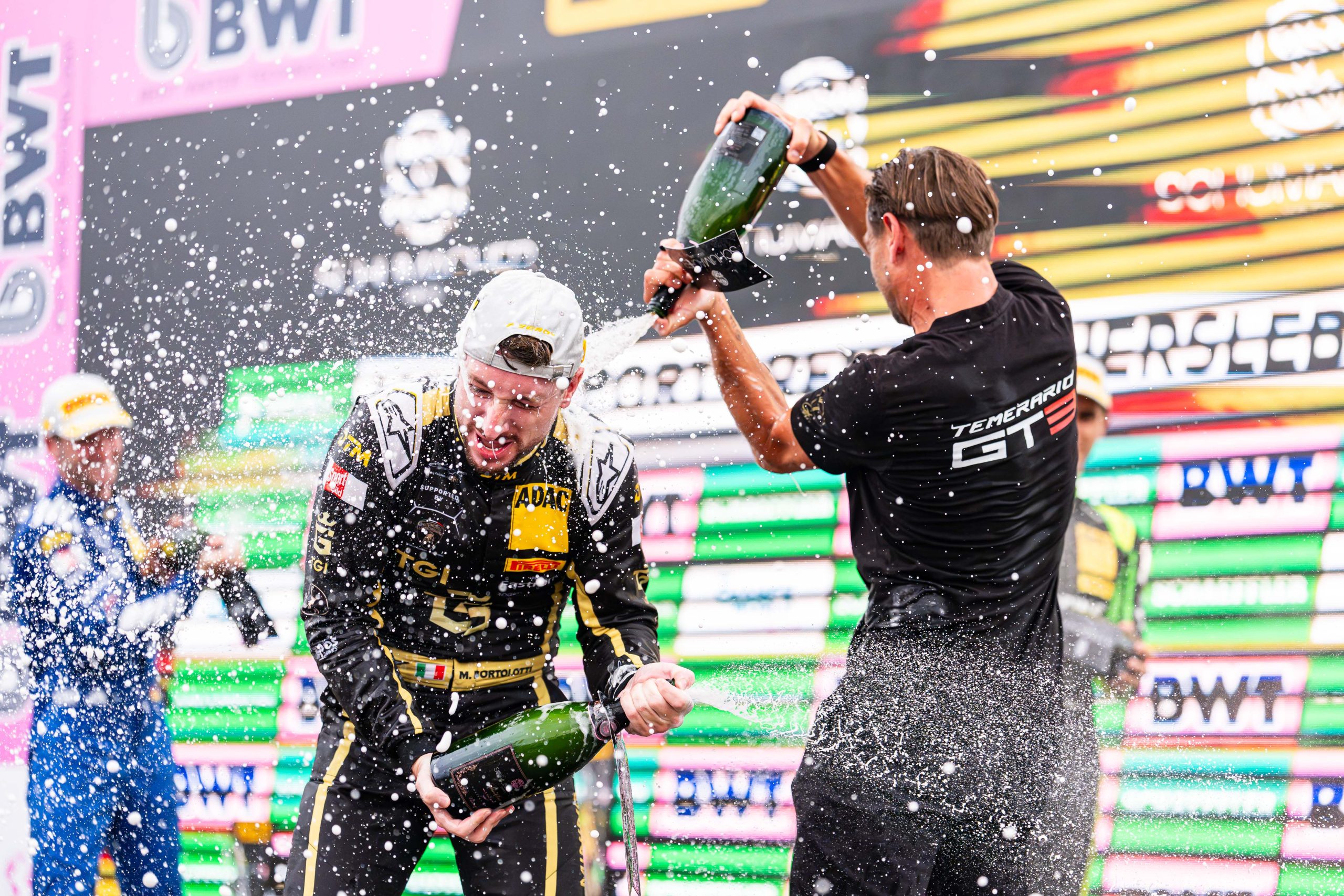
The dispute over Mirko Bortolotti’s disqualification from the second DTM race at Oschersleben could continue beyond the DMSB appeal process and potentially reach the FIA.
Bortolotti won the race on track for Grasser Racing Team, but officials later disqualified the Lamborghini driver after a post-race technical inspection found an issue with the wheel bearing on the #63 Lamborghini Temerario GT3. The result remained provisional because Grasser lodged an appeal against the decision.
The disqualification promoted Maro Engel to victory and changed the championship picture ahead of the Hockenheim finale. However, Grasser’s appeal kept the result and the related points situation open while the case moved through the DMSB process.
Grasser could still pursue FIA route
The DMSB appeals court will decide whether Bortolotti keeps the disqualification or regains the Oschersleben victory. The hearing is scheduled for 25 September, just before the final round of the season at Hockenheim.
If Grasser loses that hearing, the team could still take the case further. Article 17 of the 2026 DTM Sporting Regulations states that protests and appeals fall under the FIA International Sporting Code, DMSB rules and the FIA legal system for FIA appeals. It also lists the FIA International Court of Appeal as part of the appeal framework.
That could create an awkward scenario for DTM. If the case remained unresolved after Hockenheim, the series could finish its final weekend without being able to confirm the champion immediately.
Article 5 central to wheel bearing dispute
The case centred on whether the wheel bearing on Bortolotti’s Lamborghini complied with Article 5 of the 2026 DTM Sporting Regulations.
The article states that DTM cars must fully comply with FIA GT3 technical regulations, current FIA GT3 homologations and the GT3 DTM Homologation. It also says that all parts illustrated or specified in the FIA GT3 Homologation or GT3 DTM Homologation must be used exactly as supplied by the manufacturer, with no modification to their specification, material, weight or function.
However, the same section also says that manufacturer-supplied spare parts may be used as a reference when checking conformity. It further states that the DTM GT3 Homologation takes precedence over the FIA GT3 Homologation and the FIA GT3 Technical Regulations.
That wording made the dispute more complex than a simple technical infringement. Grasser argued that the rule interpretation supported its case, while also pointing to a 2024 clarification that it believed made the use of the wheel bearing optional.
Title fight could remain provisional
The appeal carried major consequences because the Oschersleben result directly affected the title fight.
If the disqualification stood, Engel would keep the inherited victory and the points that came with it. If Grasser won the appeal, Bortolotti would regain the race win, while Engel would lose the extra points awarded after the disqualification.
That left DTM facing uncertainty before its season finale. A clear ruling before Hockenheim would give the championship a firm points table, but a further appeal to the FIA could leave the final classification unresolved beyond the last race.
For Grasser, the case represented a chance to restore Bortolotti’s Oschersleben victory. For DTM, it risked carrying one of the season’s biggest technical disputes into the final weekend and potentially beyond it.