Just days after one of the most complex Balance of Performance (BoP) calculations in recent history, the 2026 DTM season opener at the Red Bull Ring has already produced its first major adjustments.
Officials introduced the changes after Friday’s running, which included a delayed qualifying simulation originally lost to weather during pre-season testing. They targeted four of the eight manufacturers on the grid, highlighting how uncertain the competitive picture remains.
Limited data from the late introduction of the new Pirelli control tyre forced organisers to act quickly. That process has now begun in earnest.
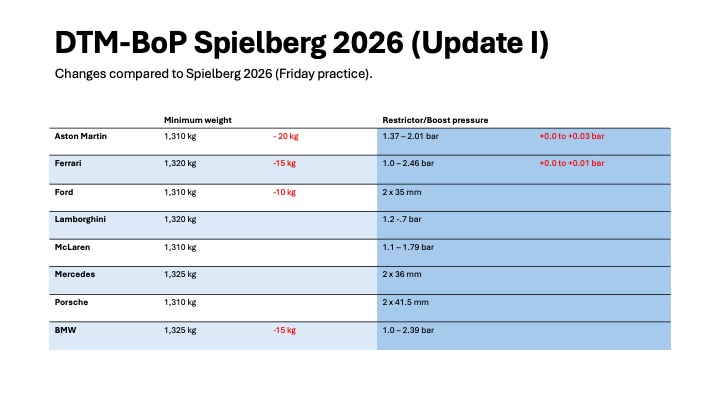
BMW stands among the biggest beneficiaries. Officials allowed the BMW M4 GT3 Evo to shed 15 kilograms of ballast after it failed to reach the top ten in Friday’s classification. The car retains its existing turbo settings, but the reduced weight should improve acceleration and tyre usage.
Ferrari also gains. The Emil Frey Racing-run 296 GT3 loses 15 kilograms and receives a small increase in turbo boost in the mid-range. While the gain appears marginal, even small improvements can influence results in such a tightly packed field.
Ford’s Mustang GT3 Evo also drops 10 kilograms. However, it must continue to run with a restrictive 35-millimetre air restrictor, limiting its straight-line speed. That constraint could prove costly on a circuit defined by long straights.
Aston Martin receives the most significant adjustment. Officials removed 20 kilograms from the Vantage GT3 Evo and increased turbo boost in the lower rev range. They also added smaller gains in the mid-range, which should improve traction and acceleration out of slower corners.
Lamborghini faces early setback
BMW, Ferrari and Aston Martin gain ground
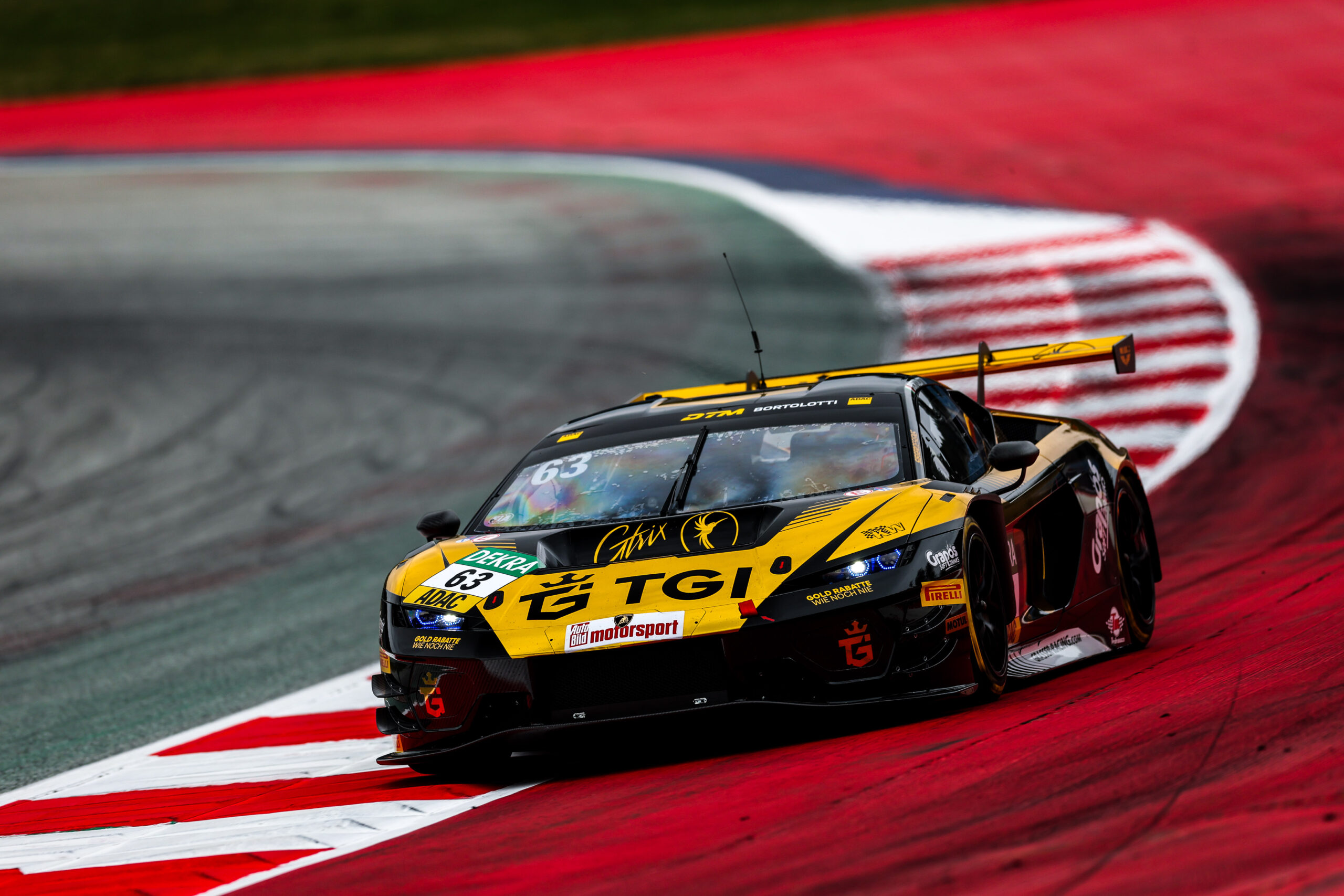
Officials made no changes to the Lamborghini Temerario GT3, despite its clear struggles.
Both Grasser Racing Team and Abt Sportsline entries occupied the final four positions in Friday’s classification, yet the car remains untouched.
This decision leaves Lamborghini at a disadvantage heading into qualifying. The Temerario remains in an early stage of development, and the regulations offer limited flexibility for immediate adjustments.
Without support, Lamborghini must rely entirely on internal improvements to close the gap.
Front-runners remain unchanged
Officials left the leading manufacturers untouched. The Mercedes-AMG GT3, which set the pace on Friday, retains its current configuration. McLaren and Porsche also continue without adjustment.
This decision confirms that officials consider the front of the field to be balanced. However, adjusting only part of the grid introduces new uncertainty, as small gains elsewhere could disrupt the established order.
A BoP still evolving
These early changes underline a key point: the 2026 BoP remains a work in progress.
The delayed qualifying simulation finally provided the SRO Motorsports Group with useful data on the new tyre. Officials have already used that information to refine performance levels, but they may need to intervene again as teams gather more data.
As drivers and engineers continue to understand the tyre, the cars and the demands of the Red Bull Ring, further adjustments remain likely.
Uncertainty defines the opening round
The revised BoP adds immediate pressure ahead of DTM’s first qualifying of the race weekend. Some manufacturers now carry clear advantages, others must respond, and Lamborghini faces a difficult starting point without assistance.
No clear hierarchy has emerged. Instead, the field remains fluid, with performance likely to shift as conditions evolve.
Qualifying will deliver the first real verdict. It will show whether these changes have balanced the field or simply moved the advantage elsewhere.