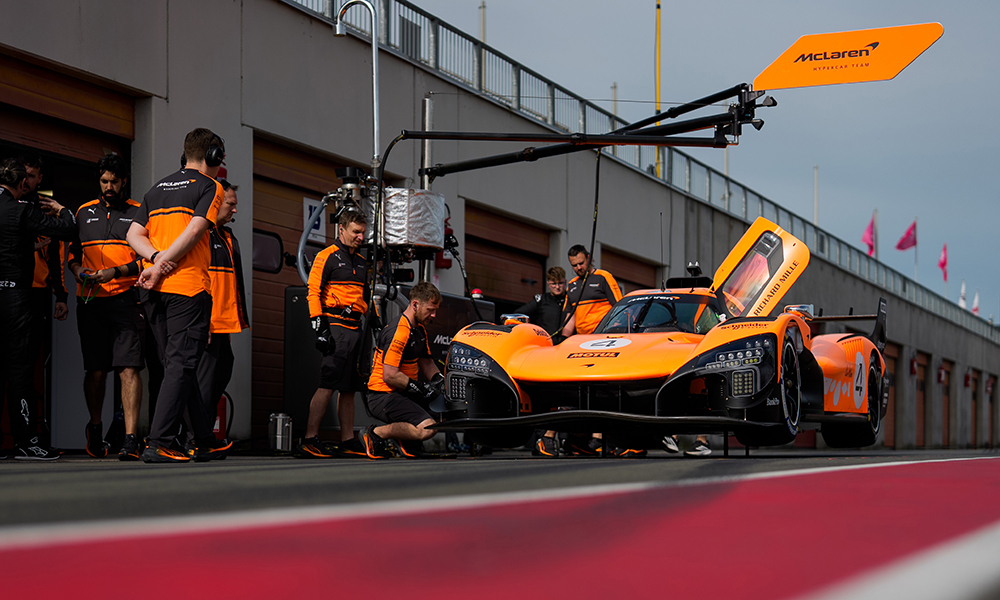
As reported by Sportscar365, McLaren will move its MCL-HY project into a more demanding phase as it prepares for the car’s first full test at Imola later this month and ahead of its 2027 WEC debut. The British manufacturer completed a two-day rollout at Varano on 4-5 May and now plans an extensive on-track development programme for its LMDh-based prototype.
The programme forms a key part of McLaren’s preparations for its future World Endurance Championship Hypercar entry. With operational partner United Autosports already building up the team structure, McLaren has mapped out a full calendar of testing across Europe, while it also intends to run in the Middle East later this year.
That schedule will give McLaren a chance to move beyond installation work and start learning how the car behaves under proper load. As the project gathers pace, the team will focus on mileage, systems checks, driver feedback and the reliability lessons that usually define the early life of a new endurance prototype.
Imola test marks the next step for the McLaren MCL-HY project ahead of 2027 WEC debut
James Barclay, McLaren Endurance Racing executive director, said the team has already entered a structured phase of development after its successful Varano shakedown.
“From that perspective, we’ve got a good test calendar and our plan is now to hopefully get through that,” he told assembled reporters at the recent 6 Hours of Spa-Francorchamps. “There’s a long road ahead. We have our normal test. Each test is 2-3-4 days and we have endurance testing this year as well. There’s a lot of miles to do and that’s the intention that we go through that a step at a time.
“The first step has been good but we’re under no illusion there will be challenges along the way. That’s what developing is going to be about.”
Mikkel Jensen and Laurens Vanthoor will take part in the Imola outing. Vanthoor, who has recently joined McLaren’s confirmed race driver group, will therefore gain early mileage in the prototype as the marque increases the intensity of its work.
The Imola test should also help McLaren establish a clearer baseline after Varano. While the rollout allowed the team to confirm core functions and complete initial running, a full test will place greater emphasis on performance windows, repeatability and the interaction between drivers, engineers and the new car.
A full test calendar already in place
McLaren has not approached the programme on a test-by-test basis. Instead, Barclay confirmed that the manufacturer has already booked its schedule for the rest of the year, combining WEC venues with other circuits that offer useful development characteristics.
“It’s a combination of circuits on the WEC calendar and some that aren’t because they just serve really well as test venues,” he explained. “Portimão is a great example. We will go test in Portimao because of the characteristics of that track are really useful for us to test there. It doesn’t matter if it’s not on the calendar.”
That approach gives McLaren the chance to expose the MCL-HY to a broader range of circuit demands. As a result, the team can study the car’s behaviour across different surfaces, layouts and loading conditions before it reaches competitive action.
Portimao, in particular, offers the type of elevation change and corner variety that can reveal how a prototype responds over crests, compressions and longer-radius sections. Therefore, McLaren can use non-calendar venues to answer specific engineering questions, rather than simply mirror the championship schedule.
McLaren plans early endurance running for MCL-HY ahead of 2027 WEC debut
While the first phase will focus on single-day running, McLaren also wants to introduce endurance mileage early in the development cycle. Barclay said the team must identify potential reliability issues before they become major problems during longer simulations.
“Now that we’ve done the shakedown, our next focus is getting the car fully stressed on individual day tests,” he said. “Our focus will be just on doing single-day tests [at first]. Once we come past that next milestone in the program and we’re comfortable, we’ll go full endurance [testing].
“We start quite early with our first endurance [test] because we need to get there and prove it out and see where we have any issues or weak spots. We’re keen to do that sooner rather than later so we don’t have a great test program ad the first time we try and go and do a 24 or 30-hour test, all of a sudden we discover those new nuances that only crop up after 20 hours.
“That’s what this sport is about. It’s all great if you can be really effective and fast and efficient for 22 hours but if you fail in the 23rd or 24th hour, it’s a bit pointless. So we’re keen to get to that sooner rather than later.”
Therefore, McLaren will use endurance tests not only to gather mileage, but also to expose the hidden issues that often appear only after prolonged running. That focus should shape the car’s reliability profile before the programme reaches its competitive debut window.
United Autosports staffing nears completion
McLaren’s operational structure also continues to take shape. United Autosports will run the programme, and Barclay said the staffing picture already looks largely settled.
The team still needs to complete a few final appointments, mainly on the race engineering side, but Barclay expects the full group to sit just below 100 staff. That scale reflects the demands of a modern Hypercar effort, especially one that must combine development, race operations and long-distance reliability work.
With most roles already in place, McLaren and United can now sharpen their focus on trackside execution. A near-complete team should also help create consistency during the test phase, as engineers and mechanics build familiarity with the car and develop processes before race pressure arrives.
Development drivers join the early running
McLaren has confirmed Jensen and Vanthoor as race drivers for 2027, but it will also lean on a wider pool during the test phase. Gregoire Saucy and Richard Verschoor, both members of McLaren’s Driver Development Programme, will join the work alongside longtime United Autosports driver Ben Hanley.
Barclay said McLaren sees value in mixing established experience with younger talent.
“It’s good for us to have a combination of youth in here in the mix,” said Barclay. “We’re not only here for one or two years. It’s a longer-term view from our perspective. Having drivers around us, at a younger point in their career, that’s a positive, long-term, regardless. It’s nice to have them supporting our test program.
“Right now if you want to get a full lineup of experienced Hypercar drivers, you can’t have them for your test program because they have other race contracts. There’s a combination of ‘Yes, ones that can join us like Mikkel, it’s fantastic.’ But then we also have younger drivers who have an opportunity to be with us in the future but also an opportunity to support our test program.”
Their involvement gives McLaren additional feedback during a mileage-heavy development schedule. It also allows the manufacturer to evaluate drivers in a Hypercar environment before it finalises its future line-up.
Saucy and Verschoor can use the test programme to learn the demands of top-level endurance machinery, while Hanley brings familiarity with United Autosports and extensive prototype experience. Together, that mix should give McLaren a broader spread of feedback as the MCL-HY evolves.
McLaren to make race seat decisions later as they continue preparation for 2027 WEC MCL-HY debut
Although Saucy, Verschoor and Hanley will support the test programme, McLaren has not yet decided whether any development drivers could earn race seats. Barclay stressed that the team currently needs drivers who can help move the project forward.
“The fact they’re in the car testing with us is the best place to be to have that opportunity as well,” he said. Right now it’s a test program to run and that’s the focus. We want drivers in who can help us achieve what we need to achieve. That’s really, really key. Our final decisions on drivers will then come as we go through this process.”
For now, McLaren’s priority remains clear. The manufacturer must turn a successful rollout into a robust development campaign, build mileage across multiple venues and expose the MCL-HY to the demands that will define its future in top-level endurance racing.
As testing expands from short runs into longer simulations, McLaren will gain a clearer picture of the car, the team and the driver pool around the project. However, Barclay’s comments underline that the marque wants to build the programme step by step, rather than rush towards final decisions before the car has completed its most important early mileage.