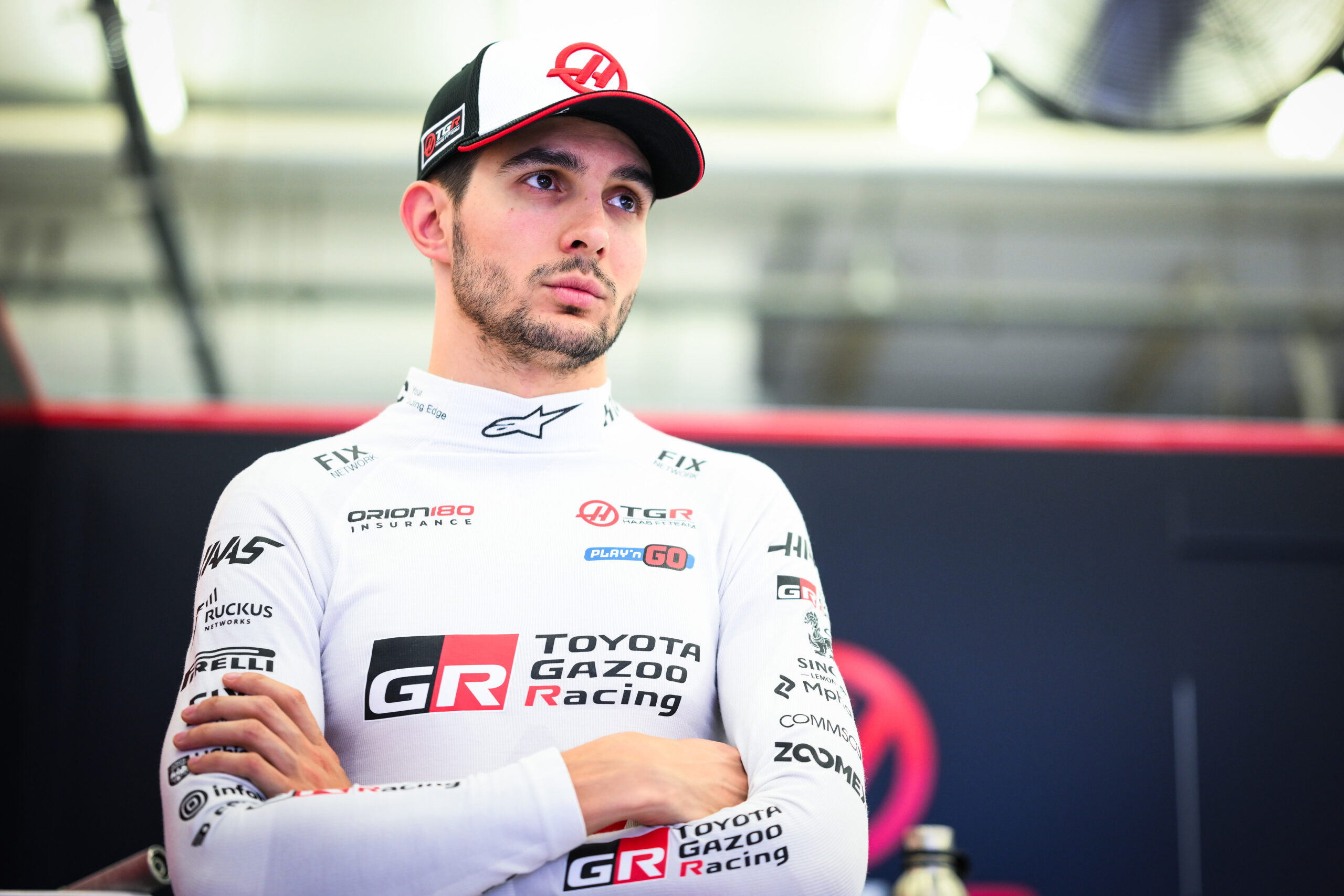
Haas F1 driver Esteban Ocon expects that the 2026 season-opening Australian GP could be a much tougher challenge for the new cars compared to testing in Bahrain and Barcelona, as the Albert Park circuit has fewer opportunities to charge the batteries, with long straights interconnected by high-speed corners.
Energy management is a big discussion point for the new F1 cars, with four-time world champion Max Verstappen even calling it “Formula E on steroids” in a blunt early-February assessment, whilst seven-time champion Lewis Hamilton said “you need a degree“ to master the new machines technicalities.
Bahrain provided a “very good” platform for 2026 F1 cars
Ocon explained how the official testing in Bahrain was a “very good” test for the 2026 F1 cars, as they were able to recover just enough energy to make the cars feel and drive somewhat similarly to the previous generation. That meant a more standard driving style, without having to lift-and-coast as much to save battery charge.
“Yeah, I think Bahrain was a very good test for everyone,” Ocon said. “It’s a shame it [didn’t] happen first, because that track is easier on that side of things we end up driving a little bit more in the same way as we did last year: there’s a lot of braking, a lot of recovery, and less high-speed corners, so it’s quite straightforward.”
Barcelona proved to be a “shock”
The shakedown in Barcelona, however, proved to be much more of a challenge for teams and drivers, as the nature of the circuit, with very few hard-braking zones and a lot of high-speed corners provide little opportunity to charge the batteries:
“Barcelona was much more of a shock what we needed to do in terms of driving style,” he revealed.
And the Frenchman expects that next week’s season opener in Australia will be an even harder challenge, given the very high-speed nature of the Albert Park circuit since the changes made in 2022:
“And when we’re going to get to Melbourne, from that first sector to the second sector, all the big straights plus just the liftóff [that will be required to charge the battery] in the reprofiled [turn eight], all of that is going to be energy hungry the whole way.
“So I think that’s going to be tough, it’s going to be a big surprise it’s going to be probably much harder than it was even in Barcelona, because it’s this long straight, followed by a high-speed corner. It’s going to be nuts.”
Bahrain not the most representative track for learning
Ocon explained that whilst Bahrain was good in providing a decent platform for the cars to drive in a more natural way, it’s perhaps not the best refletion and learning ground for the average circuit that F1 will visit throughout 2026:
“Here [in Bahrain], it’s a great track because we have a lot of experience with these new cars to test the energy deployment.
“It’s not the best one to learn for all of us, but it’s the same for all of us so we’ll see how it goes.”
Ocon reveals Haas’ “remarkable correlation” of the 2026 F1 power unit in the simulator
With so many unknowns going forward, Ocon explained that a good correlation between the simulator and the real world could make a real difference to arriving prepared for different circuits and different engine management demands.
He revealed Haas’ correlation between simulation and reality has been “remarkable” on the power unit, and says iyt now just needs to refine the actual car balance and performance, which was a bit too fast in the virtual environment:
“I think the correlation on the engine side has been remarkable,” he said. “It’s been really great and we came to Barcelona very prepared, we came to [Bahrain] very prepared.
“But it’s just now that we have obviously more data we are going to be able to correct a bit better the corner phase – I think the balance has been good, [but] maybe we are a bit [too] fast in the simulator.
“But overall the driving style and how the engine was managed was exactly the same.”
In 2026, Ocon will partner Ollie Bearman for his second season at Haas F1, and will look to improve his performance relative to his team-mate.