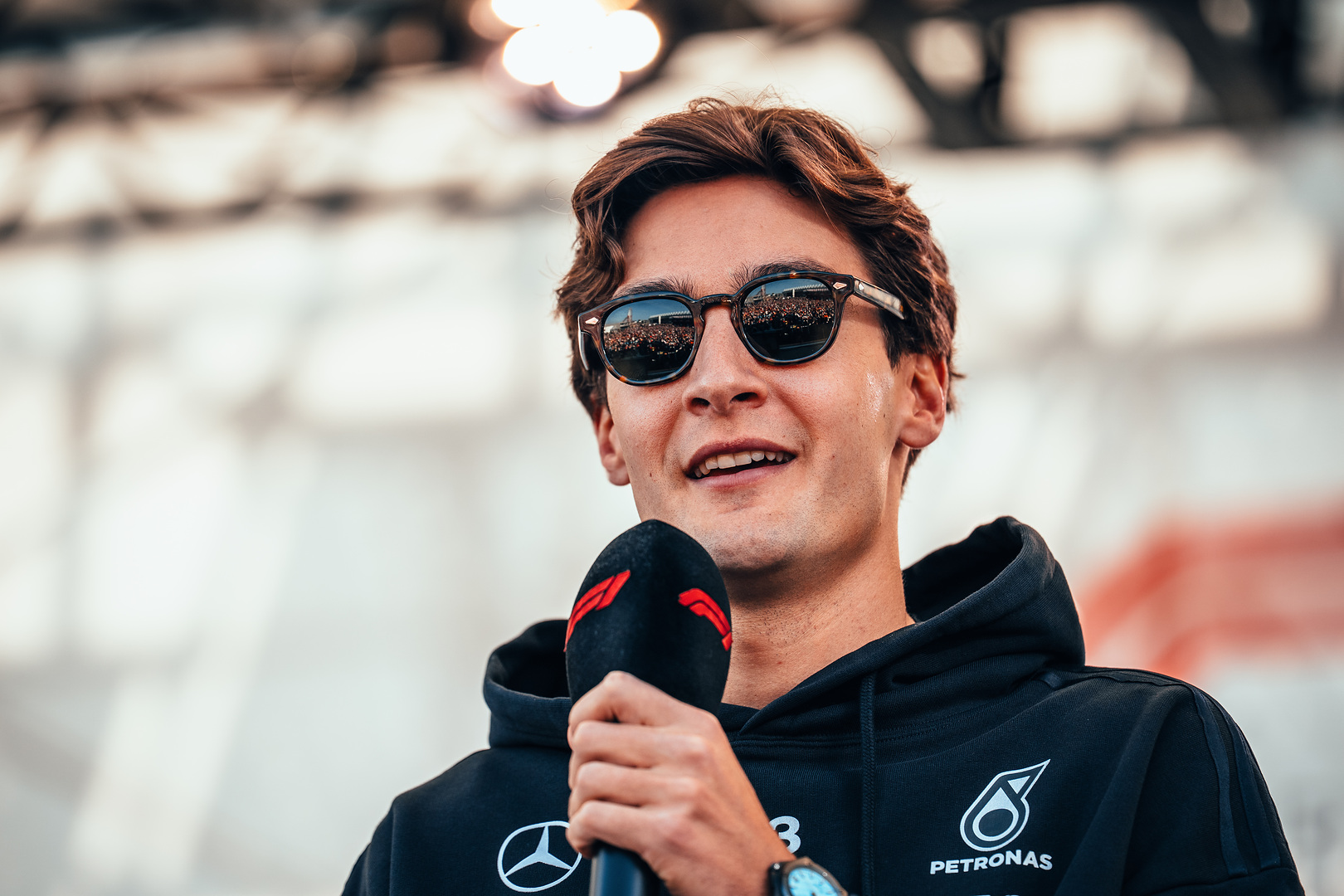
Discussions surrounding the 2026 F1 regulations and potential changes continue, as George Russell weighs in on the issue following Ollie Bearman’s high-speed crash at the 2026 F1 Japanese GP.
Since the Haas driver’s crash, the incident has brought attention to concerns over the dangerous closing speeds under the current set of regulations. Other drivers like Carlos Sainz, who serves as a GPDA Director alongside Russell, and Max Verstappen have also weighed in on the issue.
Speaking in a media session earlier today, Russell outlined the current situation the 2026 F1 grid is in with its discussions with the FIA.
He said: “Regardless of the incident in Japan, a discussion was always planned with all of the drivers, F1, and the FIA on how to make small improvements to these regulations. Of course, there are things that we want improving like qualifying, flat-out qualifying and not having to do the lift and coast.”
“And, I think there’s been some very positive conversations with the FIA and everybody’s aligned on what we’re trying to achieve. So I’m looking forward to seeing that come to fruition from Miami onwards.”
Russell: Drivers and FIA aligned on key regulation changes
Last week, the FIA held a meeting to discuss potential changes to the current regulations. While the FIA released a statement following the Japanese GP weekend, Russell and his fellow drivers identified two key priorities: eliminating a lift-and-coast driving style in qualifying and reducing the dangerous closing speeds.
From the drivers’ perspectives, the Briton stressed the importance of addressing these disparities and added that there is general alignment with the FIA on the need for change.
“I think the two headline points are flat-out qualifying, so no lift and coast, and then reducing the closing speeds. The closing speed of the Bearman-Colopinto crash was twofold.”
“One, it was, of course, Bearman was on his boost button and giving himself 350 kilowatts, so he had an abundance of power in an abnormal part of the track, and on the flip side, Colapinto used his boost on the main straights, half a lap before and was low on his battery, so he had a lack of power.”
Russell added: “So that is, at least in my eyes, where these closing speed differences are coming from, and I think the FIA are definitely very much aware of that. And from the driver’s perspective, just looking to reduce that closing speed in abnormal areas and especially in non-SM modes.”
“If there’s a straight that isn’t an SM mode, that means it’s because it’s a corner, and of course the Bearman crash was in a non-SM part of the track, so I think we’re all aligned on those points.”
Compromise needed to improve racing and reduce lift-and-coast
Several drivers, including Verstappen, have been critical and outspoken about the current regulations so far. He acknowledged that a compromise will be necessary, as the current focus on maximizing lap time has led to increased lift-and-coast and energy management.
However, Russell also pointed out that there are straightforward solutions that could significantly reduce the need for these driving styles.
“I mean, as you say, there will be a compromise somewhere, because right now the cars are set up to produce the fastest lap times possible, which is leading to this lift-and-coast driving style and a bit of energy management here and there.”
“But there are some, there’s a lot of low-hanging fruit. For example, the minus 350 kilowatts super clip is a no-brainer, and that already in itself is going to avoid a lot of energy, a lot of lift-and-coast, sorry, having the minus 350 kilowatt super clip.”
FIA have been in contact with “handful of drivers” during month-long break
The Briton explained that the current regulations limit how quickly teams can reduce engine power, which can impact driving behaviour. However, Russell added that even small regulatory adjustments could significantly improve the overall driving experience and believes the month-long break has been useful to discuss the issue. He further noted that recent discussions with the FIA and drivers have fostered a closer and collaborative relationship than in previous years.
Russell said: “And there’s other small parts of the regulation that say you can only derate the engine at a certain rate. So on a very short straight, there isn’t enough time to go from 350 kilowatts to a super clip, because the straight is too short. Some small changes around these regulations will have a major improvement for the overall sort of driving experience.”
“So as I said, this break has offered a good opportunity for everyone to go around that loop. The FIA have been in a lot of comms with a handful of drivers, and that has been sort of collective. And at least from the FIA technical standpoint, it’s probably the closest relationship we’ve had with them in numerous years. So that’s very positive to see.”