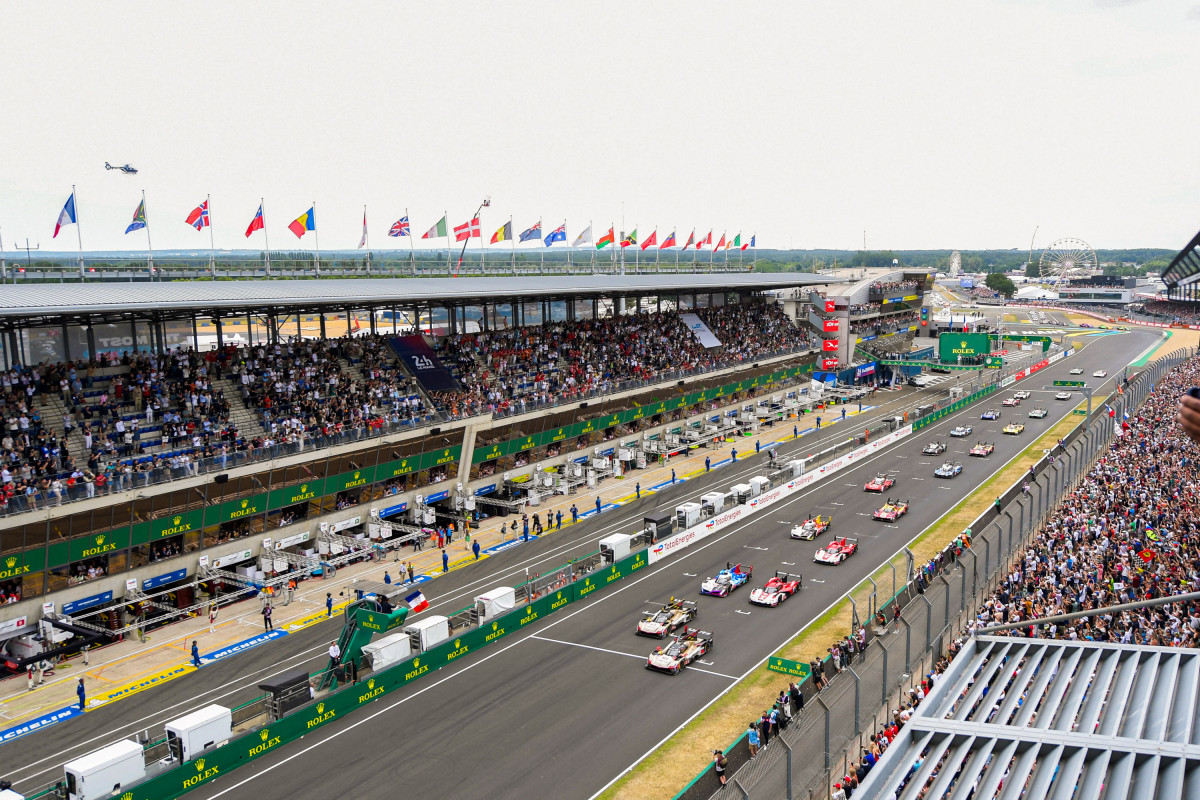
The Circuit de la Sarthe stands as one of motorsport’s greatest challenges. Each year, it turns the 24 Hours of Le Mans into a test of speed, precision, endurance and survival.
The current 24-hour layout measures 13.626km, making it one of the longest circuits in world motorsport. It combines permanent racing sections with public roads that return to everyday use outside the Le Mans event, giving the venue a character few modern circuits can match.
As a result, Le Mans asks more from drivers, teams and cars than most races. The lap includes long full-throttle sections, heavy braking zones, narrow road-course segments, fast direction changes and some of the most famous corners in endurance racing.
A semi-permanent circuit with a unique identity
The Circuit de la Sarthe sits in Le Mans, in France’s Sarthe region. Although fans often call it a permanent circuit, the full 24 Hours layout blends purpose-built sections with public roads. That mix gives the track its distinctive rhythm and explains why Le Mans feels so different from traditional race venues.
The race first took place in 1923, and the circuit has evolved many times since then. However, it has retained its essential identity: a high-speed road course built around the demands of endurance racing.
Unlike shorter circuits, the Circuit de la Sarthe stretches the field over a huge distance. Therefore, traffic management becomes one of the defining skills of the race. Hypercars, LMP2 cars and LMGT3 machinery share the same track, but they approach braking zones, corner entries and acceleration points very differently.
The lap begins with speed and commitment
The lap starts on the pit straight, where the race also reaches its dramatic conclusion after 24 hours. However, drivers cannot ease into the lap. The Dunlop Curve arrives quickly and demands immediate commitment.
This fast right-hander places emphasis on balance and confidence. Drivers then climb towards the Dunlop Chicane, where precision becomes just as important as bravery. The kerbs can help lap time, but too much aggression risks unsettling the car or causing damage.
From there, the cars flow through the Forest Esses. This section drops and rises through a sequence of quick direction changes, making stability vital. A strong exit matters because it sets up Tertre Rouge, one of the most important corners on the lap.
Tertre Rouge unlocks the Mulsanne Straight
Tertre Rouge acts as the gateway to the Mulsanne Straight. A clean exit gives drivers a higher top speed down the most famous stretch of road in endurance racing.
The official Le Mans guide notes that Hypercars can reach up to 345kph on this part of the lap, underlining how much the corner exit matters before the long run down the straight.
Historically, the Mulsanne Straight helped define Le Mans. Cars once ran for several kilometres at extreme speed before two chicanes were added ahead of the 1990 race. Those chicanes reduced the maximum speed and addressed safety concerns linked to the previous uninterrupted straight.
The chicanes turn top speed into a braking test
The modern Mulsanne Straight no longer runs uninterrupted. Instead, the Daytona Chicane and Michelin Chicane break up the full-throttle blast.
Both sections force drivers to brake hard from very high speed while running low-downforce Le Mans setups. The car can feel light and unstable on the way in, so drivers must judge the braking point precisely before attacking the kerbs and accelerating back onto the straight.
These chicanes also affect race strategy. A car with strong straight-line speed can gain time on the long runs, but it still needs braking stability, traction and tyre control to survive the full lap.
Mulsanne, Indianapolis and Arnage test braking and discipline
At the end of the straight, Mulsanne Corner creates one of the heaviest braking zones on the circuit. Drivers slow dramatically before turning right, and they must avoid locking the wheels while still carrying enough speed onto the next section.
The lap then moves towards Indianapolis, one of the circuit’s most spectacular sequences. Cars arrive through a fast right-hand kink before braking into a banked left-hander. The section rewards confidence, but it punishes small errors.
Arnage follows soon after and changes the rhythm completely. It is the slowest corner on the circuit, yet it remains difficult because drivers arrive after one of the fastest and most technical parts of the lap. A poor exit can cost time all the way down the next acceleration zone.
Porsche Curves remain the ultimate driver section
The Porsche Curves form one of the most celebrated parts of the Circuit de la Sarthe. This fast, flowing sequence demands commitment, trust in the car and total accuracy.
Drivers attack the section at high speed while making rapid direction changes. There is little room for error, and mistakes can quickly become costly. Therefore, this part of the lap often separates confident cars from difficult ones, especially at night or in changing conditions.
The Porsche Curves also reveal the quality of a car’s aerodynamic platform. A stable Hypercar can carry speed through the sequence, while a nervous car forces the driver to lift or compromise the line.
The final sector gives no time to relax
After the Porsche Curves, the Karting Esses keep the pressure high. Drivers must stay precise while managing track limits and fatigue, especially during the night or in the final hours of the race.
The lap then reaches the Ford Chicanes and the Motul Turn. This final complex looks simple compared with the Mulsanne Straight or Porsche Curves, but it still requires accuracy. Drivers must balance kerb use with traction before returning to the pit straight.
Across 24 hours, this final section becomes crucial. A clean run can complete a strong lap, but a small mistake can cost momentum, damage the car or compromise a pit entry.
Why Le Mans punishes cars as much as drivers
The Circuit de la Sarthe does not only test drivers. It also places huge stress on engines, brakes, suspension, gearboxes and tyres.
Long full-throttle sections create sustained mechanical load, while repeated heavy braking zones punish brake systems. Meanwhile, kerbs, bumps and changing road surfaces challenge suspension durability. The circuit’s length also means weather can vary from one part of the lap to another, creating added uncertainty.
For engineers, this creates a difficult compromise. Teams need low drag for the straights, but they also need enough downforce for the Porsche Curves, Indianapolis and the Esses. They must also protect the car mechanically while still giving drivers a competitive package.
Why the Circuit de la Sarthe remains Le Mans’ greatest character
The 24 Hours of Le Mans carries prestige because of its history, competition and endurance format. However, the Circuit de la Sarthe gives the race its soul.
It asks drivers to master speed and patience at the same time. It forces teams to balance performance with reliability. It also turns traffic, weather, darkness and fatigue into part of the challenge rather than background conditions.
That is why a Le Mans victory means more than simply completing 24 hours. To win, a team must understand the Circuit de la Sarthe, survive its extremes and stay fast across every phase of the race.
See the full schedule for the 2026 edition of the 24 Hours of Le Mans, and you can get live updates on race day from our blog.