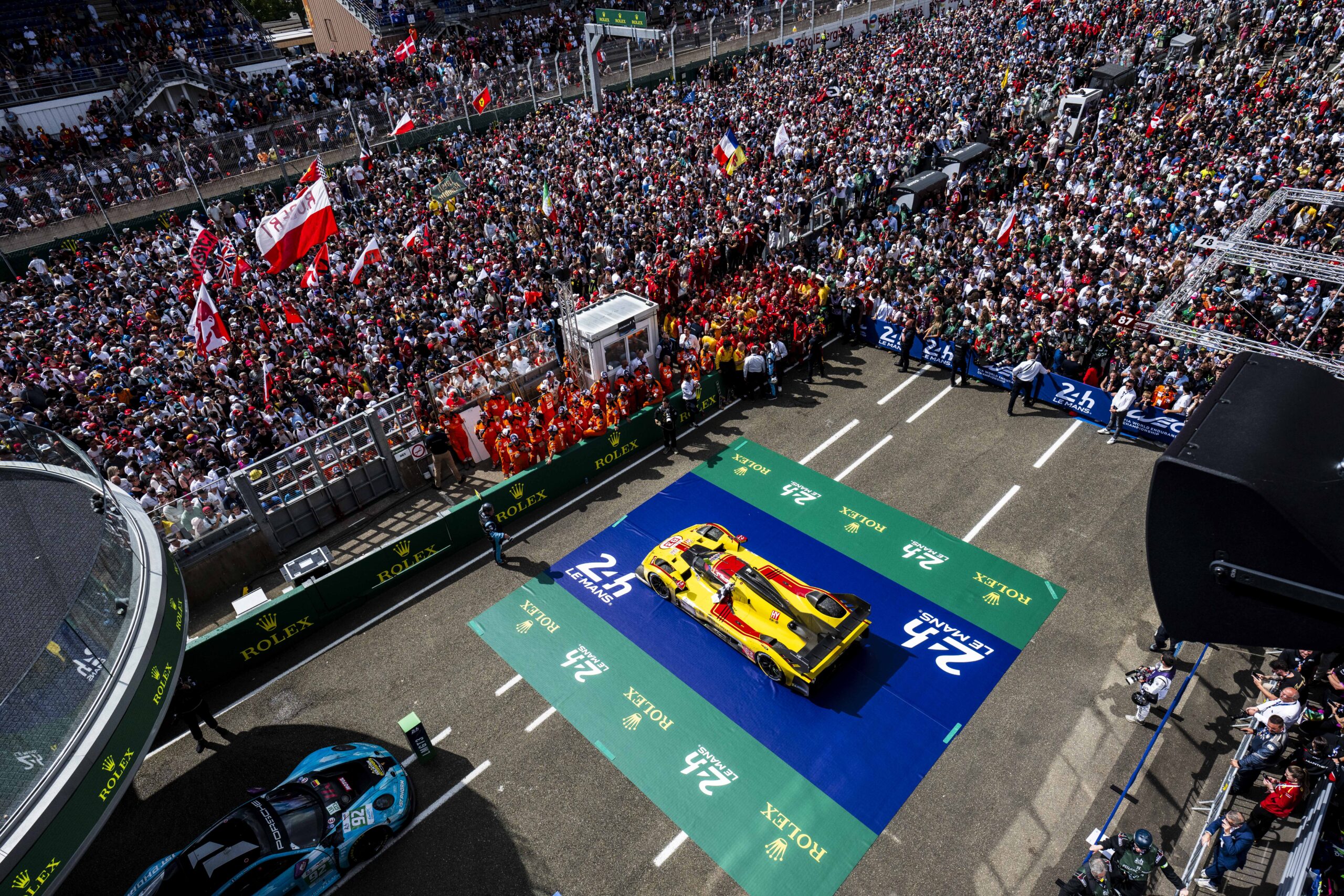
The winners of the 24 Hours of Le Mans form one of motorsport’s most prestigious lists. Since the first edition in 1923, the race has rewarded the teams, drivers and manufacturers that can combine speed, reliability, discipline and strategy across a full day and night.
The race began as the Grand Prix of Endurance and Efficiency, giving manufacturers a platform to prove durability and performance. The first winners were André Lagache and René Léonard, who won the 1923 race for Chenard & Walcker. As of the 2025 edition, Le Mans has produced 152 victorious drivers from 24 countries and 25 winning manufacturers across 93 editions.
Although the race has changed dramatically across the decades, victory at Le Mans still carries the same meaning. It remains a measure of engineering strength, driver consistency and operational excellence under the most demanding conditions in endurance racing.
The 2025 winners: Kubica, Ye and Hanson lead Ferrari hat-trick
The most recent winners of the 24 Hours of Le Mans are Robert Kubica, Yifei Ye and Phil Hanson, who claimed victory in the 2025 edition with the No. 83 AF Corse Ferrari 499P.
Their win gave Ferrari a third consecutive overall Le Mans victory in the Hypercar era, following the factory Ferrari AF Corse wins in 2023 and 2024. However, the 2025 triumph carried its own significance because it came through AF Corse’s customer-entered Ferrari rather than one of the two full factory cars.
Kubica, Ye and Hanson completed 387 laps and beat the No. 6 Porsche Penske Motorsport Porsche 963 crew of Kévin Estre, Laurens Vanthoor and Matt Campbell by 14.084 seconds. The No. 51 Ferrari AF Corse entry of Alessandro Pier Guidi, James Calado and Antonio Giovinazzi completed the overall podium.
The result also made history for the winning drivers. Kubica became the first Polish driver to win Le Mans overall, while Ye became the first Chinese driver to achieve the same feat. Hanson also earned his first overall victory at La Sarthe, adding his name to the race’s long list of endurance winners.
2025 overall podium
- No. 83 AF Corse Ferrari 499P — Robert Kubica, Yifei Ye, Phil Hanson
- No. 6 Porsche Penske Motorsport Porsche 963 — Kévin Estre, Laurens Vanthoor, Matt Campbell
- No. 51 Ferrari AF Corse Ferrari 499P — Alessandro Pier Guidi, James Calado, Antonio Giovinazzi
2025 class winners
- Hypercar / Overall: No. 83 AF Corse Ferrari 499P — Robert Kubica, Yifei Ye, Phil Hanson
- LMP2: No. 43 Inter Europol Competition Oreca 07-Gibson — Jakub Śmiechowski, Tom Dillmann, Nick Yelloly
- LMGT3: No. 92 Manthey 1st Phorm Porsche 911 GT3 R LMGT3 — Ryan Hardwick, Riccardo Pera, Richard Lietz
Porsche remains Le Mans’ most successful manufacturer
Porsche stands at the top of the all-time Le Mans winners list. The German manufacturer has taken 19 overall victories since its first win in 1970, giving it the strongest record in the race’s history.
Porsche’s success spans several eras. It won with legendary prototypes such as the 917, 936, 956, 962 and 919 Hybrid, showing an ability to adapt across changing regulations. Its most dominant run came from 1981 to 1987, when it claimed seven consecutive overall victories.
Audi then became the defining force of the modern prototype era. Its R8, R10 TDI, R15 and R18 programmes helped reshape Le Mans through reliability, diesel technology and hybrid innovation. More recently, Ferrari has returned to the front with the 499P, adding a new chapter to its Le Mans legacy.
Key manufacturer records
- Porsche — 19 wins
- Audi — 13 wins
- Ferrari — 12 wins
- Most consecutive manufacturer wins — Porsche, seven from 1981 to 1987
- Most successful manufacturer nation — Germany, 34 wins
Tom Kristensen stands above every Le Mans driver
No driver has won Le Mans more often than Tom Kristensen. The Danish driver claimed nine overall victories, earning him the nickname “Mr Le Mans”. His record includes six consecutive wins from 2000 to 2005, another benchmark no driver has matched.
Jacky Ickx sits second on the all-time list with six victories. Before Kristensen moved the record further away, Ickx stood as the race’s ultimate modern benchmark, combining speed, intelligence and consistency across different cars and eras.
Derek Bell, Frank Biela and Emanuele Pirro follow with five victories each. Their records underline how Le Mans rewards drivers who can remain competitive across multiple seasons, changing regulations and different team structures.
Key driver records
- Tom Kristensen — nine wins
- Jacky Ickx — six wins
- Derek Bell — five wins
- Frank Biela — five wins
- Emanuele Pirro — five wins
- Most consecutive driver wins — Tom Kristensen, six from 2000 to 2005
Britain leads the winners by nationality
The United Kingdom has produced more Le Mans-winning drivers than any other country. British drivers have recorded 35 victories, placing the nation ahead of France with 28 and Germany with 18.
That record reflects Britain’s long connection with the race. Bentley helped shape the early history of Le Mans, Jaguar became a post-war powerhouse, and British drivers continued to succeed with teams such as Porsche, Audi, Bentley, Toyota and Ferrari.
France, meanwhile, holds deep historical significance as the host nation and one of the race’s earliest forces. Germany’s total reflects both its driver success and the strength of manufacturers such as Porsche, Mercedes-Benz and Audi.
Key nationality records
- United Kingdom — 35 winning drivers
- France — 28 winning drivers
- Germany — 18 winning drivers
- Total countries represented by winning drivers — 24
- Countries with only one Le Mans winner — four
Bentley and Alfa Romeo shaped the early years
The first decade of Le Mans belonged to manufacturers proving the value of endurance racing. Chenard & Walcker won the inaugural race in 1923, before Bentley became the first great Le Mans dynasty.
Bentley won in 1924, then dominated from 1927 to 1930. Its victories helped establish the race’s British following and created one of Le Mans’ earliest legends through the Bentley Boys.
Alfa Romeo then took control in the early 1930s, winning four consecutive races from 1931 to 1934 with the 8C. This period showed how quickly Le Mans was evolving from a reliability trial into a serious performance contest.
Notable early winners
- 1923 — André Lagache and René Léonard, Chenard & Walcker
- 1924 — Frank Clement and John Duff, Bentley
- 1927–1930 — Bentley’s dominant winning run
- 1931–1934 — Alfa Romeo’s four-race winning streak
- 1939 — Bugatti’s final pre-war victory before the Second World War interruption
Ferrari and Jaguar defined the post-war era
Le Mans returned in 1949 after the Second World War, and Ferrari immediately joined the winners list. Luigi Chinetti and Peter Mitchell-Thomson won with the Ferrari 166 MM, giving the Italian marque its first overall victory at La Sarthe.
Jaguar then became one of the defining manufacturers of the 1950s. The British brand won with the C-Type and D-Type, using Le Mans to prove both performance and technical innovation. The D-Type’s aerodynamic design became one of the most recognisable symbols of the era.
Ferrari, Aston Martin, Mercedes-Benz and Jaguar all fought for supremacy during this period. As a result, the race became a central stage for international manufacturers rather than simply a test of durability.
Notable post-war winners
- 1949 — Ferrari 166 MM
- 1951 — Jaguar C-Type
- 1953 — Jaguar C-Type
- 1955–1957 — Jaguar D-Type winning run
- 1959 — Aston Martin DBR1
Ford’s GT40 victory changed Le Mans forever
Few winning stories carry more cultural weight than Ford’s 1966 triumph. After Ferrari dominated the early 1960s, Ford built the GT40 programme and turned Le Mans into one of motorsport’s most famous manufacturer battles.
Ford won four consecutive editions from 1966 to 1969. The 1966 victory became especially famous because it ended Ferrari’s dominance and produced a Ford one-two-three finish.
The GT40 era changed the scale of Le Mans. It showed how much a major manufacturer could invest in winning the race and helped make Le Mans a global symbol of brand rivalry.
Notable Ford-era winners
- 1966 — Ford GT40 Mk II
- 1967 — Ford GT40 Mk IV
- 1968 — Ford GT40
- 1969 — Ford GT40
- 1966–1969 — Ford’s four consecutive wins
Porsche builds the race’s strongest legacy
Porsche’s first overall win came in 1970 with the 917K, beginning a long run of success that eventually made it Le Mans’ most successful constructor.
The 1970s brought wins for the 917, 936 and other Porsche machinery, while the 1980s turned Porsche dominance into the central story of the race. The 956 and 962 became Group C icons, combining speed with fuel efficiency and durability.
Porsche later returned to the top step in the 1990s and again in the hybrid era, winning from 2015 to 2017 with the 919 Hybrid. That ability to win across such different eras explains why Porsche remains the benchmark in the Le Mans record book.
Key Porsche winners
- 1970 — Porsche 917K
- 1971 — Porsche 917K
- 1976–1977 — Porsche 936
- 1981–1987 — Porsche’s seven-year winning streak
- 2015–2017 — Porsche 919 Hybrid
Audi dominates the modern prototype era
Audi became the dominant Le Mans manufacturer of the 2000s and early 2010s. Its R8 became the most successful individual winning car model in Le Mans history, with five victories.
The manufacturer then pushed Le Mans into new technical territory with diesel and hybrid technology. Audi’s R10 TDI became the first diesel-powered car to win the race, while later R18 models continued the brand’s record of efficiency and reliability.
Audi also set one of the race’s most important distance records in 2010. Timo Bernhard, Romain Dumas and Mike Rockenfeller won in the Audi R15 TDI plus after covering 5,410.713km and completing 397 laps.
Key Audi winners
- 2000–2002 — Audi R8
- 2004–2005 — Audi R8
- 2006 — Audi R10 TDI
- 2010 — Audi R15 TDI plus, distance record
- 2012–2014 — Audi R18 hybrid-era victories
Toyota finally converts persistence into victory
Toyota spent decades chasing Le Mans success before finally winning in 2018. The Japanese manufacturer had suffered several painful near-misses, most famously in 2016, when victory slipped away on the final lap.
Once Toyota broke through, it built a dominant run. The marque won five consecutive editions from 2018 to 2022, first with the TS050 Hybrid and then with the GR010 Hybrid.
Toyota’s success marked the final great chapter of the LMP1 hybrid era and the beginning of the Hypercar transition. Its victories also showed that Le Mans rewards persistence as much as outright speed.
Key Toyota winners
- 2018 — Toyota TS050 Hybrid
- 2019 — Toyota TS050 Hybrid
- 2020 — Toyota TS050 Hybrid
- 2021 — Toyota GR010 Hybrid
- 2022 — Toyota GR010 Hybrid
Ferrari returns to the winners list in the Hypercar era
Ferrari returned to the top class in 2023 and immediately changed the modern Le Mans landscape. The 499P won the centenary edition, ending Toyota’s winning streak and giving Ferrari its first overall Le Mans victory since 1965.
The Italian manufacturer then won again in 2024 before AF Corse claimed victory in 2025 with Robert Kubica, Phil Hanson and Yifei Ye in the No. 83 Ferrari 499P. The 2025 result made Kubica, Hanson and Ye the most recent first-time winners of the race.
Ferrari’s modern run has restored one of Le Mans’ most famous names to the front of the field. It has also made the Hypercar era feel like a return to the manufacturer battles that shaped the race’s greatest periods.
Key Ferrari winners
- 1949 — Ferrari’s first overall Le Mans win
- 1960–1965 — Ferrari’s dominant early-1960s run
- 2023 — Ferrari 499P wins on top-class return
- 2024 — Ferrari adds back-to-back Hypercar victory
- 2025 — AF Corse Ferrari 499P wins with Kubica, Hanson and Ye
Joest Racing remains the most successful Le Mans team
While manufacturers often dominate Le Mans history, race teams also shape the winners list. Joest Racing stands as the most successful team in the event’s history with 15 victories.
Joest achieved success with Porsche machinery before becoming central to Audi’s dominant era. The team’s ability to execute long races with discipline, precision and reliability made it a model endurance operation.
Its record also highlights a key truth about Le Mans. A manufacturer can build a fast car, but a team must still deliver the race. Pit work, strategy, preparation and calm decision-making often decide who joins the winners list.
Key team record
- Most successful Le Mans team — Joest Racing, 15 wins
- Major winning partners — Porsche and Audi
- Defining strength — operational excellence across multiple eras
Why the Le Mans winners list matters
The Le Mans winners list tells the story of endurance racing itself. Every era has produced a different answer to the same question: who can go furthest in 24 hours?
Bentley turned the early race into a symbol of British endurance. Alfa Romeo and Bugatti shaped the pre-war years. Ferrari, Jaguar and Aston Martin defined the post-war period. Ford created one of motorsport’s greatest rivalries. Porsche built the most successful Le Mans legacy. Audi transformed the modern prototype era. Toyota turned persistence into dominance. Now, Ferrari has returned as the defining force of the Hypercar era.
That is why a Le Mans win carries such weight. It does not only reward the fastest car. It rewards the complete package: drivers, mechanics, engineers, strategy, reliability and execution across one of the toughest races in the world.
See the full schedule for the 2026 edition of the 24 Hours of Le Mans, and you can get live updates on race day from our blog.