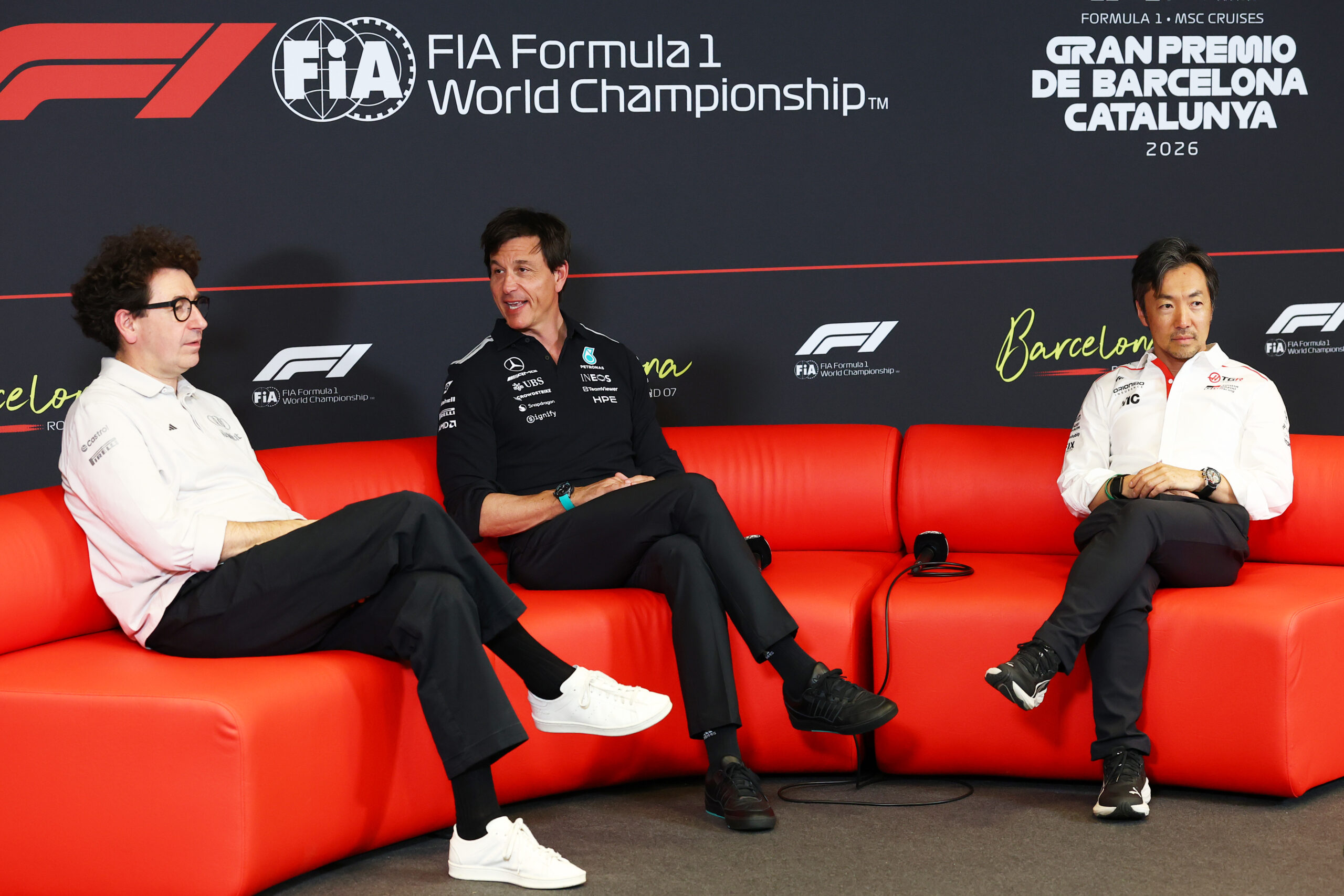
The Additional Development and Upgrade Opportunities (ADUO) system in the 2026 F1 regulations was much discussed during Friday’s press conference at the 2026 F1 Barcelona-Catalunya GP. F1 Team principals Mattia Binotto for Audi, Toto Wolff for Mercedes and Ayao Komatsu for Haas shared their perspectives on how the ADUO system will impact their teams and the general sport moving forward.
Preparing for the two ADUO stages
For Audi, the extra development opportunities arrive as a critical boost for their ongoing power unit integration. Team principal Mattia Binotto clarified that while the ADUO system grants more budget cap, extra engine dynamometer hours and development flexibility, the benefits will not show overnight.
Audi is focusing its efforts on medium- and long term gains, aligning with their competitive target of 2030. Binotto emphasized that power units require significantly more time to develop than other chassis parts, meaning they won’t see immediate performance improvement.
“For Audi it will be a significant benefit. I think it’s what we were expecting. Since the very start of the season, we knew that most of our gap to the top teams was on the power unit side. Not a surprise to us. Hard work will be required. We’ve got plans, but it will be beneficial, but not in the short term. Often maybe people may believe that once you’ve got ADUO, maybe the race after you may introduce 10 kilowatts. That’s not what will happen. In our case, we are looking for a big development, but more on the medium and long term. We are focusing our efforts more on the medium and the long term again, and the ADUO will be beneficial in that respect. So ADU means more budget cap, means more dyno hours, more freedom on development. But again, not everything sometimes is in the short term. Our journey is a long journey. We have set an objective by 2030. So as well, when it comes to car development, power unit development, especially the power units, it takes time to develop, longer than maybe some chassis parts. Again, our plans are set. We will not see immediate benefits from the ADUO, but then it will be certainly beneficial for us.”
The team from Mercedes finds themselves in a different position but similarly welcomes the upgrade path. Toto Wolff noted that a new validation window provides protection against being leapfrogged by other teams.
However, Wolff stressed that the F1 ADUO system is not a stable advantage. The FIA evaluates data every few races, meaning teams must continuously optimize their development choices under regular review.
“Well, the first thing, I had Flavio calling me and saying the deal was that he’s buying the strongest engine, and he’s found out that it’s not the strongest engine. So, what can I say? Like Mattia said, obviously we’re in a different situation than Audi, but a new homologation is definitely something that is helpful, because if you don’t get that, there is quite a possibility of being leapfrogged by somebody else who is able to do this. We have come with various ideas in the past, but, you know, we shall see how this pans out over the next term, because we must not forget this is not a frozen situation, but it’s going to be looked at every few races and then being judged upon.”
For Haas, the situation differs from the power unit manufacturers Audi and Mercedes. As a Ferrari customer team, Team principal Ayao Komatsu welcomed the arrival of two ADUO stages, viewing them as a meaningful performance boost. Komatsu emphasized that the team remains focused on chassis development while collaborating closely with Ferrari to integrate upgrades.
“Yeah, obviously our situation, not being a PUM, is different to Mattia and Toto, but of course, as a Ferrari PU user, we are very happy that we got those two stages of ADUO. That will of course help us significantly. Of course, regardless of that, we’re pushing every day trying to find more performance on the chassis side, and we work very closely with Ferrari in a very collaborative manner. As and when we get those upgrades, we are just keen, just trying to get on top of it and then make best use of it as soon as possible.”
Focus on the Internal Combustion Engine
When addressing what parts will get a little more attention now with the first upgrades, Binotto and Wolff pointed to the Internal Combustion Engine (ICE). Binotto explained that the current ADUO system measures the delta through pure engine power, excluding energy management or electrical efficiency. He noted that Audi is concentrating on combustion chamber efficiency to close the gap.
“Yes, I can start. First, the ADUO is made on assessment of engine power, pure engine power, and the delta which is measured is really on the engine itself. So, it’s not the full power unit, it’s not related to energy management, efficiency of the electrical system. It’s pure engine power. So, if you have been assessed that you are down in engine power, I think the first where you have to be concentrated and focused is really on engine power. And that’s certainly where we stand at the moment ourselves as Audi. And that’s down to the efficiency of your combustion chamber. There isn’t much you can gain in there, but that’s not obviously the overall performance of a power unit. There are certainly efficiencies in the batteries, in the inverters, in the turbo dimensioning for what can be drivability on track and compromises. So when developing a power unit there are a lot of metrics, but certainly when it comes to ADUO, I think that’s assessing, as I said, the gap on pure engine power, and that’s, I think, where at least we are focusing the most.”
Wolff agreed with Binotto, acknowledging the challenge it brings up for Mercedes. As a customer team, Haas relies on Ferrari to deliver the ICE upgrades. However, Komatsu noted that any improvements impact their energy deployment, requiring the team to adapt and use the upgrades as soon as they arrive.
“Yeah, it’s internal combustion engine, as Mattia said. And I think it’s quite easy to analyse. You can see how much grunt you have from the ICE, and definitely being behind is a challenge for us. “Did we get that wrong? Didn’t we optimise it? Didn’t we optimise it on the ICE side? And how can we do it better? I’m not getting red!”
“No, obviously my side is a bit different. Of course, we trust Ferrari to come up with a good upgrade on the ICE side. But of course, that will have an impact on our deployment, even though that’s not what you’re changing as a consequence of, let’s say, better ICE. So again, just as a customer team, just need to get on top of using it as best as we can straight away. Can’t wait.”
Binotto and Wolff discussing the F1 ADUO system and the risk ob BoP
The press conference also highlighted ongoing debates regarding how the FIA measures and implements ADUO. Following the recent data rankings in Monaco, which placed Red Bull as the benchmark, discussions arose. While Binotto and Wolff both expressed total confidence in the FIA’s measurement accuracy and data collection, Binotto suggested that a system built on the standings of the previous season might offer a more unified framework.
“In my opinion, when you speak to Nikolas, it’s data that they have measured and collected. There’s no political background, there is no favours, but it’s the outcome of their analysis of their torque sensors and the way it’s being done, and that is the result.
“Yeah, so as Toto said, I think there is no doubt on the assessment. We’ve got proper sensors on the car to measure the delta power. So, is the principle of the ADUO [being] based on the delta kilowatts the right approach? We may argue. There is an ADUO as well for the chassis, which is called differently, but as a matter of fact, if you are behind on the standings, you’ve got more opportunity in wind tunnel timing, etcetera, and that’s a way for teams somehow to converge. Now, when we discuss the power unit regulations, what would have been the way to assess it? It was decided pure kilowatts. Is that the right way to do it? We may argue again. So maybe we should do something very similar to the chassis, where you base it on standings of the previous seasons, because if convergence, if the purpose of convergence is to have a closer field, maybe that’s the most straightforward, and you would have a unique system framework between chassis and power units. So, the best teams not having advantages, the slowest teams or slowest manufacturers to have some more opportunities. But that’s the way the regulations are written today, and I think we need to fully trust the FIA. I’m sure that the FIA has done the right assessment. What should we do for the future? Should we establish a different type of ranking? Maybe yes.”
Answering a later question, Wolff issued a strong warning against letting ADUO evolve into a Balance of Performance (BoP) system. Talking about his experience with other motorsport categories, Wolff labeled BoP “a political mess” that can drive manufacturers out of racing. He argued that while a safety net is essential to prevent a single manufacturer from dominating unchallenged Formula 1 should stay away from the BoP system.
“I think it was a protection mechanism, how it was intended to be, to avoid the 2014 situation, that one engine manufacturer was having such an advantage and was running away with testing mileage and race results. We were on the good end of that, but this is what we wanted to avoid, especially newcomers coming in like Audi and to a certain degree Honda with Aston Martin, Red Bull, of course. And that’s what it is, and that’s how it should be. And now we can say, does it need an engine adjustment as it is in aero? I get a rash of allergy when talking about BoP. This is something that we should stay far away from Formula 1. It’s a political mess in all the other series. It makes manufacturers go out of the sport also, and I’ve been very close to that, as you can imagine, in DTM, in GTs, in Le Mans. And we should never be tempted to have someone agree on how the balance of performance should fall out. If there is a mechanism that consists of fine tuning in order to make sure that nobody’s embarrassed on the power unit side, I think that’s the right way to go, because when you look at aerodynamics, that was invented for a completely different situation.”