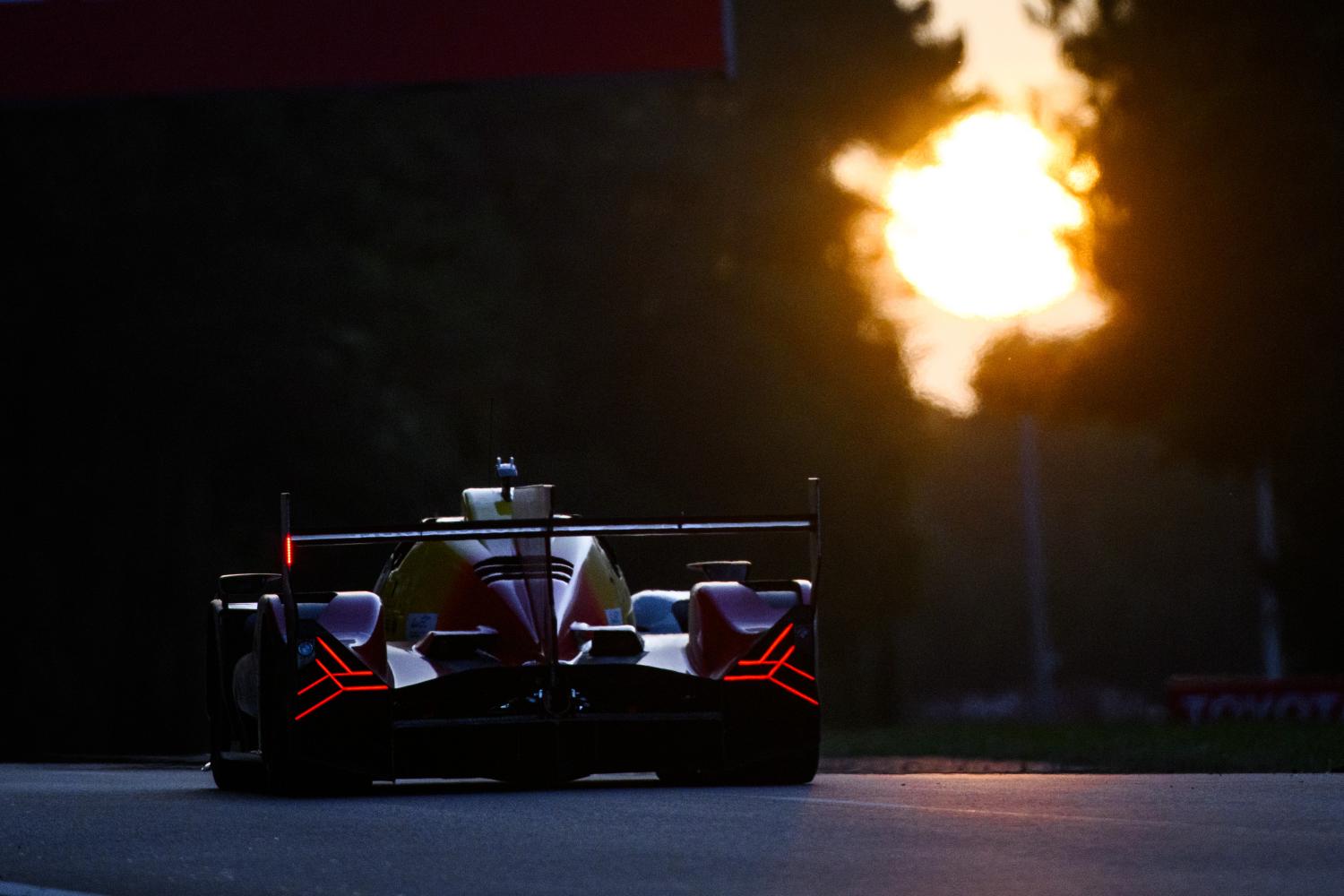
Cadillac held the advantage as the 2026 24 Hours of Le Mans approached midnight, although the race’s first Safety Car threatened to transform the order across all three classes.
Toyota, BMW and Cadillac continued to trade the Hypercar lead through differing fuel and tyre strategies. Earl Bamber moved the #38 Hertz Team JOTA Cadillac V-Series.R to the front before the interruption, while the #8 Toyota and #20 BMW remained closely matched behind.
However, race control deployed the Safety Car at 23:40 local time after incidents involving the #54 VISTA AF Corse Ferrari and #88 Proton Competition Ford Mustang at the Forest Esses.
Cadillac, Toyota and BMW continue three-way fight
The leading manufacturers adopted subtly different approaches as Saturday evening turned towards Sunday morning.
The #20 BMW M Hybrid V8 regularly completed 13-lap fuel stints, while the #8 Toyota TR010 Hybrid generally stopped after 12 laps. Consequently, the two cars repeatedly separated and converged as their pit sequences developed.
Cadillac also remained firmly involved through both Hertz Team JOTA entries. The #38 car used longer stints and a switch to Michelin’s soft compound to create another strategic variation at the front.
Sébastien Bourdais completed a strong series of stints in the #38 Cadillac and extended its fuel runs before handing over to Bamber. The New Zealander then used the soft tyres to produce the fastest lap of the race.
Bamber recorded a 3:26.370 at 23:25, improving the previous benchmark and underlining the performance available from Michelin’s softer compound in the cooler evening conditions.
Toyota and BMW choose contrasting tyre strategies
Sébastien Buemi remained central to Toyota’s challenge after returning to the #8 car.
During the eighth hour, the Swiss driver stopped but retained his existing tyres. Meanwhile, the #20 BMW took fresh rubber but remained on the medium compound.
The differing choices created a fascinating comparison between tyre age and compound performance. Toyota prioritised track position and tyre longevity, while BMW accepted the time cost of a tyre change to regain grip for the next stint.
Buemi gradually closed on Robin Frijns in the #20 BMW before the pair ran almost nose-to-tail in first and second.
However, Bamber stopped earlier in the #38 Cadillac and benefited as the strategies cycled. Before the Safety Car appeared, he held a lead of approximately 24 seconds as the race approached its ninth hour.
First Safety Car changes complexion of 2026 Le Mans race
The race had run without a Safety Car for almost eight hours before the #54 VISTA AF Corse Ferrari became stranded at the Forest Esses.
An incident involving the Ferrari and the #88 Proton Competition Ford Mustang prompted race control to neutralise the field shortly before midnight.
The intervention reduced several gaps that teams had built through pace, fuel saving and tyre strategy. It also divided the field into Safety Car groups, which carried the potential to deliver significant gains or losses depending on each car’s position when officials closed the pit lane and formed the queues.
The #12 Hertz Team JOTA Cadillac also remained in contention before the interruption. Will Stevens ran ahead of the #20 BMW on soft tyres, although the cars occupied different stages of their pit-stop cycles.
Therefore, the restart promised to renew the fight between Cadillac, Toyota and BMW under considerably different circumstances.
Wayne Taylor Racing Cadillac leads chasing group
Behind the leading quartet, Filipe Albuquerque held fifth in the #101 Wayne Taylor Racing Cadillac V-Series.R.
James Calado followed in sixth aboard the #51 Ferrari AF Corse 499P, making it the highest-placed Ferrari in the order.
Ferrari continued to recover from the incidents and penalties that affected both factory cars earlier in the race. The #50 entry remained inside the top 10 after Antonio Fuoco’s earlier spin, while the #51 sought to regain ground following Alessandro Pier Guidi’s drive-through penalty.
Meanwhile, Alpine’s challenge faded during the early evening. The #35 and #36 A424 Hypercars slipped towards the lower positions inside the top 10 after featuring closer to the leaders during the opening hours.
Toyota #7 continues recovery drive
The #7 Toyota remained on a recovery mission after Nyck de Vries suffered a slow puncture during the fourth hour.
Mike Conway returned to the car for his second stint and fought the #50 Ferrari for eighth and ninth positions.
Although the puncture had pushed Toyota down the order, the car remained on the lead lap and continued to reduce its deficit through consistent running.
The #50 Ferrari also pursued a recovery after Fuoco’s earlier contact with the #30 Duqueine Team Oreca at Tertre Rouge. Therefore, the two cars fought for position while attempting to return to the leading group.
Contact eliminates pole-sitting BMW from contention
The #15 BMW M Team WRT entry suffered a major setback during the seventh hour.
Dries Vanthoor made slight contact with John Farano’s #3 DKR Engineering Oreca at Maison Blanche. The collision damaged the BMW’s bodywork and caused a right-rear puncture shortly before 22:00.
Vanthoor had to complete a slow lap before reaching the pits. The team then replaced the rear deck and fitted a new Michelin tyre.
The repair cost more than three laps and dropped the pole-sitting BMW to the rear of the Hypercar field.
Its problems continued when the car returned to the pits at 23:15 with a technical issue at the front. As a result, the #15 effectively fell out of contention for the overall victory.
Safety Car overturns Lexus advantage in LMGT3
Akkodis ASP Team appeared to take control of LMGT3 before the Safety Car.
The #87 Lexus RC F LMGT3 held a narrow advantage over the sister #78 entry after Petru Umbrărescu and Tom van Rompuy completed lengthy and consistent stints.
The team ran first and second after eight hours and appeared well placed to continue controlling the class into the night.
However, the Safety Car changed the order significantly. The #27 Heart of Racing Team Aston Martin moved into the lead as the field reorganised.
Dennis Marschall also gained ground in the #74 Kessel Racing Ferrari 296 LMGT3 and rose to second during his second stint.
Simon Mann held third in the #21 VISTA AF Corse Ferrari at midnight, just ahead of the #77 Proton Competition Ford Mustang.
The two Akkodis ASP Lexus entries consequently dropped to fifth and sixth despite leading before the neutralisation.
Manthey Porsche loses ground with puncture
The #91 Manthey DK Engineering Porsche 911 GT3 R had emerged as one of the strongest LMGT3 contenders during the opening phase.
Ayhancan Güven delivered a rapid double stint, while James Cottingham and Timur Boguslavskiy supported the car’s charge towards the front.
However, a puncture interrupted its progress and cost the Porsche ground in the class battle.
Elsewhere, the #61 Iron Lynx Mercedes-AMG retired after suffering a suspension problem. The #13 Autosport Corvette also left the race following a terminal mechanical failure.
Duqueine Team maintains LMP2 control
Duqueine Team continued to lead LMP2 after building its advantage through strong stints from Richard Verschoor, Doriane Pin and Julien Andlauer.
Verschoor established the foundation during the opening hours before Pin maintained the team’s pace. Andlauer then extended the car’s strong run after Porsche released him to contest Le Mans with the LMP2 squad.
However, Andlauer survived a trip through the gravel at Mulsanne Corner shortly before the Safety Car period.
Despite the excursion, the #30 Oreca-Gibson retained the class lead as the race reached one-third distance.
Safety Car elevates Vector Sport to third
Inter Europol Competition held second in LMP2 with Bijoy Garg back behind the wheel of the team’s car.
Meanwhile, the Safety Car helped the #26 Vector Sport Oreca rise to third. Pietro Fittipaldi capitalised on the timing of the neutralisation to gain ground in the class order.
The interruption therefore reduced Duqueine Team’s advantage and brought its closest rivals back into contention.
Cadillac leads into the Le Mans night
The #38 Cadillac entered the Safety Car period at the head of the Hypercar field after Bamber’s rapid run on soft tyres.
However, the neutralisation erased much of the advantage that Hertz Team JOTA had created through its alternative strategy.
Toyota and BMW remained close, while the #12 Cadillac also held a strong position on its own pit sequence. As a result, the restart prepared the ground for another intense phase of the battle.
Meanwhile, the Safety Car had already overturned Akkodis ASP’s LMGT3 one-two and tightened Duqueine Team’s LMP2 advantage.
With darkness now covering the Circuit de la Sarthe, the first major neutralisation placed strategy, tyre choice and track position at the centre of the next stage of the race.
See the full entry list for the 2026 24 Hours of Le Mans.
See the full schedule for the 2026 24 Hours of Le Mans.
Follow the 2026 24 Hours of Le Mans via the Pit Debrief live blog.