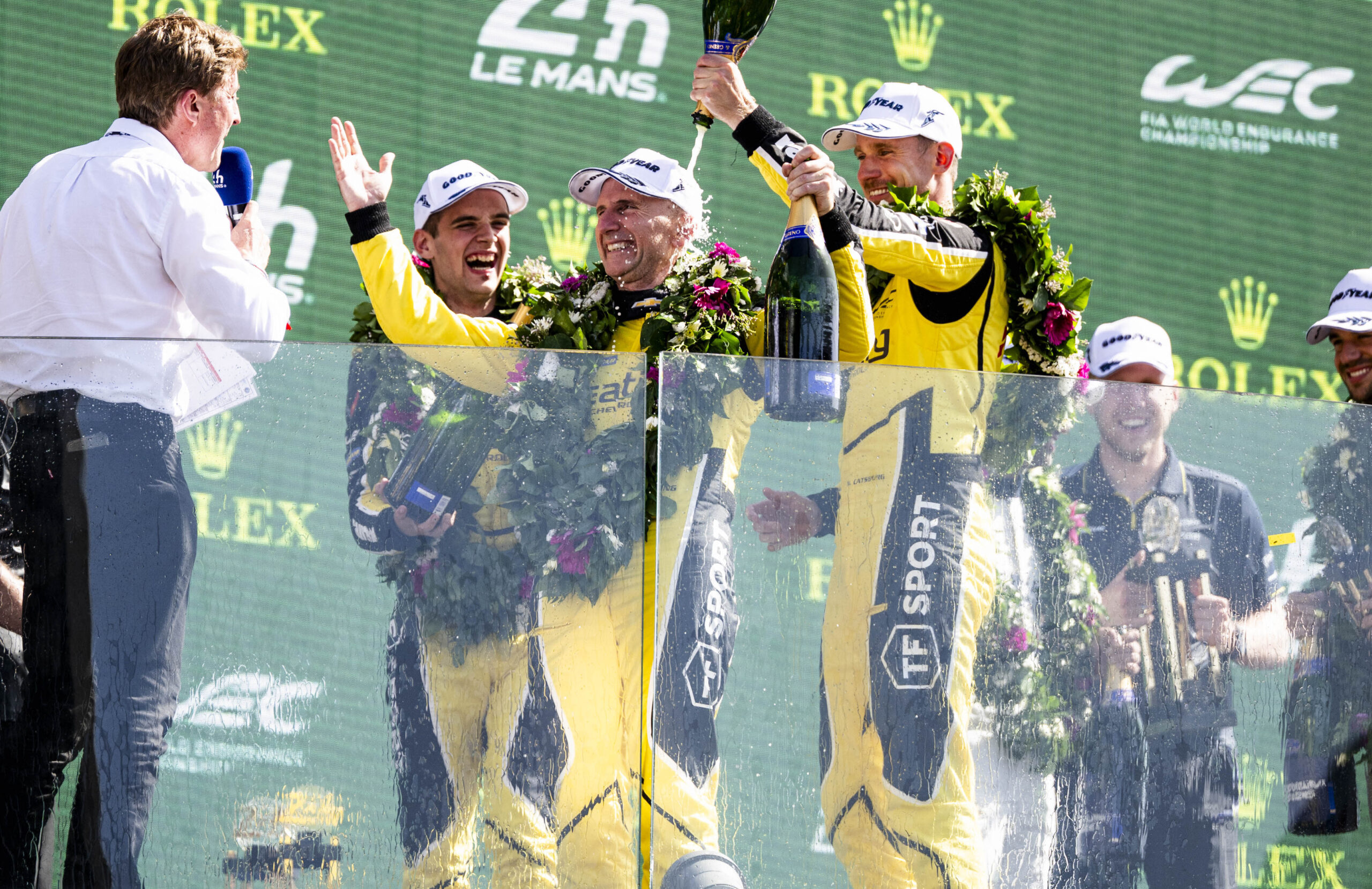
TF Sport combined a bold strategic approach with exceptional performances from Ben Keating, Jonny Edgar and Nicky Catsburg to win the LMGT3 class at the 24 Hours of Le Mans. The Tom Ferrier-led operation started the No. 33 Corvette Z06 LMGT3.R from 17th in the 25-car field but gradually moved into contention through disciplined driving, strong tyre management and faultless work in the pits.
Keating completed the majority of his mandatory driving time during the opening stages despite recently recovering from an elbow injury. Catsburg and Edgar then carried the car towards the front before a Sunday morning safety car erased a two-and-a-half-minute advantage.
Edgar responded with five consecutive stints across almost four hours and held off the team’s Aston Martin and Lexus rivals. His performance secured his first Le Mans victory, Keating’s third and Catsburg’s second.
The result also gave TF Sport its fourth win at the event and delivered Corvette Racing’s tenth Le Mans class triumph since 2001.
TF Sport commits to an alternative strategy
TF Sport entered its tenth Le Mans participation with a strategy that differed from the approach taken by most of its LMGT3 rivals. The team placed much of the early workload on Bronze-rated driver Keating. The Texan started the race and completed all six hours of his mandatory driving time within the opening eight hours.
That decision allowed TF Sport to rely primarily on Edgar and Catsburg during the final two-thirds of the race. However, Keating first needed to keep the Corvette competitive while managing traffic, changing track conditions and the pressure that comes with starting deep in the field.
He understood the potential of the car but refused to assume that strong pace would automatically produce a victory.
“You always believe it can happen, absolutely, but you can’t go into a 24-hour race expecting to do well, no matter how good your car or team is,” Keating mused while speaking to FIAWEC. “You just have to do your job, and the car was in pretty good shape.
Keating avoided unnecessary risks and completed his early programme without contact or major mistakes. His controlled approach gave his teammates a solid platform from which to build.
Keating completes demanding injury comeback
Keating’s contribution carried even greater significance because Le Mans marked his first competitive outing since he sustained an elbow injury in March.
Only nine weeks separated the injury from the race, yet the 54-year-old completed one of the most physically demanding assignments in the LMGT3 field. He spent six of the opening eight hours behind the wheel and delivered consistent lap times throughout his programme.
The demanding schedule tested his fitness, concentration and ability to manage pain. Nevertheless, Keating completed his work and positioned TF Sport to use greater strategic flexibility later in the race. His effort ultimately contributed to the third Le Mans victory of his career.
Favourable weather creates intense competition
Keating experienced far calmer conditions than those he encountered during his previous Corvette victory in 2023. Heavy rain, poor visibility and frequent incidents had shaped that race. By contrast, warm and largely stable conditions allowed the 2026 field to race at a consistently high pace.
“When Nicky and I won in the Corvette in 2023, that was far and away the worst weather conditions I had ever experienced. I think over half the field retired with damage and it was a really difficult race, whereas this has to be the best weather I’ve ever seen at Le Mans in the 12 times I’ve done it.
The improved weather reduced some of the unpredictable dangers, but it also tightened the competition. Fewer incidents separated the leading cars, while sustained heat increased the importance of tyre life and long-run performance.
Corvette turns tyre management into an advantage
The extreme temperatures suited the Corvette Z06 LMGT3.R and its ability to protect its Goodyear tyres. While other cars struggled to maintain consistent performance across longer runs, the Corvette preserved its pace as each stint developed. That characteristic later became one of TF Sport’s most important advantages.
Keating recognised how the car’s tyre management helped the team remain competitive.
“That made for really competitive racing, and I think the extreme heat was beneficial for our car, because the Corvette is really good at taking care of its Goodyear tyres. It’s so good to do this with these guys – I enjoy racing with Nicky, and I’m super-proud of Jonny. To win with Corvette again is really special – and it’s even better to have my name on the side!”
After Keating completed his mandatory running, Catsburg and Edgar took greater responsibility for moving the car forward. Their pace carried the No. 33 entry into the leading battle as the race progressed through the night.
Edgar and Catsburg rise through the field
TF Sport’s professional drivers steadily recovered the ground lost through the car’s 17th-place starting position. Catsburg used his extensive endurance racing experience to keep the Corvette in contention, while Edgar continued to demonstrate the speed that had already marked him as one of the crew’s standout performers.
By sunrise over north-western France, the No. 33 Corvette had moved to the front of the LMGT3 class. The team built its lead through clean driving, efficient stops and consistent pace rather than relying on mistakes from its opponents.
Edgar believed the car had enough speed to fight for victory. However, he also understood how quickly a mechanical issue, collision or pit-stop error could end a Le Mans challenge.
“I knew we had a fighting chance because the car felt really good and we seemed pretty fast,” reflected Edgar, “but in a 24-hour race, you need so much to go right. There are a hundred things that could have gone wrong but we had a pretty perfect race, I would say – no mistakes, no contact and good pit-stops the whole time.
TF Sport’s near-flawless execution allowed the team to establish an advantage of approximately two-and-a-half minutes heading into Sunday morning.
Safety car resets the LMGT3 contest
Ayhancan Güven’s crash in the Manthey DK Engineering Porsche then triggered a safety car intervention and transformed the shape of the race. The neutralisation erased TF Sport’s comfortable margin and placed the leading LMGT3 cars together. Edgar suddenly faced immediate pressure from Aston Martin and Lexus entries that had previously trailed by more than two minutes.
The setback forced TF Sport to reconsider its strategy. The team could no longer rely on its existing advantage and needed to find another way to control the final phase.
“The biggest thing was straight after the safety car on Sunday morning, which reduced what had been a two-and-a-half-minute lead to just a few seconds. The team calculated that if we could stretch the fuel to do an extra lap every stint from that point on, we’d save a stop, which we knew the Lexus would do, too. I think we had a little bit more pace than the Lexus but they could do an extra lap quite easily, whereas for us, it was difficult.
The revised strategy required Edgar to extend every fuel run by one lap. He needed to save enough fuel to avoid an additional stop without sacrificing so much pace that the Lexus could attack.
Fuel saving changes the final battle
The safety car created a contest that combined outright speed with careful energy management. TF Sport knew the Lexus could reach its fuel target more comfortably. Therefore, Edgar needed to manage the Corvette precisely while maintaining enough pressure to keep control of the race.
He balanced fuel saving through slower sections with strong pace in the most important parts of the lap. Meanwhile, the team monitored consumption and adjusted its targets throughout each stint. The strategy placed considerable responsibility on Edgar, particularly because any miscalculation could have forced a late splash-and-dash stop.
Tyre degradation creates the decisive margin
Although the Lexus held an advantage in fuel range, the Corvette produced stronger pace as its tyres aged. Edgar used that strength to create a gap during the second half of each stint. The car’s ability to maintain consistent lap times allowed TF Sport to offset the fuel-saving challenge.
“That was the trickiest part of the race, but our pace was still really good, and especially on tyre degradation, we seemed better than everyone else, so that’s where we really made the difference.
The tyre advantage also encouraged TF Sport to extend Edgar’s time in the car. Rather than changing drivers and potentially disrupting the rhythm of the race, the team continued to rely on the young Briton.
Three planned stints become five
TF Sport originally planned for Edgar to complete three stints during the final phase. However, the team’s tyre strategy made a fourth stint more efficient. Once Edgar completed that run without a decline in pace or concentration, TF Sport decided to leave him in the car for a fifth.
“The plan wasn’t actually to do five stints at the end – I was going to do three but because of what we were doing with the tyres, it made sense to do four and once I was already in for four, we decided I may as well stay in again, so it went from three stints to five pretty quickly! But I felt good in the car and it was really nice to drive, and I was quite surprised by how easy those five stints were.
Edgar ultimately spent almost four consecutive hours behind the wheel. He maintained his pace, managed the fuel targets and protected the car while carrying the pressure of leading at Le Mans. His consistency denied the chasing Aston Martin and Lexus crews an opportunity to attack. He then took the chequered flag to secure the first Le Mans victory of his career.
Edgar praises Keating’s opening contribution
Edgar’s final drive decided the outcome, but TF Sport’s victory relied on the work of all three drivers. Keating’s early six-hour contribution gave the team the freedom to maximise Edgar and Catsburg later in the contest. Catsburg also played a central role in moving the car into the lead and preparing the team for the closing stages.
Edgar praised the crew’s execution and highlighted the scale of Keating’s contribution after his injury.
“Everyone in the TF Sport team did a great job, our strategy worked perfectly and it was very impressive what Ben did, completing six out of the first eight hours of driving. Even on a normal day, I wouldn’t want to do that, never mind coming back from an injury – that was crazy!”
TF Sport supported the drivers with clean pit stops and accurate strategic decisions. The team also adapted quickly when the safety car removed its advantage.
Catsburg identifies Edgar as the standout performer
Catsburg shared Edgar’s admiration for Keating’s recovery and early workload. However, the Dutchman regarded Edgar as the defining performer of the race. The 22-year-old entered only his second Le Mans appearance but handled the closing pressure with the composure of a far more experienced endurance driver.
“For Ben to do all of his driving before Sunday with no mistakes, nine weeks after breaking his elbow, was incredible,” echoed Catsburg, who celebrated his second success at La Sarthe. “Then Jonny – if you ask me, he was man of the match. He was unbeatable, and I feel like this is one of those races that could be career-changing for him.
Edgar’s five-stint performance demonstrated his speed, physical resilience and ability to execute complex strategic instructions. It also delivered the most significant victory of his endurance racing career.
A perfect comeback story for TF Sport
TF Sport faced a difficult task after starting from the ninth row of the LMGT3 grid. However, the team remained patient during the opening hours and allowed its strategy to develop. Keating completed his demanding programme, Catsburg helped move the Corvette towards the front and Edgar controlled the decisive phase.
Catsburg believed the sequence of events created an ideal Le Mans story.
“If you got to write the story, you would write it this way. We had to come all the way from the back, so it was an incredible result for us. You couldn’t ask for better!”
The victory gave Catsburg his second success at La Sarthe after his 2023 win with Keating in a Corvette.
Sister Corvette completes strong recovery
TF Sport also achieved a significant result with its sister No. 34 Racing Team Turkey by TF Corvette. Charlie Eastwood, Salih Yoluç and Peter Dempsey started last in the 25-car LMGT3 field after a post-qualifying penalty. However, the trio climbed steadily through the order and finished sixth.
Their recovery demonstrated the strength of the Corvette package and TF Sport’s ability to manage both entries across the full 24-hour race. The two cars gained a combined 28 positions from their starting places, giving TF Sport one of the most impressive collective performances in the class.
Corvette credits its customer racing programme
Corvette Racing Programme Manager Andrea Hidalgo celebrated the result as an important achievement for the manufacturer and its customer team. The No. 33 crew delivered speed, reliability and consistency across the entire race, while TF Sport converted the platform’s strengths into victory through its strategy.
“It’s amazing to be able to help bring home such an important win for Corvette Racing and add to the long legacy Corvette has at Le Mans,” acknowledged Programme Manager, Andrea Hidalgo. “This shows the strength of our Corvette LMGT3 platform and the strength of our customer teams. Congratulations to TF Sport, Nicky, Jonny and Ben on a near-flawless race.”
The victory reinforced the strength of the Corvette Z06 LMGT3.R during its early years in international GT3 competition.
Tenth Le Mans win extends Corvette legacy
Corvette Racing claimed its first Le Mans class victory in 2001. TF Sport’s latest success increased the American manufacturer’s total to 10. The milestone added another chapter to Corvette’s long relationship with the event and rewarded the wider group of engineers, designers, team members and customer racing personnel behind the programme.
General Motors President Mark Reuss described the result as a historic achievement for the organisation.
“What a historic day for General Motors and Corvette Racing,” echoed Reuss. “To earn Corvette Racing’s tenth class victory at Le Mans is a tremendous achievement for our motorsport, design and engineering teams.
Corvette reached the landmark through a combination of factory and customer-team successes across several generations of racing machinery.
General Motors celebrates a collective success
Reuss also praised TF Sport and its three drivers for securing their places within Corvette’s Le Mans history. Each driver delivered a vital element of the victory. Keating overcame his injury and completed the demanding opening workload, Catsburg helped guide the car through the night and Edgar produced the decisive final charge.
“Huge congratulations to Nicky Catsburg, Jonny Edgar and Ben Keating, and our partner TF Sport – they have earned their place in the history books! It’s an incredibly proud moment for all of us and it shows that, working as one team, GM can beat the best in the world.”
TF Sport turned a 17th-place start into victory through disciplined execution and an adaptable strategy. Keating’s comeback, Catsburg’s experience and Edgar’s five-stint masterclass then completed a memorable triumph for the team and Corvette Racing.