The DTM heads to the 2026 Norisring round with a Balance of Performance (BoP) package that requires more than a quick glance at the headline numbers.
At first look, Mercedes-AMG and Porsche stand out because both naturally aspirated cars receive large restrictor figures for the Nuremberg street circuit. However, BoP does not work through one single adjustment. Weight, ballast, ride height, wing angle, lambda values and boost limits all shape how each GT3 car produces lap time.
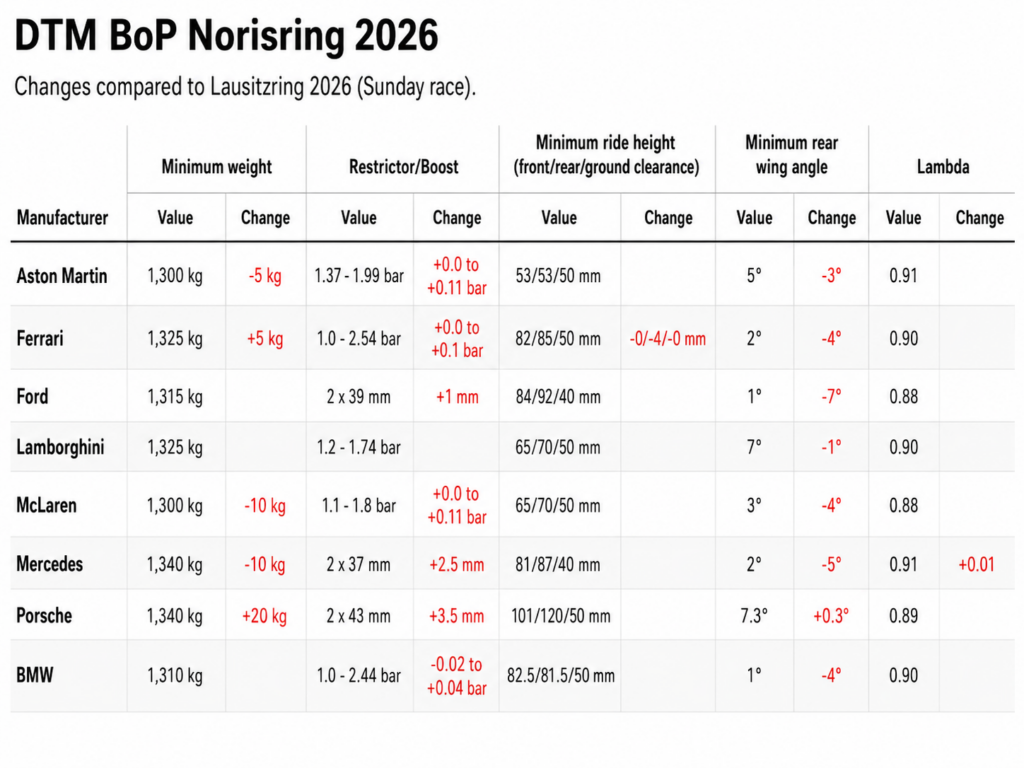
The official SRO GT Bureau document for the 2026 DTM Norisring round, with decisions taken on 26 June 2026, sets out the latest values for all FIA GT3 cars competing this weekend, listing the minimum weight, BoP ballast, total weight, engine restrictor size, ride heights, ground clearance, wing angle and lambda values for every model.
How to read the DTM Norisring BoP
Balance of Performance aims to place different GT3 concepts into a similar performance window.
The DTM grid contains front-engined, mid-engined, naturally aspirated and turbocharged cars. Each model creates lap time in a different way, so the BoP cannot rely on one universal tool. Instead, officials adjust several areas at once.
Weight is the easiest number to understand. A heavier car usually works harder under braking, acceleration and direction changes. Around the Norisring, that matters because drivers repeatedly slow the car, rotate it and launch out of tight corners.
For naturally aspirated cars, engine performance is controlled through restrictors. A larger restrictor allows more air into the engine, which can help power delivery, particularly on acceleration and full-throttle sections. However, extra weight, ride-height settings or aerodynamic requirements can reduce that advantage.
Turbocharged cars follow a different system. Aston Martin, BMW, Ferrari, Lamborghini and McLaren do not use restrictor sizes in the main BoP table. Their engine output is managed through boost pressure limits, with the official document noting that the values are boost pressure ratios that must be adjusted relative to ambient pressure at each event.
Why the Norisring makes BoP difficult
The Norisring creates a different challenge from most other circuits on the DTM calendar.
The street track is short, narrow and heavily dependent on braking stability, traction and straight-line efficiency. A car that looks strong on paper can still struggle if it lacks confidence under braking or cannot put its power down cleanly.
That makes the interaction between BoP values particularly important.
A lighter car may accelerate and brake better, but it still needs the correct boost delivery, ride height and aero balance. A car with a bigger restrictor may gain engine breathing, but extra weight can make it harder to stop and rotate. A higher wing angle can improve rear stability, but it can also add drag on the straights.
That is why the headline numbers can be misleading. The Norisring BoP sheet gives a technical snapshot, not a guaranteed competitive order.
Mercedes and Porsche carry the heaviest packages
Mercedes-AMG and Porsche both sit at 1340kg without the driver, making them the heaviest cars listed in the Norisring BoP.
The Mercedes-AMG GT3 Evo has a 1315kg minimum weight plus 25kg of BoP ballast. It will run with two 37mm restrictors, a 40mm minimum ground clearance, a two-degree minimum rear wing angle and the 2026 ECU map.
Porsche reaches the same 1340kg total with a 1310kg minimum weight and 30kg of BoP ballast. The 911 GT3 R Evo receives two 43mm restrictors, the largest restrictor size among the naturally aspirated cars in the table. However, it also has a 120mm rear ride height and a 7.3-degree minimum wing angle.
That creates two different trade-offs. Mercedes gets a sizeable restrictor opening but carries the joint-highest total weight. Porsche receives the largest restrictors, but also has to manage the same total weight and more demanding ride-height and wing settings.
At the Norisring, that means both cars may gain on engine performance while still paying a price under braking, through traction zones and over the street circuit surface.
Ford gets a lighter naturally aspirated profile
Ford sits in a different position among the naturally aspirated cars.
The Mustang GT3 Evo has a 1313kg minimum weight and only 2kg of BoP ballast, bringing it to 1315kg. It will run with two 39mm restrictors, a 40mm minimum ground clearance and a one-degree minimum rear wing angle.
That gives Ford less total weight than Mercedes-AMG and Porsche, but also a smaller restrictor than the Porsche.
The result is a different type of compromise. Ford may benefit from carrying less mass through braking and acceleration zones, while Porsche may receive more engine breathing through its larger restrictors. Mercedes sits between the two on restrictor size but matches Porsche on total weight.
This is where BoP becomes more complex than simply asking which car has the largest restrictor.
Turbocars are balanced through boost
The turbocharged cars use boost limits rather than restrictor sizes.
The official document includes a Pboost ratio table on page 3 for McLaren, Lamborghini, Ferrari, BMW and Aston Martin. Those values change across the rev range, meaning each car’s power delivery depends not only on peak boost but also on how that boost is shaped at different engine speeds.
That matters at the Norisring because acceleration out of slower corners can be just as important as top speed. A car with strong low-rev boost may feel different from one that performs better higher in the rev range.
The document also includes a Pboost Control Strategy diagram on page 4, showing how boost monitoring feeds into overboost checks. That reinforces the point that turbo performance is not managed by one simple number.
For the turbocars, weight and boost work together. A lighter car still needs the correct boost delivery, while a heavier car can remain competitive if its power curve and traction suit the circuit.
McLaren and Aston Martin sit lightest
McLaren and Aston Martin have the lowest total weights on the Norisring BoP sheet.
The McLaren 720S GT3 Evo carries a 1250kg minimum weight plus 50kg of BoP ballast, giving it a total of 1300kg. Aston Martin reaches the same total through a 1280kg minimum weight and 20kg of ballast.
However, they do not share identical packages.
The Aston Martin Vantage AMR GT3 Evo runs with 53mm front and rear ride heights and a five-degree minimum wing angle. The McLaren has 65mm at the front, 70mm at the rear and a three-degree minimum wing angle.
Both cars may benefit from the lower total weight, especially under braking and acceleration. However, their different ride heights, wing angles and boost tables mean they may achieve their lap time in different ways.
At a narrow street circuit, those differences can decide how easily a driver attacks kerbs, manages traction and commits under braking.
Ferrari and Lamborghini share weight but not character
Ferrari and Lamborghini both sit at 1325kg, but the matching total weight does not mean the cars have similar BoP profiles.
The Ferrari 296 GT3 Evo starts from a 1285kg minimum weight and carries 40kg of BoP ballast. The Lamborghini Temerario GT3 has a much higher 1320kg minimum weight but only 5kg of ballast.
Their aero and ride-height settings also differ. Ferrari runs 82mm at the front, 85mm at the rear and a two-degree minimum wing angle. Lamborghini sits lower, with 65mm at the front and 70mm at the rear, but carries a seven-degree minimum wing angle.
That changes the way each car may behave. Ferrari and Lamborghini carry the same total weight, but one has more ballast added to a lighter base car, while the other sits closer to its minimum weight. Their ride-height and wing settings also suggest different balances between aero efficiency, stability and drag.
On a lap as short as the Norisring, that can create very different strengths and weaknesses despite the identical total weight.
BMW occupies the middle ground
BMW sits between the lightest turbocars and the heavier Ferrari-Lamborghini group.
The M4 GT3 Evo has a 1300kg minimum weight and 10kg of BoP ballast, giving it a 1310kg total weight. The car uses boost control rather than restrictors and runs with a one-degree minimum rear wing angle.
Its ride-height values are 82.5mm at the front and 81.5mm at the rear, putting it closer to Ferrari’s range than to the lower Aston Martin, McLaren or Lamborghini figures.
BMW therefore does not sit at either extreme of the BoP table. It is not the lightest car, but it avoids the heavier totals carried by Ferrari, Lamborghini, Mercedes and Porsche. It also has the lowest minimum rear wing angle listed alongside Ford, which could influence its drag and stability balance.
For Schubert Motorsport, the question will be whether that middle-ground package gives the M4 GT3 Evo enough braking confidence, traction and straight-line efficiency around the Norisring.
Why one number cannot predict the order
The Norisring BoP sheet shows why comparing GT3 cars requires caution.
Porsche has the largest restrictors, but it also carries 1340kg and a 7.3-degree wing angle. Mercedes has larger restrictors than Ford, but it carries 25kg more total weight than the Mustang. McLaren and Aston Martin sit lightest, but their boost, ride-height and wing settings still shape their final performance. Ferrari and Lamborghini share a total weight, but their technical profiles differ significantly.
That is the core purpose of BoP. Officials do not try to equalise cars through one adjustment. They combine several tools to bring different engineering concepts into the same competitive range.
The Norisring will reveal how those choices translate on track. The circuit’s short lap will keep the margins small, while traffic and qualifying execution could distort the order further.
On paper, several manufacturers can find reasons for optimism. In reality, the stopwatch will show whether the official BoP package has created the close fight the DTM expects at its only street circuit.