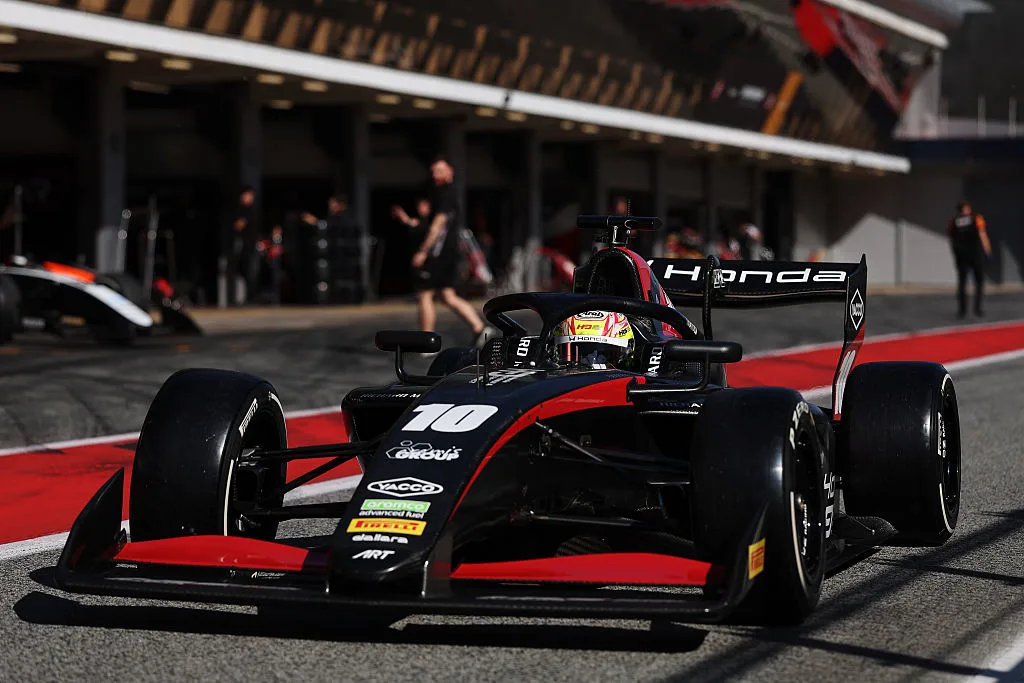
ART Grand Prix’s Taito Kato concluded the 2026 FIA Formula 3 (F3) post-season testing programme with the fastest lap across both days at the Circuit de Barcelona-Catalunya. The Japanese driver recorded a 1:27.902 during Tuesday morning’s session, narrowly beating Campos Racing’s Ernesto Rivera and Rodin Motorsport’s Alessandro Giusti.
Kato’s performance represented a significant improvement over the opening day, when he finished fifth in the morning session. However, the 19-year-old identified the team’s progress during longer runs as an equally important achievement, highlighting improvements in both single-lap performance and race pace.
The result also provided an encouraging conclusion to his rookie F3 season, during which he secured his maiden victory and finished fourth in the Drivers’ Championship.
Kato credits ART Grand Prix improvements for Barcelona performance
Kato approached the second day of Barcelona testing determined to improve upon Monday’s performance, having encountered difficulties with the car’s setup during the opening sessions.
The ART Grand Prix driver finished fifth during Monday morning’s running with a 1:29.167, while MP Motorsport’s Matteo De Palo topped the classification with a 1:28.516.
However, Kato and his engineers identified the issues affecting the car and made adjustments ahead of Tuesday’s sessions.
The changes produced an immediate improvement, allowing the Japanese driver to challenge consistently near the front throughout the final day.
Reflecting on the progress, Kato expressed satisfaction with the team’s ability to address its earlier difficulties.
“I think we made quite a good step from yesterday. Actually, we are missing the pace a little bit from yesterday. But, we found what the issue with the car was and then we made quite a good step from that.
“I think pace was really, really good. I think when I was on track, every time I was fighting for top five, top three, so I think car was looking pretty nice.
“What was especially good was that the long run pace was really, really good, to be honest. I think that is the biggest step from this weekend, so we are quite happy with it.”
The improvements allowed ART Grand Prix to complete its final testing programme with greater confidence, particularly as the team continued gathering information ahead of the winter break.
Furthermore, Kato’s assessment highlighted the importance of balancing outright speed with consistency across longer runs, rather than concentrating exclusively on qualifying simulations.
Kato secures fastest lap as margins remain extremely close
Kato established the fastest time of the Barcelona test during Tuesday morning’s session, recording a 1:27.902 as several teams concentrated on qualifying simulations.
The Japanese driver initially moved to the top of the timesheets during the opening ten minutes before Giusti and Rivera emerged as strong challengers.
Rivera subsequently recorded a 1:28.186 to lead the session, while the leading seven drivers became separated by just 0.186 seconds.
However, Kato delivered the decisive improvement approaching the halfway point, setting a lap that none of his rivals could match.
Rivera eventually finished second with a 1:27.914, just 0.012 seconds behind the ART Grand Prix driver. Meanwhile, Giusti completed the top three with a 1:27.971, only 0.069 seconds away from Kato’s benchmark.
Rodin Motorsport’s Reza Seewooruthun followed in fourth with a 1:27.989, leaving the leading four separated by just 0.087 seconds.
Van Amersfoort Racing’s Yevan David completed the top five, recording a 1:28.073.
The final day of Barcelona post-season testing therefore produced exceptionally close margins, with several drivers demonstrating competitive single-lap pace.
Kato’s benchmark also represented a significant improvement over the opening day of the Barcelona test, when De Palo established the fastest time with a 1:28.516.
Despite the narrow advantage, Kato regarded his performance as a successful conclusion to the team’s qualifying-focused programme.
Cooler conditions help Kato unlock pace in final sector
Kato’s fastest lap also surpassed two significant benchmarks at the Circuit de Barcelona-Catalunya.
His 1:27.902 was 0.496 seconds quicker than Théophile Naël’s leading time from the 2025 post-season test and 0.361 seconds faster than the pole position lap Naël recorded during the 2026 F3 race weekend.
However, Kato acknowledged the influence of track conditions, particularly the cooler temperatures that helped drivers manage their rear tyres.
Barcelona’s final sector places considerable demands on tyre performance, making temperature management an important factor when attempting to complete a competitive qualifying lap.
The ART Grand Prix driver explained how the conditions contributed to his performance while also highlighting the quality of his individual lap.
“For sure, track temperature was much cooler than the race weekend here earlier this year, so I think that helped prevent overheating the rear tyres, especially in Sector 3. So that’s why we gained time there a little bit.
“I think that lap was quite decent. I was able to put the lap all together in all three sectors. Looking at the laptimes overall, we were really, really close between P1 to P5.
“If I lost, like, two or three hundredths, I’d have lost three or four positions. So I think lap was quite nice.”
His comments underlined the importance of precision during the session, particularly as the smallest differences could determine several positions in the classification.
Although the cooler conditions contributed to the improved lap times, Kato remained pleased with his ability to combine strong sectors and deliver a complete qualifying simulation.
Strong long-run pace provides further encouragement for ART Grand Prix
While Kato’s fastest lap attracted attention, the Japanese driver identified the team’s long-run performance as one of the most positive aspects of the test.
Following the morning’s qualifying simulations, ART Grand Prix shifted its focus towards longer runs during Tuesday afternoon.
Kato completed another 52 laps, bringing his total to 76 across the final day as the team continued evaluating race pace, tyre behaviour and setup performance.
The Japanese driver finished ninth in the afternoon classification with a 1:32.554. However, outright lap times carried less significance during the session because teams concentrated on longer race simulations rather than qualifying performance.
TRIDENT’s Niccolò Maccagnani topped the afternoon with a 1:29.994, while AIX Racing’s Dion Gowda and James Egozi completed the leading three.
Nevertheless, Kato’s comments suggested that ART Grand Prix had made meaningful progress in the areas that had troubled the team earlier in the test.
His satisfaction with the longer runs also provided an encouraging indication of the team’s development, particularly as consistent race pace remains crucial in a championship where tyre management and overtaking opportunities can significantly influence results.
Consequently, ART Grand Prix concluded the Barcelona programme with positive indications from both qualifying simulations and race-focused running.
Kato reflects on successful rookie season and close relationship with ART
The Barcelona test also marked the conclusion of Kato’s first season in FIA F3, during which he established himself as one of the championship’s leading rookies.
Driving for ART Grand Prix, the Japanese driver secured his maiden F3 victory during the Sprint Race at Monza in September.
Starting ninth, Kato produced an impressive recovery through the field before executing a decisive overtake during the closing stages.
The Monza victory marked an important breakthrough in his debut campaign, providing a reward for the progress he and ART Grand Prix had made throughout the season.
Kato eventually finished fourth in the Drivers’ Championship with 105 points, behind champion Ugo Ugochukwu, Freddie Slater and Tuukka Taponen.
Meanwhile, ART Grand Prix completed the Teams’ Championship in fourth, collecting 189 points across the season.
Beyond his competitive achievements, Kato also developed a close relationship with the French organisation.
Reflecting on his experiences, he expressed his appreciation for both the F3 machinery and the team that supported him throughout his rookie campaign.
“I’m always happy to jump in the Formula 3 car. Such a really, really good car with the downforce and speed and the pace was amazing. So, just the same mindset as always.
“Just see what I can do and then just focus on my driving and then just enjoy the moment with the team. I love the team, ART feel like it’s my family. That’s why I’m so happy to jump in the car every time.”
His comments reflected the positive relationship he established with ART Grand Prix, particularly as the team helped him adapt to the demands of F3 competition.
Furthermore, the Barcelona test gave Kato another opportunity to work with the organisation following a season that included his maiden victory, several competitive performances and a top-four championship finish.
ART Grand Prix concludes 2026 testing with encouraging results
Kato’s performance provided ART Grand Prix with a positive conclusion to the 2026 post-season testing programme, which included two days of running at Jerez followed by another two at Barcelona.
The Japanese driver topped the final test with his 1:27.902, narrowly beating Rivera and Giusti as the leading competitors demonstrated how closely matched the field remained.
However, Kato’s satisfaction extended beyond the outright result. The team’s ability to identify and resolve its earlier setup difficulties, combined with improved long-run performance, represented important achievements during the final sessions.
His comments also highlighted the confidence he developed throughout his rookie season and the strong working relationship he established with ART Grand Prix.
With the four-day testing programme complete, teams will now analyse their findings and continue preparations for the 2027 F3 season.
For Kato, the Barcelona result brought a successful first championship campaign to a close, combining the fastest lap of the final test with encouraging progress in race pace and car performance.