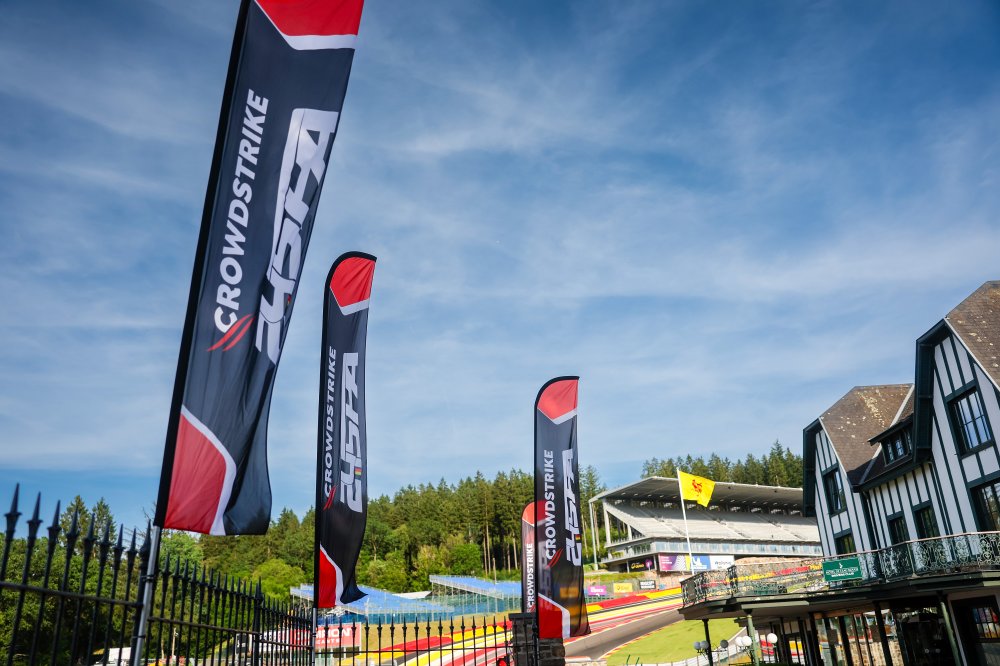
The 2026 CrowdStrike 24H of Spa introduces a completely revised Qualifying and Superpole format. Organisers have designed the new system to reduce traffic on Thursday evening while creating a more intense battle for pole position on Friday.
Thursday Qualifying will test the strength of each complete driver line-up. Every driver must contribute to the crew’s average time, which will decide whether the car progresses to Superpole.
Friday then shifts the responsibility to one nominated driver. The 32 quickest cars will enter a four-stage knockout contest that gradually reduces the field to four, before a single flying lap decides pole position.
Qualifying and Superpole at a glance
- Thursday Qualifying: Four separate driver sessions
- Track groups: Bronze Cup and Pro-Am, followed by Silver and Gold, then Pro
- Time per group: 10 minutes
- Combined result: The average of each crew’s driver times
- Superpole qualification: The fastest 32 cars
- Superpole driver: One nominated driver per car
- Superpole format: 32 cars, then 16, eight and four
- Final stage: One flying lap for pole position
The format creates two distinct tests. Thursday rewards consistency across the complete crew, while Friday places one driver under maximum pressure.
Thursday Qualifying begins with class-based groups
Qualifying takes place on Thursday evening across four blocks, named Qualifying 1 through Qualifying 4. Rather than releasing the entire field at once, organisers will separate the cars into three groups according to their competition class.
Group A contains the Bronze Cup and Pro-Am entries. Group B brings together the Silver and Gold Cup cars, while Group C contains the Pro field. Each group receives 10 minutes of track time before the next group begins its run.
The latest official timetable schedules Qualifying 1 from 19:45, followed by Qualifying 2 at 20:10, Qualifying 3 at 20:45 and Qualifying 4 at 21:20. The first block only features Groups A and B, while all three groups run during the remaining sessions.
This structure reflects the different crew sizes. Pro teams use three drivers, so they only need three individual Qualifying sessions. Four-driver crews use all four blocks, while three-driver entries from the other classes follow the relevant three-session arrangement.
Every driver contributes to the average
Each driver receives an individual Qualifying opportunity. The combined classification then uses the average of the times recorded by every member of the crew.
For a four-driver entry, all four drivers contribute to the final average. A three-driver crew produces its result from three times. Therefore, one exceptional lap cannot completely rescue weaker performances from the rest of the line-up.
This system places pressure on every driver. Each competitor must find space, bring the tyres into the correct operating window and complete a clean lap within only 10 minutes.
A professional driver may produce one of the fastest times of the evening, but the car can still fall down the order if a team-mate loses time in traffic or fails to deliver a representative lap. Conversely, a balanced crew can outperform a rival that relies heavily on one standout driver.
The format should have particular significance in the mixed categories. Gold Cup, Bronze Cup and Pro-Am crews combine drivers with different classifications and levels of experience. Teams that maintain a small performance gap across their line-up may gain more than those with one exceptionally quick professional and several slower contributions.
Why organisers introduced the groups
Spa-Francorchamps stretches across 7.004 kilometres, but a large GT3 field can still create severe traffic during Qualifying. Cars preparing for fast laps often meet others slowing down to create space, which can compromise both drivers.
The class-based groups should reduce that problem. Each 10-minute run places fewer cars on the circuit and gives drivers a better chance to complete a clear lap.
The split also groups entries with broadly similar line-up structures. Bronze Cup and Pro-Am cars run together, followed by the Gold and Silver entries, before the unrestricted Pro crews take their turn.
However, the system cannot remove every variable. Track conditions may improve as rubber builds, while changing temperatures or rain could favour one group over another. Drivers must still react quickly because the short sessions leave little time to wait for a perfect opportunity.
What Thursday Qualifying decides
The average-time classification establishes the first competitive order of the weekend. Most importantly, it determines which 32 cars advance to Friday’s Superpole.
Cars outside the top 32 will not take part in the knockout session, so Thursday effectively settles their places in the starting order, subject to any sporting penalties or technical decisions.
Meanwhile, the qualifying teams must nominate one driver to contest Superpole. The official timetable requires teams to submit that nomination after Thursday’s track action, which prevents them from changing drivers freely during Friday’s knockout contest.
That decision creates an important strategic question. Teams need a driver with raw speed, but they also need someone who can perform repeatedly under pressure. The nominated competitor may need to progress through four separate stages before reaching the pole shootout.
Friday Superpole introduces a knockout contest
The latest official timetable schedules Superpole from 15:05 on Friday. The session will last approximately 50 minutes, including the gaps between its four stages.
Each of the 32 qualifying cars will use one nominated driver. The stewards will allow one new set of tyres for Superpole, but teams cannot change those tyres once the session begins. They also cannot change drivers, add or remove fuel, or connect computers to the car during the knockout contest.
The restrictions increase the strategic challenge. A driver who reaches the final stage must manage the same tyre set through every preceding session while continuing to produce competitive laps.
Superpole will unfold as follows:
- SP1 – 10 minutes: All 32 cars compete, with the fastest 16 progressing.
- SP2 – seven minutes: The remaining 16 cars fight for eight places.
- SP3 – seven minutes: The fastest eight compete for four positions.
- SP4 – one flying lap: The final four drivers decide pole position.
The session runs from 15:05 until approximately 15:52, with short intervals between each stage.
Each stage starts a new fight
A fast time in one Superpole stage only guarantees progression to the next. It does not protect the driver once the following session begins.
For example, the quickest driver in SP1 must produce another competitive lap in SP2. The same principle applies in SP3, where the eight remaining cars fight for only four places in the final shootout.
The stewards will classify the Superpole runners according to the last stage they reach:
- Positions 1–4: Determined by the SP4 times
- Positions 5–8: Set by the times of the four cars eliminated in SP3
- Positions 9–16: Set by the times of the eight cars eliminated in SP2
- Positions 17–32: Set by the times of the 16 cars eliminated in SP1
Therefore, a driver cannot rely on an earlier lap to retain a stronger position. Every stage demands another clean and competitive performance.
The final four face a one-lap shootout
SP4 reduces the contest to four cars and gives each nominated driver one flying lap to secure pole position.
That format leaves no room for a cautious first attempt. Drivers must build tyre temperature, prepare the brakes and begin the lap with complete commitment.
At the same time, they cannot cross the limit. A mistake at La Source can damage the entire lap before it properly begins, while a poor exit from Raidillon can cost speed along the Kemmel Straight. The middle sector demands precision, before Blanchimont and the Bus Stop provide two final opportunities to gain or lose time.
Track limits add another threat. The Race Director will delete any Superpole lap that breaches the circuit boundaries, which could leave a driver without a representative time at the most important moment of the session.
The final stage should therefore produce one of the weekend’s most intense moments. Four drivers will carry the responsibility for their complete teams, but each will have only one opportunity to deliver.
Why the format places greater value on pole
The previous Superpole system gave the leading Qualifying cars two flying laps in a single-car shootout. The 2026 version demands repeated performance through a full knockout contest.
A pole-winning driver must first survive SP1, then remain inside the top eight during SP2 and reach the final four through SP3. Only then can they attack the decisive flying lap.
As a result, pole will reward more than one burst of outright pace. The successful driver must manage tyres, traffic and pressure across several stages without receiving major assistance from the team.
The system also creates more opportunities for surprises. A Gold or Silver Cup entry can reach Superpole through a strong crew average, then climb further if its nominated driver produces Pro-level pace. Meanwhile, a leading Pro car can drop down the order after one mistake or deleted lap.
A collective test followed by an individual one
The revised format changes the character of Qualifying at the 24H of Spa. Thursday will no longer revolve around one driver dragging a car into Superpole. Instead, every member of the line-up must contribute to the average.
Friday then reverses that emphasis. One nominated driver takes control of the car and carries the team through an increasingly demanding knockout contest.
That contrast gives the new system its appeal. Qualifying rewards the strongest complete crew, while Superpole rewards the driver who can repeatedly perform under intense pressure.
Pole position cannot guarantee success in a 24-hour race. However, it offers a clear track at the start, reduces early exposure to traffic and delivers one of the event’s most prestigious achievements.
Before the 2026 CrowdStrike 24H of Spa begins, the new format will ensure that teams and drivers already face two very different endurance-racing tests.
Full entry list
Weekend schedule
Watch the race live here and follow along with Pit Debrief‘s live blog.