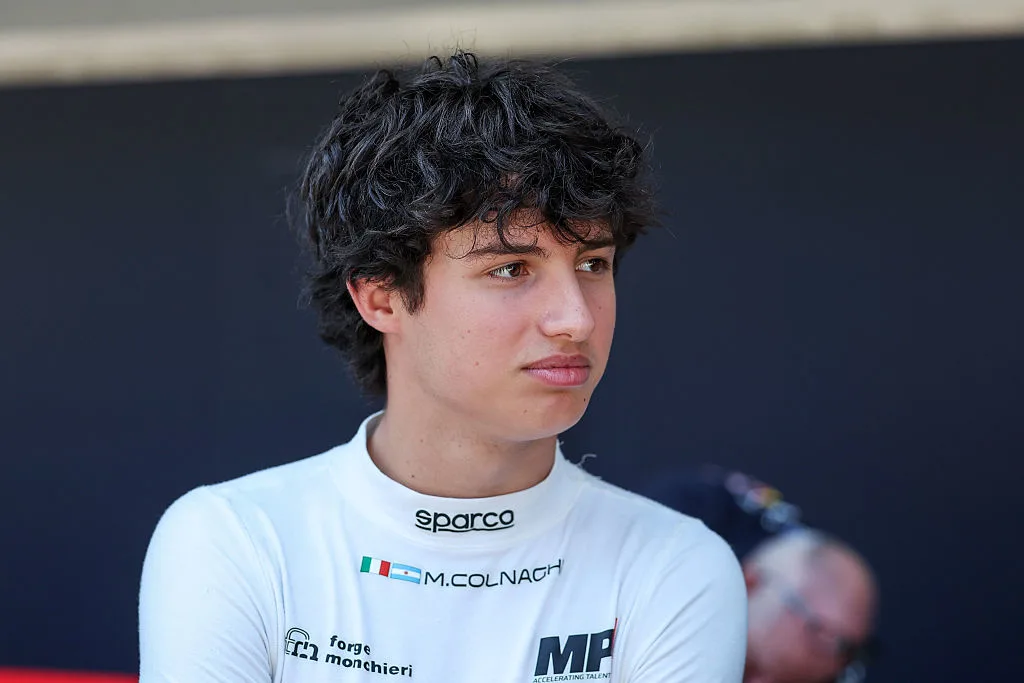
Mattia Colnaghi’s rookie FIA Formula 3 campaign produced two very different halves. The MP Motorsport driver scored just one point across the opening five rounds as he struggled to convert promising qualifying pace into race results. From Spa onwards, however, Colnaghi became one of the 2026 F3 championship’s most consistent midfield scorers and transformed the outlook of his season.
The Red Bull Junior Team driver eventually finished 13th in the Drivers’ Championship with 54 points, level with Maciej Gładysz and only one ahead of Jin Nakamura. He never reached the podium, but consecutive double points finishes at Spa and Budapest established a much stronger baseline before additional scores at Monza and Madrid helped MP climb to third in the Teams’ Championship.
Colnaghi arrives in F3 after back-to-back titles
Colnaghi entered F3 with considerable momentum despite his limited single-seater experience. He won the 2024 Spanish F4 Championship before following that success with the 2025 Eurocup-3 title, completing both campaigns with MP Motorsport. His promotion therefore allowed him to continue a partnership that had already delivered consecutive championships.
He also joined the Red Bull Junior Team ahead of his F3 debut, adding another layer of expectation to a rapid rise through the junior categories. However, Colnaghi approached the season without making bold predictions. He instead focused on maximising the package available to him and learning from experienced teammates Tuukka Taponen and Alessandro Giusti.
That continuity gave Colnaghi an advantage in understanding MP’s working methods, but F3 still introduced new challenges. He needed to learn the Pirelli tyres, manage more complex races and adapt to circuits such as Melbourne and Monaco for the first time.
Melbourne pace brings little reward
Colnaghi immediately demonstrated that outright speed would not represent his main problem. He qualified sixth in Melbourne, producing one of the strongest performances among the rookies and placing himself comfortably ahead of both MP teammates.
The races told a different story. Colnaghi finished last in the Sprint before taking 10th in the Feature Race, leaving Australia with only one point despite starting Sunday from the third row. He identified tyre management as one of the main areas requiring improvement after his mixed Melbourne debut, particularly after struggling to maintain performance through the later stages of the races.
The weekend therefore established a pattern that continued through the opening half of the season. Colnaghi could produce competitive qualifying pace, but he struggled to convert it into meaningful points.
The opening half becomes a test of patience
Monaco offered another opportunity to build on his qualifying speed, but Colnaghi again left without points. Barcelona followed with the same outcome before Spielberg and Silverstone extended his scoreless run to four consecutive rounds.
The lack of results also reflected MP Motorsport’s wider difficulties. The team entered 2026 with two experienced drivers and a highly rated rookie but struggled to establish itself among the leading teams during the first half. Taponen and Giusti also endured difficult stretches, leaving the entire operation searching for greater consistency.
For Colnaghi, that context mattered, but his single Melbourne point still represented a disappointing return after five rounds. His pre-season reputation rested partly on consistency and his ability to maximise opportunities, yet F3 had so far provided the opposite experience. The pace appeared intermittently, but the results did not follow.
Spa transforms Colnaghi’s season
Spa-Francorchamps finally changed that pattern. Colnaghi qualified sixth before post-session penalties moved him to fifth for the Feature Race, giving him one of his strongest starting positions since Melbourne.
He first finished fourth in the Sprint Race, collecting seven points after remaining in contention around the leading group. Sunday then brought another fourth-place finish. Colnaghi started fifth, stayed close to the podium positions and moved ahead of Taponen after his teammate made a mistake at La Source. He eventually finished behind Ernesto Rivera, Hiyu Yamakoshi and Freddie Slater in the Belgian GP Feature Race.
The 19-point haul transformed his championship position. Colnaghi entered Spa with a single point and left with 20, climbing five places after Sunday alone. More importantly, the weekend finally connected the qualifying potential he had shown since Melbourne with strong race execution.
Budapest confirms the breakthrough
Budapest removed any suggestion that Spa represented an isolated result. Colnaghi qualified third, only 0.064s behind Taponen’s pole position, as MP locked two cars into the top three. The result represented his strongest qualifying performance of the season and showed how far the team had progressed since the opening rounds.
Colnaghi started ninth for the reverse-grid Sprint and worked his way to fourth, finishing immediately behind Théophile Naël, Kanato Le and Ernesto Rivera. His fourth place in the Budapest Sprint Race added another seven points and placed him in an excellent position for Sunday.
The Feature Race offered a genuine podium opportunity. Colnaghi started third and moved into second during the opening stages, but Ugo Ugochukwu and Brando Badoer eventually found a way past. He finished fourth again and collected 12 points, later acknowledging that the podium had remained within reach.
Although missing the top three brought some frustration, consecutive fourth-place finishes across both Spa and Budapest Feature Races marked significant progress. Colnaghi scored 38 points across those two weekends after managing only one in the first five rounds.
Monza interrupts his momentum
Colnaghi arrived at Monza with his season moving firmly in the right direction. MP reinforced that progress by locking out the top three positions in Free Practice, with Giusti leading Taponen and Colnaghi.
However, Qualifying brought a setback. The stewards gave Colnaghi a three-place grid penalty after an unsafe release, compromising his starting positions for both races. He still recovered to score five points in the Sprint Race, but Sunday produced no further reward.
The weekend ended the run of double points finishes he had established at Spa and Budapest, yet it did not erase the progress of the previous rounds. Colnaghi had moved from the fringes of the points battle to regularly placing himself around the top five.
Madrid completes a strong second half
Madrid offered one final opportunity to strengthen his rookie campaign. MP arrived at the new circuit fighting for third in the Teams’ Championship, with all three drivers contributing to the team’s late-season resurgence.
Colnaghi failed to score in the Sprint or the first Feature Race, but Sunday gave him another strong result. He started fifth and maintained that position through the final race, finishing behind Taponen, Ugochukwu, Pedro Clerot and Taito Kato. His fifth place added 10 points and helped MP secure third in the Teams’ standings with 208 points.
The result also moved Colnaghi to 54 points and 13th in the final 2026 F3 Drivers’ Championship. Taponen finished third with 109 points, while Giusti took 15th with 45. Colnaghi therefore ended his rookie campaign ahead of the more experienced Giusti, although Taponen remained comfortably clear as MP’s benchmark.
A slow start gives way to significant progress
Colnaghi’s final championship position only partially reflects how unusual his season became. He scored one point across the first five rounds and 53 across the final five, making the improvement after Silverstone impossible to ignore.
Spa and Budapest provided the clearest evidence of that development. Four consecutive fourth-place finishes across those weekends showed that Colnaghi could qualify near the front, race consistently inside the leading group and convert opportunities into substantial points. Monza and Madrid then added further evidence that his stronger second half had created a more reliable baseline.
The lack of a podium prevents 2026 from standing out among the championship’s strongest rookie campaigns, particularly alongside drivers such as Taito Kato and Pedro Clerot. However, Colnaghi’s progression matters more than his early results alone suggest. He entered F3 after dominating lower categories, struggled through the adjustment and then responded with a second half that placed him firmly among the stronger midfield runners.
His next challenge lies in eliminating the long adaptation period that defined the first half of 2026. If Colnaghi can begin his next campaign at the level he reached from Spa onwards, his rookie season will have provided a valuable foundation rather than simply a difficult introduction to F3.