FIA Formula 2 (F2) CEO Bruno Michel has reflected on the championship’s evolution over the past decade, highlighting its growing international presence, successful progression of drivers into F1 and the challenges of preparing competitors for the sport’s increasingly complex technical regulations.
During an October 2026 virtual media event attended by Pit Debrief, Michel discussed F2’s development since its introduction in 2017, including its changing relationship with F1 and the growing number of drivers pursuing alternative routes into the championship. He also offered his assessment of Colton Herta’s difficult transition from IndyCar, while reflecting on Kimi Antonelli’s progression through the junior categories and subsequent success with Mercedes.
As F2 approaches its second decade, the championship faces additional challenges. The introduction of updated machinery for 2027, the growing technical differences between F2 and F1, and the financial demands of international competition will all influence its future development. However, Michel remains committed to maintaining the championship’s central role in preparing drivers for F1.
Michel reflects on F2’s transformation since 2017
F2 celebrates its tenth season in 2026, marking a significant milestone for a championship that has established itself as the final step on the FIA’s junior single-seater ladder.
Since replacing GP2 in 2017, F2 has expanded its international presence and strengthened its relationship with F1. The championship now forms an established part of Grand Prix weekends, providing drivers with opportunities to compete at circuits they could encounter again if they progress to the highest level.
Michel believes the championship has benefited considerably from F1’s wider development, particularly its growing international popularity and the increased attention surrounding junior racing.
“Well, there’s been a lot of changes, that’s for sure. If you look at the situation 10 years ago, I think we had less than 20 events a year. We were racing mainly in Europe and in the Middle East and the visibility of F2 was not that big. The awareness of F2 was not that big at the time. So, we took a massive advantage of the way Formula 1 has been developing over the last 10 years as well under the leadership of Stefano Domenicali and his team.”
The expansion has helped F2 develop a more recognisable identity, while its increasing presence on the F1 calendar has introduced the championship to new audiences.
F2 strengthens its position within F1 race weekends
Beyond its geographical expansion, F2 has become an increasingly important part of the F1 weekend experience.
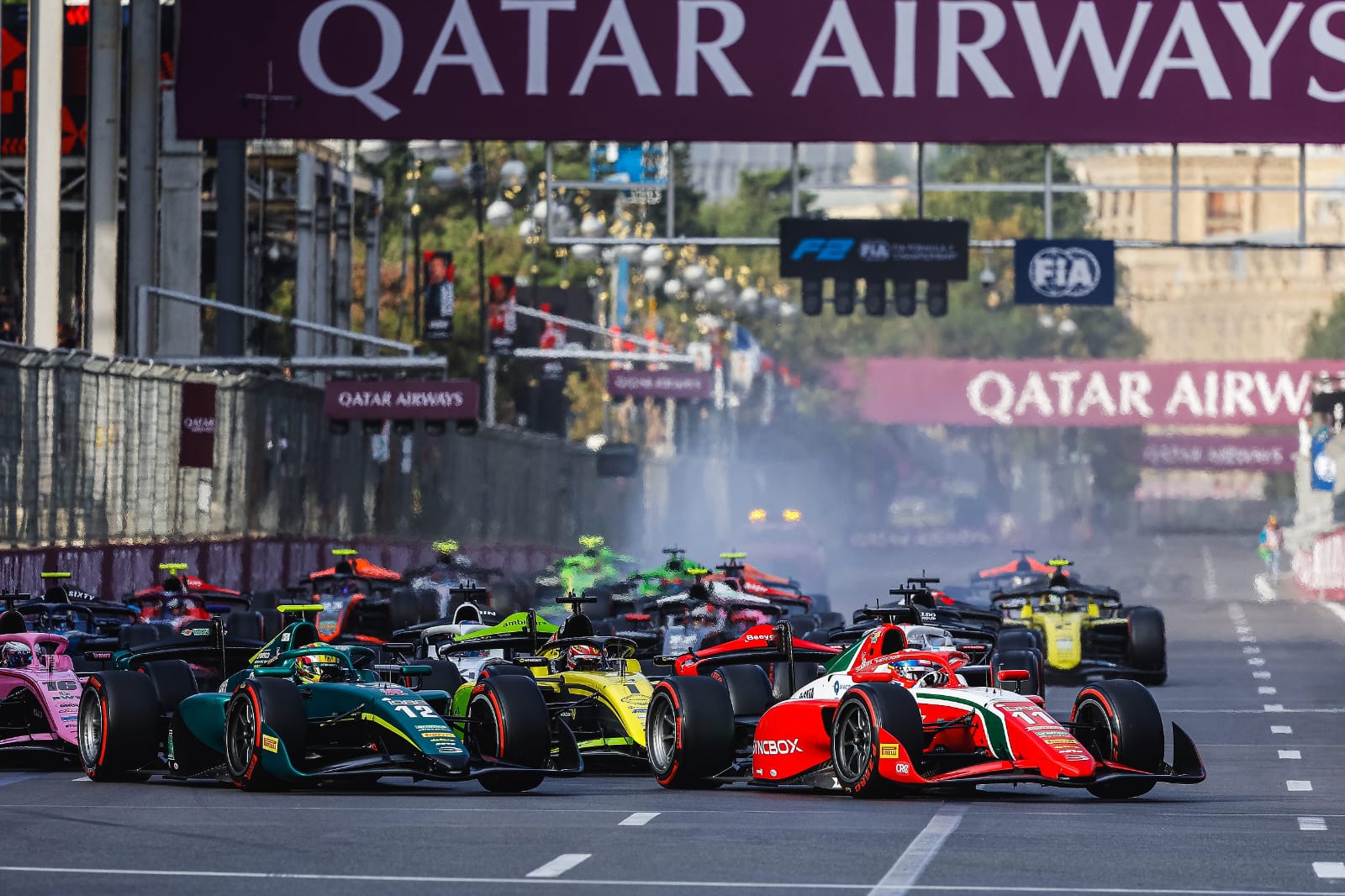
The championship’s Sprint and Feature Race format provides two opportunities for drivers to demonstrate their abilities, while F3 contributes another two races at shared events. Together, the categories add competitive action to Grand Prix weekends and allow spectators to follow drivers as they progress through the junior single-seater ladder.
The championship has also strengthened its reputation through the success of its graduates. Since 2017, 22 drivers have progressed directly from F2 to F1, including several Grand Prix winners and world champions.
Michel believes those achievements have contributed significantly to the championship’s increased appeal among race promoters.
“And I think now, if we look over the last 10 years, number one, what is really nice to see is the number of drivers that went into Formula 1 coming from Formula 2. That’s something that we’re always happy to see. And also the fact that most now promoters would like F2 and F3 to be there, because we bring something very big into the weekend. Because we come up with four races. We come up with very spectacular races. So, all this has really changed the image that we’re having and we’re very happy.”
The championship’s growth therefore reflects both its sporting achievements and its value within the wider F1 programme.
F2 graduates provide Michel with memorable milestones
When reflecting on his favourite moments from F2’s first decade, Michel highlighted the progression of several drivers into F1 as particularly significant.
The championship has produced an increasingly substantial proportion of the F1 grid, with its graduates demonstrating their capabilities across different teams and competitive environments.
Michel identified the group of drivers who progressed into F1 around the 2024 and 2025 seasons as one of his proudest achievements. Their performances reinforced the value of F2 as a development category capable of preparing drivers for the highest level.
“I would say probably two years ago when five drivers went into Formula 1. When, together, Kimi [Antonelli], Isack [Hadjar], Ollie [Bearman], Franco [Colapinto] and Gabriel ][Bortoleto] went into Formula 1. It was a pretty good achievement, not only because we have two strong drivers this year, but because there were five or six of them in Formula 1 as well. Which is always good news. So that was a really good memory.”
Antonelli, Hadjar, Bearman and Bortoleto became full-time F1 drivers in 2025, while Colapinto had already made his debut with Williams during the latter part of 2024.
Their progression highlighted the opportunities available to drivers who demonstrate sufficient ability, even without winning the F2 Championship.
Russell, Norris and Albon establish early F2 success
Michel also highlighted the progression of George Russell, Lando Norris and Alex Albon as another important moment in the championship’s history.
The three drivers competed against each other during the 2018 F2 season, with Russell securing the championship ahead of Norris and Albon. All three subsequently progressed into F1 for 2019, establishing one of the most successful graduating groups in the championship’s history.
Their subsequent careers have reinforced the importance of that season. Russell established himself at Mercedes, Norris became the 2025 F1 World Champion with McLaren, and Albon developed into an experienced competitor with Williams.
Michel considers their progression a particularly strong example of F2 fulfilling its central purpose.
“And the other one, of course, is when we had Lando [Norris], George [Russell] and Alex [Albon] coming into Formula 1. When we have this kind of track record, it’s always a great thing.”
The success of those drivers continues to demonstrate that the championship can prepare competitors for long-term careers in F1 rather than simply providing a route to an initial race seat.
The championship’s tenth anniversary has consequently offered an opportunity to examine how those early graduates helped establish its reputation.
FIA development pyramid creates clearer routes into F2
Although most drivers progress through the established junior categories, F2 has increasingly attracted competitors with different racing backgrounds.
The conventional pathway begins in national F4 championships before progressing through Formula Regional, F3 and F2. However, drivers occasionally bypass individual categories or return to single-seater racing after establishing careers elsewhere.
Michel believes the FIA’s development structure has helped create a clearer route towards F1, although he also welcomes competitors who follow less conventional pathways.
“Well, I think it’s important to have drivers from different routes. The logical path is now what is called the pyramid. The FIA pyramid, which is Formula 4, Formula Regional, Formula 3, Formula 2. You can skip one part of it. For instance, Kimi [did not come] to Formula 3 and went from the Formula Regional directly to Formula 2. It happens sometimes.”
Antonelli represents one example of that flexibility, having progressed directly from Formula Regional to F2 in 2024.
However, the 2026 season has also featured drivers arriving from established professional championships. Colton Herta joined from IndyCar, while Nicolás Varrone returned to single-seater racing following a successful career in endurance competition.
Their participation demonstrates that F2 can offer opportunities beyond the traditional junior racing structure.
Herta and Varrone highlight alternative career pathways
Herta’s move from IndyCar to F2 represented one of the championship’s most unusual recent driver transfers.
The American had already established himself as a nine-time IndyCar race winner before joining Hitech for 2026. His decision formed part of a wider effort to pursue an F1 opportunity, while he also undertook test-driver responsibilities with Cadillac.
Meanwhile, Nicolás Varrone’s move from endurance racing provided another example of an unconventional route. The Argentine joined Van Amersfoort Racing after winning the LMGTE Am class at the 2023 24 Hours of Le Mans and gaining extensive experience across GT and prototype categories.
Michel welcomed the presence of drivers with different backgrounds, although he acknowledged the challenges of adapting to F2.
“But generally speaking, it’s a very positive thing, I would say, to have people coming from outside. I took the Colton approach as a very interesting one. Because Colton is a very successful driver in [IndyCar]. He won races, he was very close in the championship. And for him, coming from Formula 2 was a big step, a big different step. And I think it was very positive for him to do that. It’s difficult, because he’s coming from a very different environment. And it doesn’t help. But on the other hand, I think it’s very important for people to come from Formula 1.”
Herta encounters difficult transition from IndyCar
Despite his substantial experience in professional single-seater racing, Herta has endured a challenging introduction to F2.
The American joined Hitech following seven full seasons in IndyCar, during which he developed considerable experience with different circuits, race strategies and technical demands. However, transitioning to F2 required him to adjust his driving style, understand unfamiliar tyre characteristics and adapt to a different competitive environment.
Ahead of his debut, Herta acknowledged that the F2 car required a substantially different driving approach. Although he initially made progress during testing, consistently extracting competitive performance during race weekends has proved more difficult.
Michel admitted that Herta’s adaptation had been more challenging than he expected.
“Well, yes, it’s been more difficult than what I thought it was going to be, because Colton is a very strong driver, there’s no doubt about that. And as I said, he and we maybe underestimated the difference of working environment that we had compared to unique teams. But I don’t think it has to be settled as an example, and I really hope that he’s going to finish the season in a high. We’re still working for that. He had some good races as well.”
Michel nevertheless remains confident that Herta’s difficulties should not discourage other established drivers from pursuing opportunities in the championship.
Qualifying emerges as Herta’s biggest challenge
One of Herta’s most significant difficulties has involved adapting to F2’s qualifying format.
Unlike IndyCar, where drivers often have multiple opportunities to improve across different qualifying segments, F2 provides a single 30-minute session. Competitors must therefore maximise their available laps while managing tyre preparation, traffic and rapidly changing track conditions.
Those demands have proved particularly challenging for Herta, whose race pace has frequently exceeded his qualifying performance. His difficulties have often left him starting outside the leading positions, creating additional obstacles during races where overtaking opportunities remain limited.
The issue became apparent early in the season, with Herta identifying qualifying improvement as a priority ahead of Monaco.
Michel also identified the limited track time as an important factor.
“He had more difficulties in Quali. And maybe also that’s one of the limits that we were having, because you need 30 minutes to come up with the right time immediately. You have one lap, maybe two, five laps on sets of tyres in which you have very limited track time. But that’s also the way we prepare drivers for Formula 1, because you know in Formula 1 that you have limited track time as well. So probably he struggled for that and he suffered from that a bit more than we expected. Now I really hope, sincerely, that he’s going to finish the season in a high. He deserves it.”
Limited track time remains important part of F1 preparation
Although Herta’s experience demonstrates the difficulties associated with F2 qualifying, Michel believes those demands serve an important developmental purpose.
F1 drivers must also adapt quickly during practice and qualifying, particularly when changing conditions, technical problems or restricted running limit their preparation. F2 therefore requires its competitors to develop similar skills, even when the format creates difficulties for drivers arriving from other championships.
The category’s single-make structure also places considerable emphasis on driver execution. With competitors using equivalent machinery, small differences in tyre preparation, braking and cornering technique can have significant consequences for qualifying positions.
Consequently, experienced drivers cannot necessarily rely on achievements in other categories to guarantee immediate success.
Herta’s season has illustrated that distinction. Despite his record in IndyCar, adapting to the specific demands of F2 has required considerable work with Hitech’s engineers.
However, his experiences could also provide valuable lessons for other drivers considering unconventional routes into the championship.
Michel’s assessment suggests that F2’s value lies not only in developing outright speed but also in teaching competitors to deliver competitive performances within a highly restricted operating environment.
Antonelli demonstrates potential of accelerated progression
While Herta’s experience illustrates the difficulties of transitioning between championships, Antonelli represents a different example of an unconventional pathway.
The Italian bypassed F3 entirely, progressing from Formula Regional directly to F2 with PREMA Racing in 2024. Although he encountered several difficult weekends during his rookie campaign, he secured two victories at Silverstone and Budapest before Mercedes promoted him to F1 for 2025.
His accelerated progression through the junior categories attracted considerable attention, particularly as Mercedes selected him to replace Lewis Hamilton despite his limited experience in higher-level single-seaters.
Antonelli subsequently experienced an inconsistent rookie F1 campaign, combining promising performances with mistakes as he adapted to the category.
However, his second season has demonstrated the benefits of that early experience. The Mercedes driver claimed his maiden F1 victory at the 2026 Chinese GP before establishing himself as the championship’s leading contender.
His progression has consequently raised questions about whether another season in F2 would have provided additional preparation or simply delayed his development.
Michel defends Antonelli’s rapid promotion to F1
Asked whether Antonelli might have benefited from another year in F2, Michel acknowledged that additional experience could have helped but questioned whether it would have changed the Italian’s eventual development.
The Mercedes driver’s promotion followed an unusual opportunity within the team’s line-up, with Hamilton’s departure creating a vacancy for 2025.
Although Antonelli had completed only one F2 season, Mercedes believed he possessed sufficient talent to progress directly into F1. His improvement throughout 2025 and subsequent success in 2026 have strengthened that assessment.
Michel believes the Italian would probably have challenged for the F2 title had he remained in the category, although he considers his F1 progression equally significant.
“Well, it’s difficult to say, because when you see what he’s been this year, obviously his trajectory was good. After that, you can always say, maybe he could have done this, he could have done that. Also, I think it was quite related to the fact that Mercedes needed a driver for last year. That’s also the type of the opportunity that is very important. Yes, definitely, if he had done a second year F2, I’m sure he would have won it. But on the other hand, when you see what he’s doing now, and how fast it took him to get his grip on the new F1 car, I have a lot of respect for him. And I don’t think anybody can criticise the way he’s been managed and the way he decided to go forward.”
Antonelli’s 2026 F1 title reinforces Michel’s assessment
Antonelli’s achievements have become even more significant following his recent championship success.
The Italian secured the 2026 F1 World Drivers’ Championship at the Mexico City GP, becoming the youngest driver to win the title after finishing third behind Max Verstappen and Lewis Hamilton.
His achievement followed a remarkable second season with Mercedes, during which he established himself as a consistent race winner and overcame the difficulties that affected his rookie campaign.
Antonelli has also reflected on the lessons he learned during his sole F2 season, particularly the importance of adapting quickly and extracting performance from limited track time.
Those experiences provide additional context for Michel’s comments, demonstrating that an accelerated route into F1 can succeed when a driver receives suitable preparation and support.
Nevertheless, Antonelli’s progression does not necessarily establish a pathway suitable for every competitor. His success reflects a combination of exceptional ability, opportunities within Mercedes and continued development after reaching F1.
For Michel, the Italian’s achievements offer further evidence of F2’s effectiveness as a development category, even when drivers spend only one season competing in it.
Modern F1 power units create greater technical differences
While F2 continues preparing drivers for F1, the introduction of the 2026 technical regulations has created additional differences between the two championships.
F1’s latest power units place substantially greater emphasis on electrical energy, requiring drivers to manage deployment, harvesting and efficiency throughout a lap. These systems have introduced new challenges that drivers must understand alongside conventional racing techniques.
However, F2 continues using a 3.4-litre turbocharged Mecachrome engine without the same hybrid complexity. The championship’s technical and financial structure makes adopting an equivalent F1 power unit impractical.
Michel acknowledged that the differences have increased, although he emphasised that F2 must maintain a manageable operating model.
“It sure is. The Formula 1 engine is a very complex engine. And, of course, we didn’t want and we couldn’t afford to go into that direction. So, we stayed with a more classical engine with low electricity. On the other hand, we were the first ones to work on sustainable fuel. And we started to work with 100% sustainable fuel in F2 before F1 did it.”
The decision reflects the challenge of maintaining F2’s relevance without introducing technology that would significantly increase costs for participating teams.
Technical differences create additional learning demands
Although F2 drivers do not experience the same energy-management demands as their F1 counterparts, Michel believes their broader preparation remains relevant.
The championship exposes drivers to high-performance single-seaters, complex tyre management, aerodynamic sensitivity and intense competition. Those experiences provide a foundation for adapting to F1, even when additional technical systems require further learning.
Michel acknowledged that graduates now face more responsibilities when mastering F1 machinery.
“After that, it’s probably true that when the driver gets into a Formula 1 car, he’s got a little bit more things to learn and to think of. Because utilising those engines at their maximum possibilities is quite complex. That’s what all the F1 drivers are saying.”
However, he also believes that the underlying abilities of talented drivers remain transferable, even when the machinery differs significantly.
“But, you know, a strong driver is a strong driver. It’s like when people are saying they need to go testing on the track in three laps. A strong driver knows how to drive. And if it’s a different car, it might take a bit of time.”
His assessment suggests that F2’s primary responsibility remains developing adaptable competitors rather than reproducing every technical characteristic of contemporary F1 machinery.
Sustainable fuel demonstrates F2’s development role
Although F2 cannot replicate F1’s increasingly sophisticated hybrid systems, the championship has contributed to several important technical developments.
Its collaboration with Aramco has supported the introduction and testing of advanced sustainable fuels, providing experience relevant to the wider motorsport industry’s sustainability objectives.
F2 also introduced 18-inch Pirelli tyres in 2020, preceding their adoption in F1 in 2022. That transition allowed drivers and engineers to gain experience with a different tyre construction and operating characteristics.
The championship’s technical structure therefore serves two purposes. It prepares drivers for the demands of F1 while also providing a controlled environment in which organisers and suppliers can develop selected technologies.
However, maintaining that role requires careful decisions about which innovations provide meaningful benefits without significantly increasing costs.
The development of F2 over its first decade has consequently involved balancing performance, accessibility, safety and financial sustainability.
As F1 continues evolving, Michel faces the challenge of ensuring that F2 remains technically relevant while preserving its position as a comparatively affordable development championship.
Updated F2 car will support driver preparation from 2027
The championship will introduce an updated car for the 2027–2029 seasons, marking another stage in its technical development.
The new F2 package retains the existing Dallara chassis but introduces redesigned front and rear wings. The revisions aim to improve aerodynamic performance when following another car while bringing its appearance closer to modern F1 machinery.
The updated car will also introduce an onboard starter, allowing drivers to restart their engines independently after certain stalls or spins. Meanwhile, the championship will retain its Mecachrome engine, Aramco sustainable fuel and Pirelli tyres.
Michel identified continued technical development as a priority when discussing F2’s future.
“Well, it’s a very tricky question. Of course, we want to continue to prepare drivers for Formula 1. So we need to make sure that we have cars that are preparing them in a proper way, whether it’s F3 or F2. The development of the car and the development of the car in the future is really, really important to be in line with what they need to do.”
His comments underline the importance of adapting the championship’s machinery as F1 evolves, while preserving a technical package suitable for junior competition.
Michel wants greater visibility for future F1 stars
Beyond technical development, Michel wants F2 and F3 to continue strengthening their international profiles and relationships with fans.
The championships now benefit from greater exposure through their presence on F1 weekends, allowing spectators to follow young drivers before they progress into the highest category.
That visibility has become increasingly important as more junior drivers establish substantial followings during their development. Competitors such as Câmara, Tsolov and Dunne have attracted attention through their performances, while Antonelli’s success demonstrates the potential for those drivers to become future F1 stars.
Michel believes expanding awareness of emerging talent should remain an important objective.
“Going to F1 tracks as well, getting more and more visibility. Because what’s important for me as well now is that a lot of fans know our drivers, knowing that they will be the stars of the future. People know Câmara, people know Tsolov, people know Dunne, because they want to know who’s going to be the next Antonelli. And that’s something that we want to continue to do.”
The championships’ growing international presence could support that objective, particularly as new venues introduce junior single-seater racing to additional audiences.
Financial sustainability remains central to the next decade
Although Michel welcomes greater international exposure, he remains cautious about significantly expanding the number of races.
F2 currently operates a 14-round calendar, while F3 contests ten events. Both championships must balance the sporting benefits of additional races against the financial demands placed on participating teams and drivers.
International travel, freight, staffing and equipment costs represent substantial expenses, particularly for junior racing programmes that rely heavily on sponsorship and development funding.
Michel therefore believes the championships should focus on improving their existing structures rather than expanding without clear financial justification.
“And then I don’t think we’ll go into much more races for budget reasons as well. And we need to make sure that we’re still having costs that are financially sustainable for the team. When you say that, it’s a lot of things that need to work together. That’s not always easy and compatible, but that’s really where we want to be.”
The approach reflects the wider challenge facing F2 as it enters its second decade. Organisers must balance technical progress, international expansion and growing commercial interest while ensuring that teams can continue operating sustainably.
F2 enters second decade with established development role
F2’s first decade has demonstrated its importance within the modern single-seater development system. The championship has expanded beyond its traditional European base, established a stronger international identity and helped numerous drivers progress into F1.
The success of graduates including Russell, Norris, Leclerc, Piastri and Antonelli highlights the opportunities available through the category, while the experiences of Herta and Varrone demonstrate that the championship can also attract competitors with unconventional career backgrounds.
However, Michel’s comments reveal the challenges that remain. F2 must continue adapting to evolving F1 technology, provide suitable preparation for increasingly complex machinery and maintain a financially sustainable operating model.
The introduction of updated cars in 2027 will provide another opportunity to strengthen that relationship, while the championships’ growing international presence could help attract additional drivers and audiences.
As F2 approaches its second decade, Michel’s priorities remain closely connected to the objectives established in 2017. Developing competitive drivers, supporting their progression into F1 and providing compelling racing will continue guiding the championship’s evolution.